


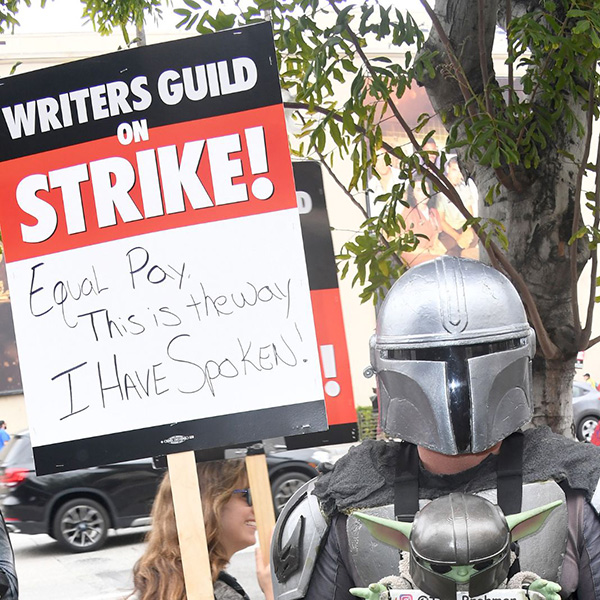
It turns out that the writers’ and actors’ strike in Hollywood is having some profound, and sometimes unintended, impacts on the industry.
Written by Tommy Tables, a VIPro Guest Writer
It is undeniable that a lot has changed in our society in the past decade. Whether you believe in it or not, the notion of “wokeness” has pervaded almost everything and is now firmly planted in the mainstream. So too are newly expanded concepts of diversity, equity and inclusion, forming a triumvirate of what is also known as “social justice”. First espoused in university lecture halls, these concepts have become ubiquitous in Western society, to the point where many feel that they have fundamentally shifted our entire culture, for good or for ill depending on which side you fall on.
Nowhere has this trend to promote these progressive ideals been more apparent than in Hollywood. Regardless of which side of the political spectrum you fall on, the postmodern concept of the politics of identity have become central in almost every single consumable product produced by Western media. Even those that try to ignore the trend are invariably dragged back in afterwards by the legions on social media, who are quick to rain criticism on tv shows and films for not being diverse enough, not having the “right” kind of diversity, not paying enough attention to gender and sexual issues, or not sending the proper message. On the flip side, films which do espouse these ideals are also coming under criticism from an increasingly growing group of people who are pushing back against the messaging. Barbie is currently causing a storm of controversy, just as Top Gun Maverick before it. Even the recent Oppenheimer biopic by Christopher Nolan has been criticized as focusing too much on its titular character and not enough on the victims of the atomic bomb he created.
During a recent Pro Show livestream, WDWPro pointed out that Hollywood studios would soon be facing a content crisis due to the ongoing writers and actors strikes. New shows and movies which would have been slated to hit our screens will either be significantly delayed or outright cancelled in the next year or so. He predicted that in order to fill this shortfall, we would soon see more networks and streaming services import content from other countries in order to satisfy the insatiable appetites of Americans to consume new media. As these things go, it’s a sure bet, as we have already seen many major studios start down this path. Even Disney, notorious for trying to push its own content, has begun hosting Korean dramas on its Disney+ streaming service.
It’s perfectly understandable that the studios would resort to this tactic, as the streaming wars are wait for no strike, and none of them can afford to have their membership or viewership numbers drop further for lack of content. At the same time, this mad scramble for content may have long-term unintended consequences for the Hollywood writers, actors, executives, studios and the financiers who have been championing progressive ideology up to this point.
Hollywood’s efforts to drive progressive values have been ongoing for many years, but only recently have they intensified to a fever pitch. Their strategy has been simple but effective: constant and consistent exposure while gently but firmly pushing the boundaries of what audiences would accept. Little-by-little. Bit-by-bit. The delicate part has always been to ensure that the flow of moralizing is both gradual and consistent. In the same way that a person who eats a bag of Doritos every day will gradually gain weight, so too was the hope that someone consuming hours of media laced with increasingly progressive messaging on a daily basis would eventually make that person “think progressive thoughts”.
Before you jump down my throat on the matter, remember that this isn’t some Qanon conspiracy theory either. Executives have been quite clear about their attempts at social engineering for the greater good, with people such as Disney executives Latoya Raveneau and Kevin Feige openly admitting to it, and responding to the rumblings of pushback from the audience with comments about “how they need to be better at hiding” the messaging in their media. Barbie, for example, seems to be one of the ways they’ve been able to do so.
Yet pushback is also not a glitch, and is likely not going to go away any time soon.
Although many on the progressive side will vehemently deny it, the facts are clear that the current strikes raging in Hollywood are driven, in part, by a rejection of North American and worldwide audiences of the injection of this progressive messaging in its content. Yes, there are other issues at play such as pay, use of AI, etc., but 2023 has been a year of failure at both the box office and in the streaming world, as product after product has bombed and viewership across all segments has declined. Like the frog finally realizing it’s in boiling water, audiences have, by and large, begun jumping out of the pot en masse. For those whose goal it is to keep progress progressing, the ongoing strike represents a giant brick wall cutting off the steady stream of content flooding the masses and putting the brakes on any new content moving ahead.
This on its own would likely be survivable for our brave social engineers, however they may not be expecting the follow-up punch, which will likely be a knockout. And that punch is coming, ironically enough, from the foreign, non-Western content they are now sourcing.
Why? Because the rest of the world does not think the way they do and, by and large, has not bought into progressive ideology. The harsh truth is that they often make fun of us for it, and nowhere is this more apparent than in Asia, which is where the vast majority of new content will be coming from. While Hollywood has made some inroads with its messaging there (through Netflix-funded Korean dramas, as an example), it has been minimal, and nowhere close to the level of what they’ve been able to accomplish here at home, which is about to become a very big problem for them.
In truth, Americans had already begun shifting their consumption practices away from mainstream Hollywood, but the effects of the strike will supercharge this phenomenon. And what happens then? What happens when, for example, audiences are exposed to heroic male leads again? What happens when the bulk of our new content once-more features family-focused stories, strong father figures, women who aren’t written like men, unsubverted heroes journeys and story-first storytelling? Are we on the verge of a grand re-awakening? Perhaps we will not only jump out of the boiling pot of progressiveness but kick the entire thing over and demand better from the Western studios that have been feeding us their poor excuse for food.
Rumors persist that American executives are trying to prolong the strike in order to rid themselves of “dead weight” creatives that they had signed on during the dizzying heights of the social justice trend during the past few years, and who have returned nothing but costly failures (Ava DuVernay comes to mind). Whether this is true or not, the fact remains that ultimately the long-term danger of this strike and the subsequent substitution of foreign media in place of American-produced content could quite possibly roll-back all of the years of hard work that Western progressives have toiled for, and far quicker than they would expect. Even if they can see it coming, the worst part is that they may be powerless to stop it, as they are caught between the rock of supporting their fellow working class peoples on strike and the hard place of watching all of their work slip away at the same time as society potentially rediscovers the joys of good content. When the strike is over, it is quite clear that “business as usual” as they have understood it will not come back.
Time will tell, but for now reality seems to be much more interesting than what Hollywood is producing, and it will be fascinating to see where things go.
