


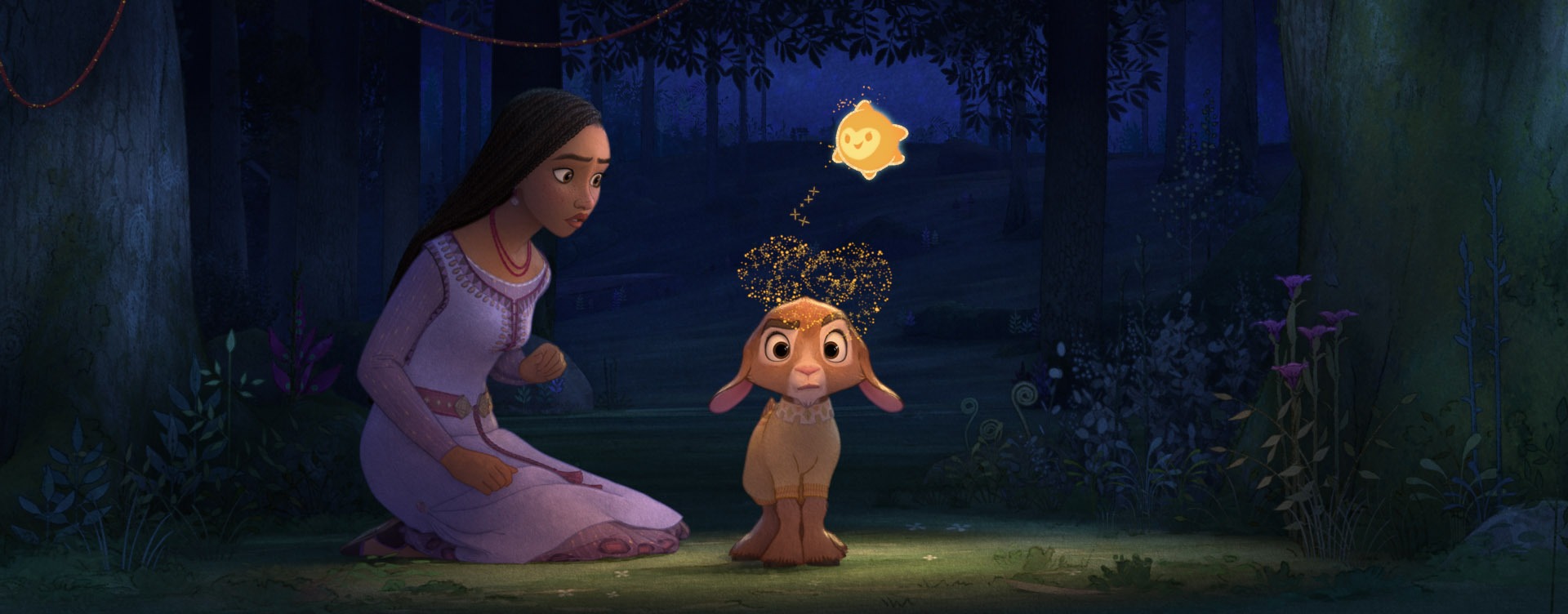
The Walt Disney Company is celebrating its 100th anniversary with a new animated film. While it features a number of cameos, winks and nods, it is ultimately a shadow of the company’s former glory. It is, therefore, a reminder that what the company once was is only something the modern Disney might aspire to be… if it recognized the plight it is in. Until now, it has not.
The following is a spoiler-filled review.
Wish is a movie that dreams of being something far more than it can be. That’s not to say that it is an awful or painful film to watch. In reality, the film is — at its heart — an anti-authoritarian, anti-socialist, anti-communist display that teaches small children they should follow their passions. The passions, in this film, are referred to as wishes for the convenience of tying into the Disneyisms necessary for merchandising. You wish upon a star, as popularized by Walt Disney in Pinocchio and your wishes just might come true. Except in this movie, wishes really refer (seemingly) to what you would like to be in the future. There are a few nods to frivolous wishes, but these are not Genie in a lamp style requests from a deity.
In order to maintain peace and stability in their lives, the townfolk in this movie all acquiesce to having their king take their most fervent dreams and hold them hostage. A few are granted these dreams, but the most extravagant hopes are seemingly never permitted. Why this is the case is not explicitly said in the movie. Neither are we given any real reason for understanding why the king, who is a magical sorcerer, would contrive such an odd system. All of that would make the movie far more meaningful, but probably is too great a task for the writers here. The feelings of ill-defined personal empowerment and the magic of squeaky, almost-plushy stars with streams of pixie dust flying across the screen are all in service of making you feel that Disney nostalgia. Going any further might take the movie into a path of real statement or intuition. And, frankly, that’s just too dangerous for a studio making sure whatever they produce will be allowed in China.
Still, one might think that Wish would be a great piece of pro-Western messaging if it were released in North Korea. Ultimately, the movie is about the power of following your dreams; doing so, according to the film’s ethic, is enough to overthrow authoritarian dictators.
While I am mostly supportive of the core message of the film, even if it is watered down to the point of corporate sloganisms, what I can’t support is the packaging of the story. While the message would surely be of great importance in less-liberty nations, the overall animation feels like it came from a China or a North Korea. The beautiful cinematography and artistry of Disney-past is utterly missing here. Characters are bland, boring and ugly in design. Character personalities are totally forgettable, as are their names. The animation style here is robotic, as if it was created by artificial intelligence. Key strokes in animation exist as a way to get a limb or a facial expression to that point with rigidity in between. This leaves the film looking more like a low budget television show for small children. Instead, it is a $200 million Disney celebration of 100 years of animated excellence.
The songs, likewise, are quite forgettable. The villain gets two songs here, one of which is serviceable. Asha, the lead, gets an anthem song that might have some kids listening to it. No song in this soundtrack, however, is better than the worst song on Moana, Tangled or Encanto. And during the songs, its as if the director thought the film was being made on a stage. Characters act as if they’re on Broadway. Remember during Simba’s song about being king how the movie went to all sorts of incredible animated sequences? Remember how the Genie teaches Aladdin he has a friend with zany visuals that amaze? Now imagine if those songs had been sung with characters standing in place and orbs of light flowing around them… for two straight minutes.
And this is why I cannot endorse this film as anything more than Disney propaganda that they likely believed was nostalgia or homage. Maybe if I thought they had purposefully made a statement about the evils of communism, I might find it all a bit more impressive. That I think they actually tried to create an activist revolution film in support of the matriarchy and then somehow ended up here instead leaves me feeling hollow as I walk out. And if you’re wondering how in the world the matriarchy comes into being with this film, just watch and see the bizarre queen character suddenly turn on her husband and doom him to a dungeon in the closest thing Disney has ever attempted for displaying an ugly divorce in animation. But what was likely intended to be a poignant moment with the queen is left feeling rushed… the same as many of the other plot points in the film because they don’t have enough time to naturally evolve in the script.
But at least there’s a star that squeaks, a goat that talks in a humorous way, a few seconds of smile-inducing chicken dancing, and a core message that I can’t disagree with. I just wonder if they ever intended to write it. For as much as the central ethic here is diluted but right, the lack of emphasis on it makes it feel that it was never the intended moral of the story. Or maybe that’s just what happens when a film goes through enough corporate board rooms. In the end, it was always about the squeaky star and the talking goat after all.
Review Score: 4.5 / 10
For all the latest news that should be fun, keep reading That Park Place. As always, drop a comment down below and let us know your thoughts!
