



The Walt Disney Company is making it more difficult for families and friends to share accounts in separate households. The so-called password sharing concept is facing the ire of a company seeking to implement a similar system as Netflix. When Netflix eliminated the ability to share accounts amongst family and friends, the result was a booming stock and increase in subscribers. However, not all is a sure-fire hit for Disney with this maneuver. Unlike Netflix at the time, Disney is losing market share; it has yet to be seen how a weakening platform performs when it is made more difficult to obtain it.
A quick look at the Nielsen Gauge shows how things are going. First, let’s take a look at July:
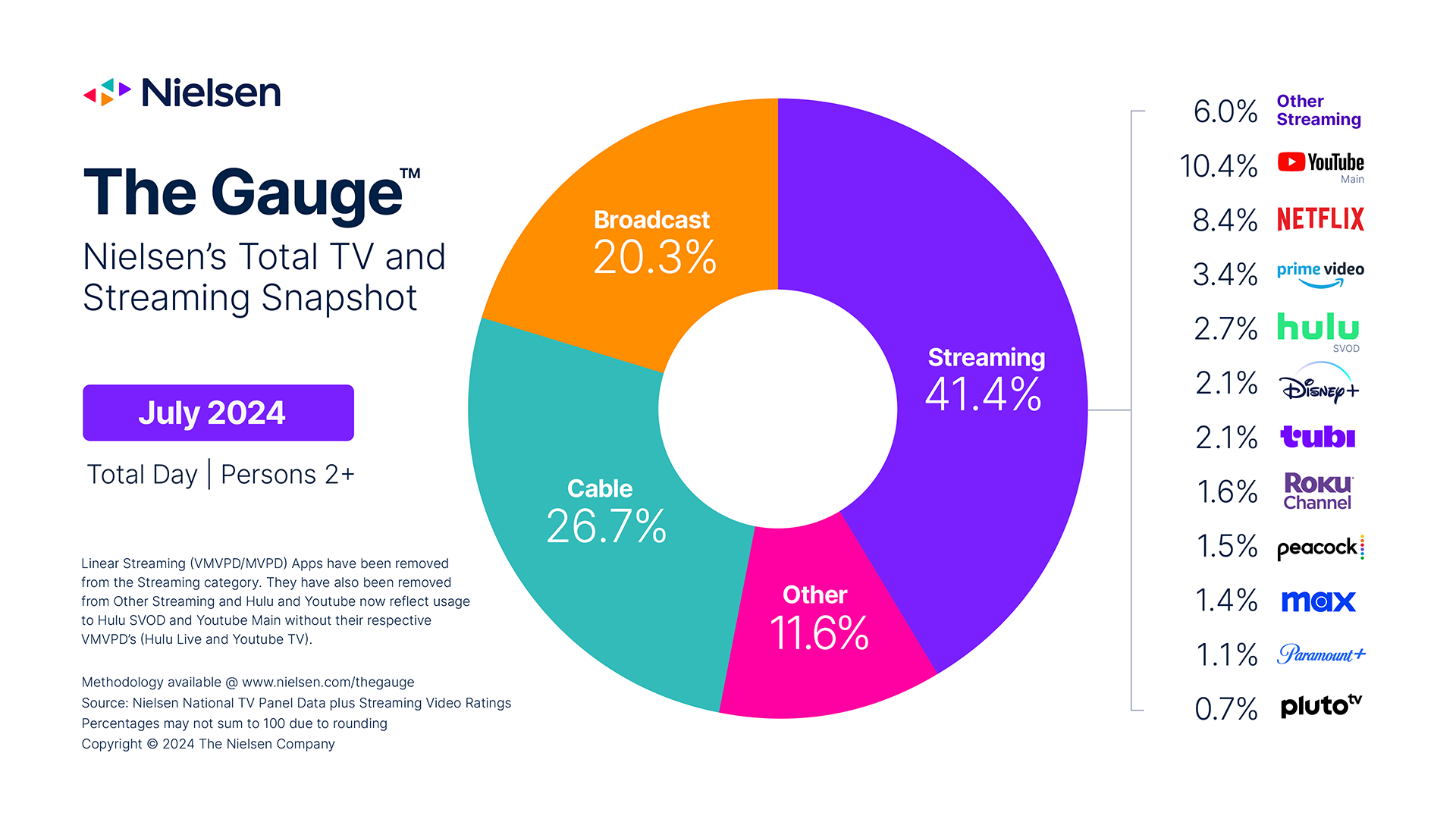
Market Share of all TV Content Creators and Platforms; Courtesy Nielsen.
As you can see, Disney+ and Hulu (which are largely merged and interconnected) captured a combined 4.8% of all television watching during the month of July. Of course, that’s significantly lower than both Netflix (8.4%) and YouTube (10.4%), which are in a different class of scale and scope. It should also be noted that Disney is still paying to finish its acquisition of Hulu, whereas YouTube is largely just a profit-making-machine for its parent company, Alphabet.
Now let’s compare that to August:
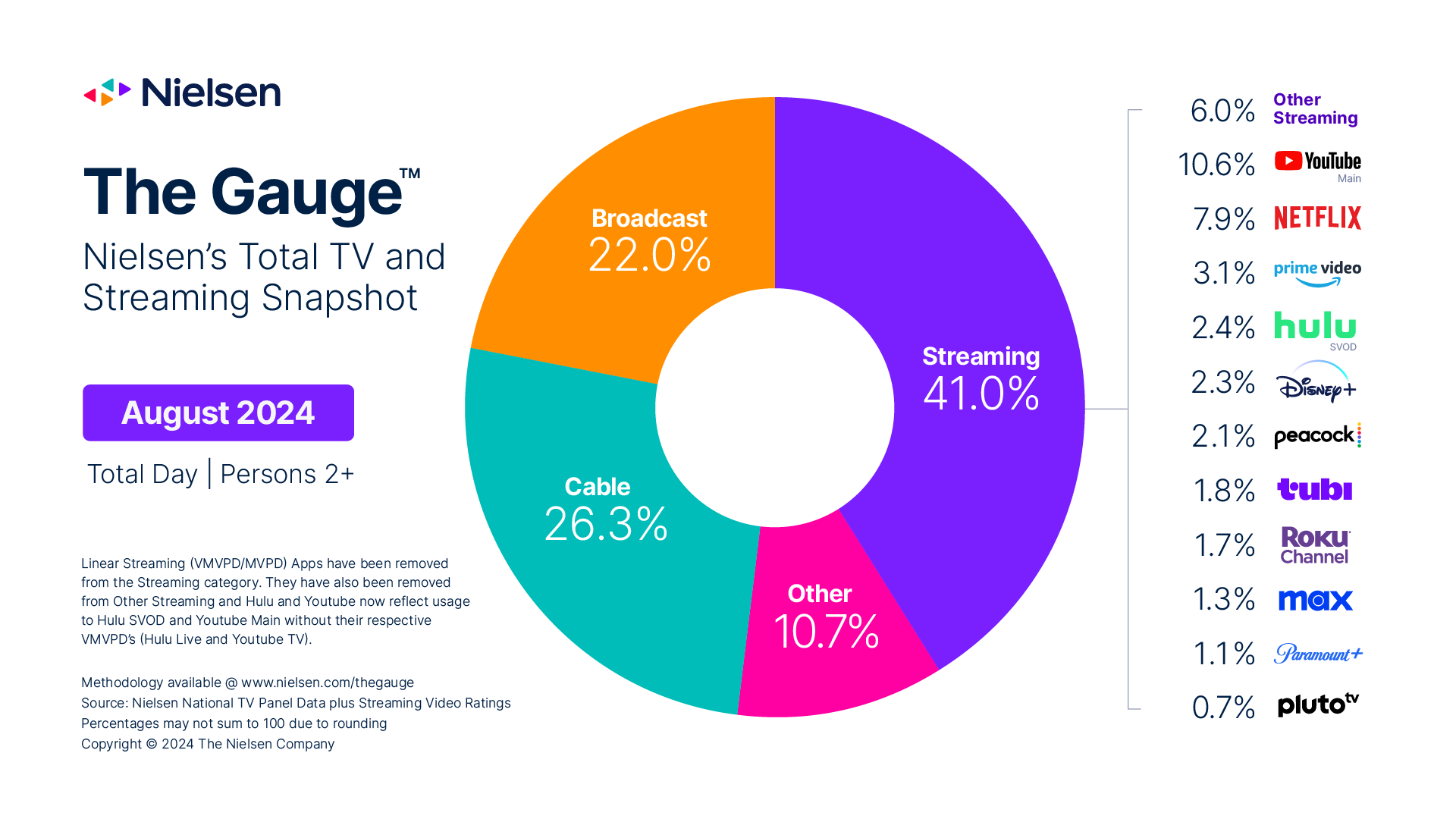
Measurement of all TV content creators and platforms; courtesy Nielsen.
When combined, Disney+ and Hulu lost 0.1% of market share for the month, but a more worrisome statistic stands out. Whereas Disney+ gained 0.2%, Hulu dropped 0.4%. This could indicate worries that Disney+ is cannibalizing Hulu via its content-sharing plan are coming to fruition. One could wisely ask “what does that matter in the grand scheme of things?” But the answer should be alarming for Disney executives. The latest information indicates that Disney+ does not drive as much revenue per user as Hulu. The gamble is that cracking down on password sharing will create better parity, but it’s a gamble nonetheless from a company that is not driving better revenues via content demand. A quick scan of Disney’s latest exclusives reveals that neither The Acolyte nor Agatha All Along (both Disney+ live action series with huge budgets) are driving enthusiasm nor ratings. Disney+ continues to be largely propped up by animated movies and Bluey — neither are ad-supported due to their young demographics.
To help customers navigating the Disney+ password crackdown, the company has released the following press release as assistance:
__
This week, Disney+ expanded its paid sharing program to give its users ways to enjoy their Disney+ subscription along with a family member or friend, through the management of devices within a household.
These features and capabilities are now available in the United States, Canada, Costa Rica, Guatemala, Europe, and the Asia-Pacific region after launching in select markets over the summer.
So, what is paid sharing, what does it mean for your account, and how will it impact everything Disney+ has to offer? Here’s what you need to know:
How does paid sharing work?
Your Disney+ subscription is meant to be used within your Household, which is a collection of devices associated with your primary personal residence that are used by the individuals who reside there. But what about people outside of your Household? They will need to sign up and pay for their own subscription or be added as an Extra Member to your account for an additional monthly fee to continue enjoying Disney+.
Wait, how do I add someone outside my Household to my subscription?
Account holders who want to add someone outside of their Household to their Disney+ subscription will be able to do so with the Extra Member add-on. For example, in the U.S., an Extra Member profile will cost an additional $6.99 per month for Disney+ Basic subscriptions and $9.99 per month for Disney+ Premium subscriptions. Note that only one Extra Member slot is available per account*.
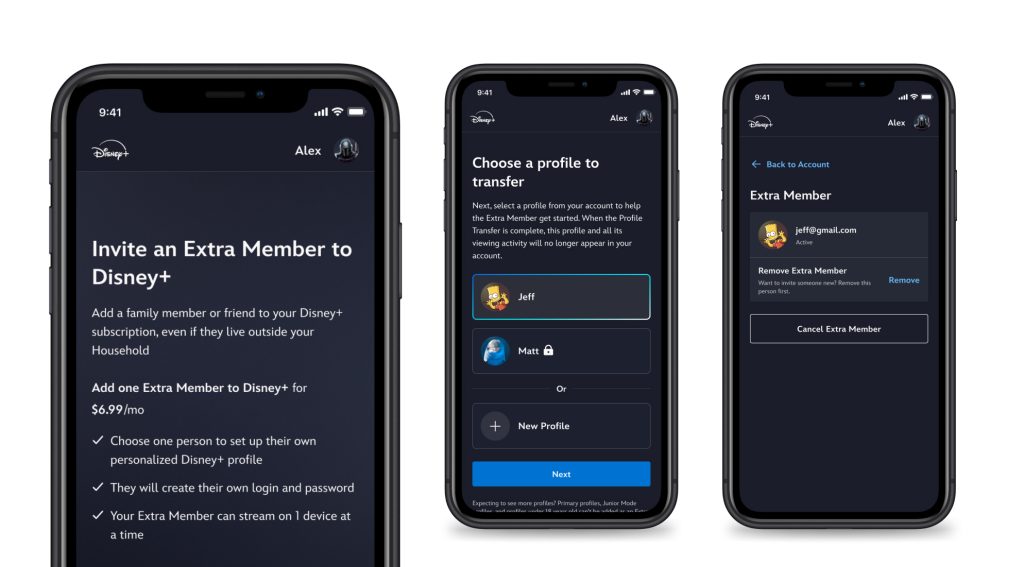
*Extra Member not available for Disney Bundle subscribers or for subscribers billed through our partners at this time.
Is there an alternative to the Extra Member add-on?
As an alternative to Extra Member, people outside of your Household can sign up for their own subscription to watch Disney+. As the account holder, you can transfer an eligible profile to a new subscription or Extra Member to keep that profile’s Disney+ watch history and settings. Note that certain profiles – including primary profiles (account holders), minors’ profiles, and those set to Junior Mode – cannot be transferred.
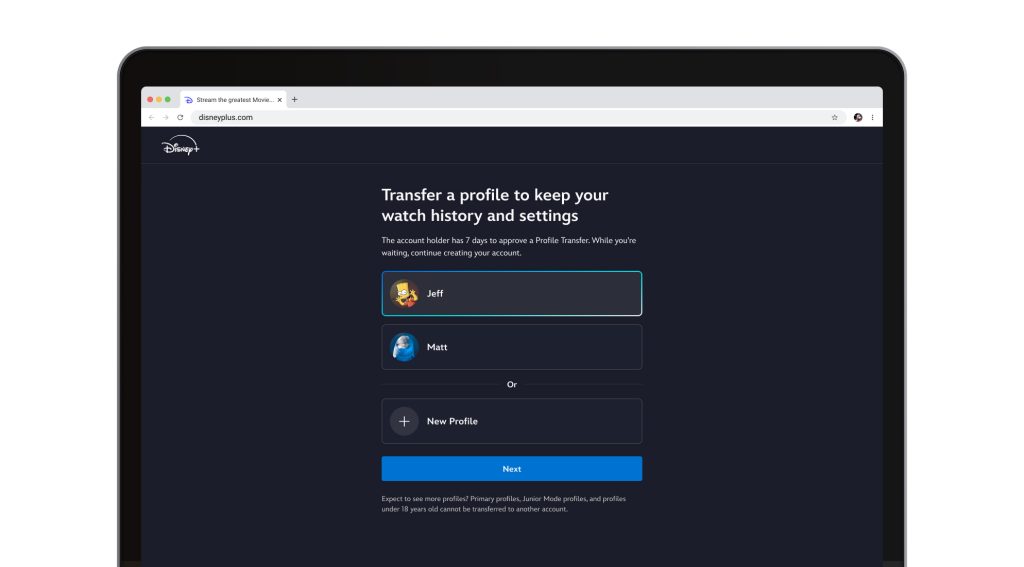
Okay, so can I watch Disney+ outside of my Household?
Yes, if you’re away from home or on the go, you’ll still be able to watch Disney+ on your supported devices as the account holder or member of your Household.
If you’re on the go and you see the message “This TV doesn’t seem to be part of the Household for this account”, you can mark yourself as I’M AWAY FROM HOME, or select UPDATE HOUSEHOLD if you’ve recently moved and need to reset the Household location for your Disney+ subscription. These selections will require a one-time passcode that’s sent to the email address associated with the account.
Is there anything else I need to consider when choosing a paid sharing option for Disney+?
For more details on the benefits and differences between a Disney+ subscription and an Extra Member add-on – including eligibility, pricing, and plan features – visit the Disney+ Help Center in your region.
__
Remember that Disney+ and Hulu have a combined investment amount that is likely close to $100 billion when including infrastructure, technology, bandwidth and content. That investment was made to challenge (at least) Netflix. In order to achieve such a feat, Disney will need to double its current streaming market share. Thus, how the password sharing crackdown impacts that will be of great interest throughout the industry.
