



Mastercard in its attempt to distance itself from the recent gaming censorship controversy found itself hit with a damning X community note.
In a bid to quell mounting outrage over alleged involvement in the mass removal of adult-themed games from platforms like Steam and Itch.io, Mastercard issued a public statement on August 1, 2025, emphatically denying any role in censoring or restricting content.

Eve in Stellar Blade (2024), Shift Up
Posted on X by the company’s official news account (@MastercardNews), the statement aimed to clarify “recent headlines on gaming content” amid a broader controversy sparked by advocacy groups and payment processor policies.
However, the post was swiftly appended with a damning Community Note—a crowdsourced fact-check feature on X—that highlighted direct contradictions from affected platforms and Mastercard’s past actions, complete with linked “receipts” that amplified the backlash.
Mastercard’s Attempt to Distance Itself
The controversy traces its roots to mid-July 2025, when Steam and Itch.io began purging or hiding thousands of adult-oriented titles, citing compliance with payment processor demands to avoid service disruptions. This followed an open letter from Australian anti-exploitation group Collective Shout, which urged processors like Mastercard, Visa, PayPal, and Stripe to halt support for platforms hosting games with specific themes.

Eve in Stellar Blade (2024), Shift Up
Mastercard’s response came via a linked press release and an embedded image in their X post, stating: “Mastercard has not evaluated any game or required restrictions of any activity on game creator sites and platforms, contrary to media reports and allegations. Our payment network follows standards based on the rule of law. Put simply, we allow all lawful purchases on our network. At the same time, we require merchants to have appropriate controls to ensure Mastercard cards cannot be used for unlawful purchases, including illegal adult content.”
The statement positioned Mastercard as a neutral facilitator, emphasizing legal compliance over moral judgments. Yet, this narrative clashed with reports from the gaming platforms themselves, fueling accusations of gaslighting.
Imagine thinking you could gaslight at this point instead of being honest and just simply backtracking.
This is actually insane. You guys have let power go to your head. It may work with the rest of business, but not, and never will, with gamers.Try again.
— Smash JT (@SmashJT) August 1, 2025
The post garnered over 8.6 million views, thousands of likes, and a torrent of critical replies from gamers, developers, and influencers, who flooded Mastercard’s customer service lines and launched petitions demanding transparency.
The Community Note: Bringing the Receipts
Within hours, X users contributed and upvoted a Community Note that appeared beneath the post, effectively undermining Mastercard’s claims.
The note reads:
“Both Steam and Itch have stated their removal of adult content came from pressure by payment processors, including Mastercard. Furthermore, Mastercard and other payment processors have a documented history of refusing service to Japanese retailers…”
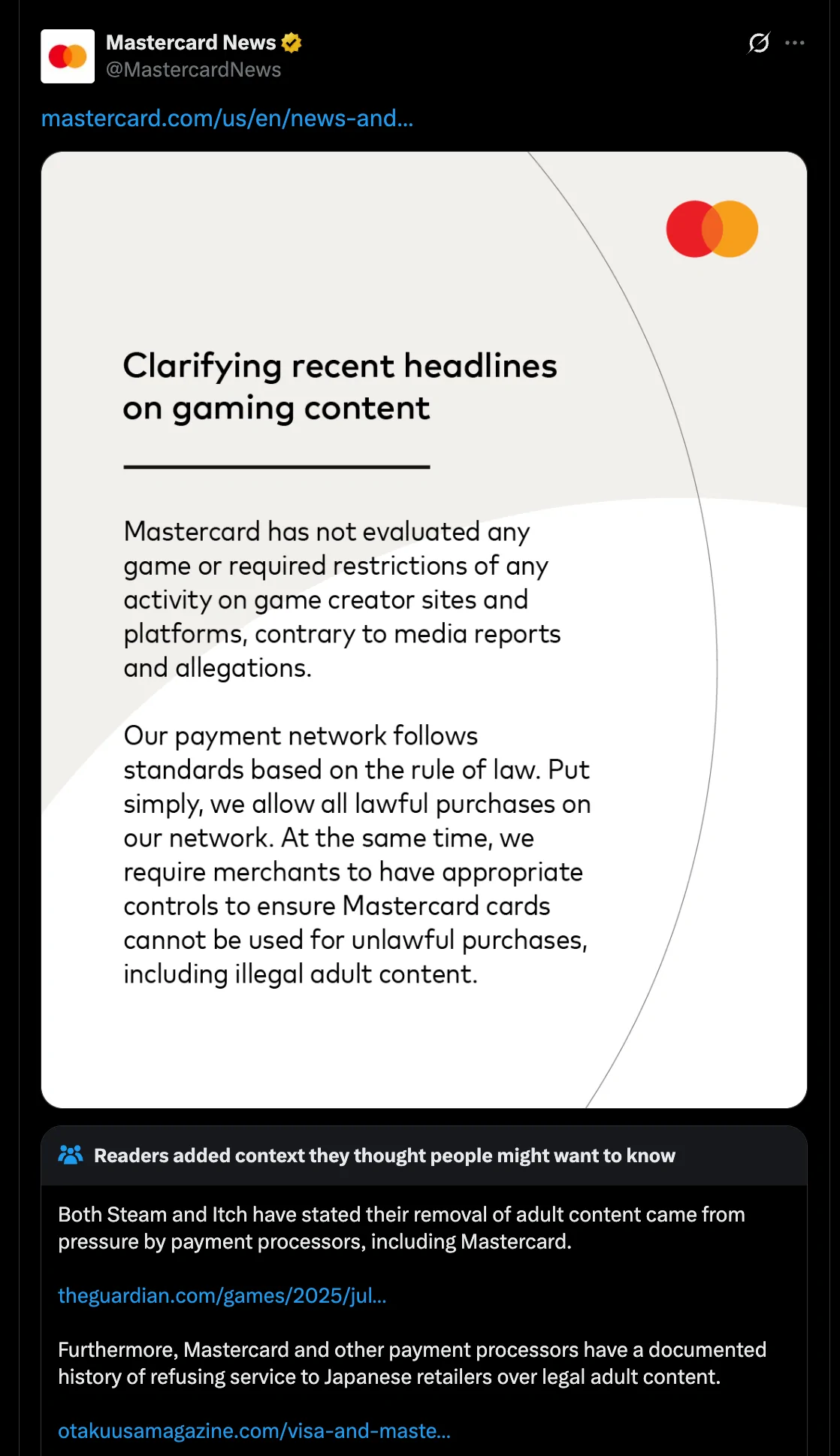
A community note on an X post by Mastercard – X, @MastercardNews
This note, rated helpful by the X community, served as a concise rebuttal, linking to sources that provided evidence of Mastercard’s involvement in similar content restrictions. It confirmed a pattern of behavior, suggesting the company’s denial ignored both current events and historical precedents, and it brought receipts to back up these claims.
What the Links Revealed: Steam and Itch.io’s Statements on Pressure
The first link in the Mastercard Community Note directed to a July 29, 2025, article in The Guardian. The piece detailed how payment processors’ policies forced platforms to act, with direct quotes from Steam and Itch.io contradicting Mastercard’s hands-off portrayal.
Steam’s Response
On July 18th, Valve (Steam’s parent company) told PC Gamer that it was “retiring” several games to align with updated guidelines introduced on July 16th. These rules explicitly prohibited “content that may violate the rules and standards set forth by Steam’s payment processors.”
A screenshot of Dragon Age: The Veilguard’s ranking on Steam DB’s Most Wishlisted Upcoming Games list. Screenshot taken on October 21, 2024 at 7:31 AM ET.
While Valve didn’t name Mastercard directly in the quote, the context tied the changes to processor demands, noting that without compliance, the entire platform risked losing payment capabilities.
The impact was significant: hundreds of titles, primarily visual novels and adult-themed games, were removed, affecting indie developers who relied on Steam for distribution.
Itch.io’s Response
On July 23rd, Itch.io announced via its updates page that it was “deindexing” (hiding from search) all adult-oriented games—over 20,000 titles—while conducting a “comprehensive audit of content to ensure we can meet the requirements of our payment processors.”

An image from Mouthwashing – X, @RealHypnotic1
The platform described the move as a response to “scrutiny” from these processors, which they linked to Collective Shout’s campaign. Itch.io emphasized the broad sweep, noting it affected not just mature content but also award-winning games exploring themes like identity, body image, and sexuality.
They added that they were “working to clarify new payment processing policies” and “seeking alternate payment partners for adult-rated content” to mitigate future restrictions. Again, while specific companies like Mastercard weren’t quoted verbatim, the article framed the pressure as coming from major processors, including those handling Visa and Mastercard transactions via intermediaries like Stripe.

A clip from the trailer to Mouthwashing – YouTube, GameTrailers
The Guardian article highlighted the ripple effects. Developers faced sudden income loss, and critics argued this constituted “financial censorship” by corporations wielding outsized influence over digital economies.
The Historical Precedent: Mastercard’s Actions in Japan
The second link pointed to an article in Otaku USA Magazine discussing Mastercard and Visa’s refusal to service Japanese retailers over mature legal content. While direct access to that specific page yielded limited details, related reporting from The Asahi Shimbun in March 2025 provided a comprehensive account of similar incidents, illustrating a “documented history” as noted in the Community Note.

Screenshot from Final Fantasy VII Rebirth (2024), Square Enix
In 2024-2025, Visa and Mastercard suspended payments to several Japanese sites specializing in adult-oriented manga, illustrations, and fan-made works.
Reasons cited included pressure from international human rights groups (e.g., a 2020 letter urging card companies to block certain sites) and a 2022 U.S. court ruling allowing Visa as a defendant in a lawsuit pertaining to such content.
Payment agencies framed it as protecting against “abundant” content, but affected parties argued it was legal in Japan. Visa stated it “restrict[s] neither legal and free speech nor transactions containing expressions of legal and free speech,” while Mastercard declined to comment.

A scene from Final Fantasy VII Rebirth (2024), Square Enix
Critics like Kotaro Ogino of the Uguisu Ribbon Campaign noted a decade-long trend of suspensions, and legal experts like Yoko Shida warned of threats to free expression. This Japanese case mirrored the gaming controversy, showing Mastercard’s pattern of indirect enforcement through policies that force platforms to self-censor, even for legal content.
Broader Implications and Ongoing Backlash
The Community Note’s “receipts” amplified calls for accountability.
Indie developers and free speech advocates, including the Free Speech Coalition, decried the moves as setting a dangerous precedent for corporate control over creative expression. As of now, Mastercard has not issued a follow-up, but the Community Note highlights the tension between anti-exploitation efforts, brand protection, and digital freedoms in an increasingly interconnected global market.

Eve in Stellar Blade (2024), Shift Up
This incident serves as a stark reminder: in the age of crowdsourced fact-checking, corporate denials can quickly unravel when confronted with evidence from the very platforms they influence.
How do you feel about this Mastercard Community Note? Sound off in the comments and let us know!
UP NEXT: Universal Orlando Rolls Out Test‑Seat Photos in Mobile App and Parks
