



The following article is used on permission of David Walker, a commenter on the Valliant Renegade YouTube channel. While That Park Place does not take a position as to the rightness or wrongness of this material, so much work was put into it that TPP analyst WDW Pro felt it deserved to be seen by a broader audience. We thank David Walker, a self-proclaimed person of indigenous decent, for his thoughtfulness in expressing his opinion with such developed reasoning. From time-to-time we like to offer our space to readers and listeners; the next time this happens it may be a completely opposite position but we’re very interested in careful construction of opinions regarding all that should be fun. Enjoy the read:
I … hate the perceived offense in the depiction of the Indigenous people in Peter Pan.
In Disney’s film, John identifies them as Algonquin and adds, “they’re quite savage, you know.” In the film is the song, “What Makes the Red Man Red?” Some might find the term “red man” offensive, but there are a number of Indigenous people in North America that refer to ourselves as “the red man” particularly in relation to the more contemporary teachings of the medicine wheel and our place within global society. The answer to the question in the song is actually quite sweet. The red man is red because he’s blushing from being kissed by an Indian maiden. Other questions in the song include, “why does he ask us how?” “How” being a Hollywood misinterpretation of the greeting, “ah-how.” The answer, because he’s inquisitive and that’s why he knows so much. “When did he first say ugh?” Answer, when he first saw his mother-in-law. A mother-in-law joke. It’s very much Marc Davis humour. It’s all funny in a dated sort of way, but the punchlines are mostly positive. The term “squaw” is used in the song as well, but the only character referred to as a squaw in the film is actually, Wendy. And it’s the old woman that’s treating Wendy like a squaw, so it’s absolutely relevant.
None of this “racially insensitive” humour is featured in the attraction, though. The ride vehicles merely swoop over the Indigenous encampment where guests can view the Indigenous people sitting around a campfire. How is mere depiction of Indigenous people offensive? The background music doesn’t even sample “What Makes the Red Man Red.” In another scene, Tiger Lily is tied-up and left to drown by Captain Hook in an effort to trap Peter Pan. Tiger Lily is no passive princess, either. Nor is she Hook’s victim. She’s a hero. She’s willing to sacrifice herself before betraying Pan to the enemy. Can you imagine the scene Anna would have put on if Hans tried such tactics in Frozen? The removal of the Indigenous characters from the Peter Pan attraction would be another act of “inclusivity” by Disney by excluding us from our own story. As much as it’s Wendy, John, Michael and even Peter Pan’s story, it is also our story. The Indigenous people, the alleged Algonquins, were inhabitants of Neverland.

They played, therefore, we as fellow Indigenous peoples played, an active role in the story. We may have played war games with the Lost Boys, and sometimes we won and sometimes they won, but these games always ended in a positive outcome. We were equal rivals, but we were also respected friends. And when it came to battling Captain Hook, we were valued allies. The bond between the Indigenous people and Peter Pan and the Lost Boys was so great that Pan was even adopted into the society for his role in saving Tiger Lily. He became known as Little Chief Flying Eagle.
Disney had already done this sort of editing of Indigenous peoples from their part of the story in their “reimagining” of The Jungle Cruise. The Indigenous peoples of the Amazon, once referred to as “head hunters” was replaced by a gag scene featuring chimpanzees in a sunken boat. Years ago, any reference to “head hunting” or “head shrinking” was dropped from the attraction. It’s as if the cultural practice of head hunting and head shrinking is somehow shameful. It’s a cultural practice and if anything, it’s racist to judge and condemn other cultures by outside standards. Egyptians and other peoples aren’t shamed for mummification. Why is mummification culturally tolerated, but not head hunting or shrinking? With the removal of the depiction of these Indigenous peoples from their depicted Indigenous lands, Disney is perpetuating the myth of terra nullius. Disney is depicting the jungles of the world void of any Indigenous human inhabitants. It’s sending the message that these lands are unoccupied and are therefore free to be claimed and exploited by colonial explorers.
More galling, is Disney’s diversity and inclusion efforts, in which they remove any depiction of Indigenous peoples from the story and populate the colonial explorers with a group of ethnically diverse people. Leading the explorers is Alberta Falls, a woman with Indian and British ancestry. Others among the expedition include, Alberta’s Irish cousin on her father’s side, Siobahn, who is nicknamed Puffin because of her fondness for those birds. Dr. Kon Chunosuke, a Japanese entomologist, Rosa Soto Dominguez, a Mexican artist recently returned from an exhibition in Paris, Dr. Leonard Moss, a black Canadian botanist and at the bottom of the totem pole is Felix Pechman, the skipper of the Jungle Cruise charter that’s originally from Florida. How progressive it is of Disney to cast a number of women as colonial jungle explorers. But, how racially insensitive it is to cast an Irish woman, a black man, a Mexican woman and an Indian woman as members of a colonial expedition when these peoples had their own experiences of colonialism under British and Spanish expansion. How inclusive of Disney to paint the victims of colonialism as colonial explorers. Thank goodness, they replaced the peoples under the treat of colonial expansion in this particular narrative with a boatload of apes.
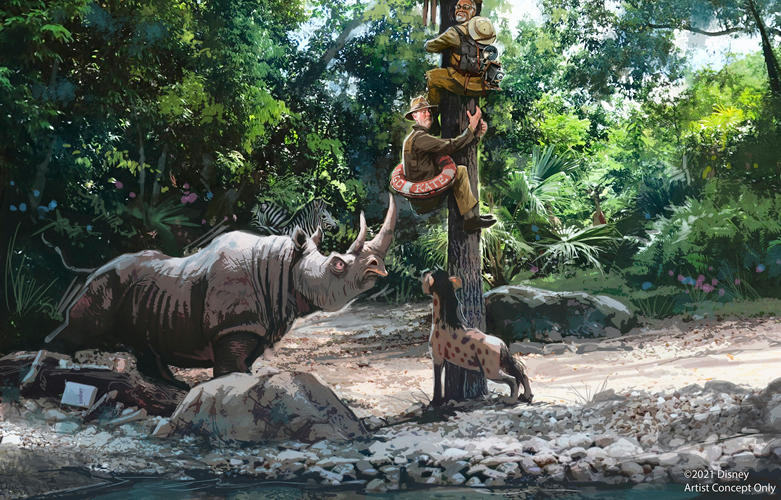
If Disney truly wanted to be inclusive and diverse, they’d tell a more wholistic story. A colonial era adventure down the jungle rivers of the world is perfectly fine, but let guests hear or at least see the other side of the story. There are people who live along the shores of these rivers. Why can’t guests encounter and even interact with some of them? How progressive would it be to have an Indigenous translator aboard the odd charter boat. Not only could he negotiate the safe passage through certain Indigenous territories, he could also regale guests with Indigenous knowledge and folklore. Losing one’s head to Trader Sam might be considered an offensive joke, but it is just a joke. Trade was a common practice between Indigenous peoples and colonial explorers. It’s part of the story. Recasting an Indigenous person as a businessman who sells goods from the lost and found is inauthentic to his cultural narrative and I think it’s as offensive of a joke as a trader potentially losing their head.
During Walt’s era of Disneyland, Disneyland was pretty inclusive. The section of Frontierland that became Bear Country and Critter Country was originally Indian Country. It had a giftshop where guests could buy some inauthentic Indian arts and crafts. At that time, I imagine it wasn’t so easy to source authentic Indigenous made arts and crafts. But, the area featured a number of different Indigenous peoples who were contracted to perform at Disneyland for weeks at a time. These performers weren’t costumed by Disney, either. Each performer wore their own traditional regalia and they danced in a pow wow arbour. Guests could simply watch the dancers perform in the circle, or they could join in. But, most importantly, they were able to engage living, breathing Indigenous people. I don’t know what these interactions were like, but if it were done today, I’d hope that there’d be a number of Indigenous elders sharing traditional legends, myths and folklore because we all have our own unique cultures and stories apart from our colonial experiences.
Today, Indigenous people in Frontierland are represented by some static figures in an isolated encampment which can be viewed from the watercraft of the Rivers of America or the Disneyland Railroad. It’s as if we’re segregated to our “Indian Reservation” and can only be seen by others from the distance; from the outside looking in. Our only major narrative within Frontierland involves the folklore of the Thunder Bird that cursed Big Thunder Mountain Mine. It’s fine that the story primarily involves the settlers; a Thunder Bird wouldn’t curse its own people. But, I fear this reference too will be erased out of Disney’s concerns from inclusivity.

The African folklore behind the Br’er Rabbit fables depicted in Splash Mountain is scheduled to be replaced by a Germanic fairytale adapted to film by Disney as a black waitress with dreams of being a small business owner. It’s tragic that there’s a preference for superficial representation in a character in film media over the depiction of authentic black and African folklore. The Br’er Rabbit characters and stories were bought over from Africa and perpetuated by black slaves until they were eventually compiled by an American author and discovered by Disney and adapted to film. I understand the confusion of the depiction of a black freeman willingly living out his final years on the plantation where he can openly bicker and quip with the old plantation owner because they have a well established relationship of mutual friendship and respect. A casual viewer, especially today, won’t understand that Uncle Remus is indeed a freeman and the film is depicted during the restoration era after the abolition of slavery. But, I think it was important to depict a man like Uncle Remus as the narrator of the Br’er Rabbit stories because it gives ownership of the folklore to him and black culture and it was people like him that kept the stories alive through generations of suffering and exploitation. A remake can easily involve voiced narration by a man like James Earl Jones or Morgan Freeman with an animated storybook like the Winnie the Pooh films and few could take offense. But, these stories were oral traditions that were perpetuated by black slaves.
There’s value in that history and it should be honoured, not suppressed out of fear of offense. But, no one thinks like me. Not at Disney. And there’s no room for anyone like me within the company. Disney has it’s activists and hired outside advisors and they’re the ones with a voice.
If you enjoyed this article by David Walker, make sure to comment and let him know. As always, That Park Place is your place for all the latest news, opinion, leaks and rumors that should be fun!
