



It’s not easy to move a place the size of Manhattan. But let’s imagine for a moment that there was a moving company willing to take on the task…
Let’s engage in a thought experiment.
Things have become so untenable in central Florida and the leadership at The Walt Disney Company comes to us with a project. “Keith Olbermann,” they tell us, “made a lot of sense and we’ve decided to relocate theme park operations. Your job is to find the right place.” That’s it, that’s all the guidance we get.
Where do you start with that sort of thing?
Whenever you hear people talk about this, they offer a US location: upstate New York, Wyoming, and Puerto Rico have been proposed. This is bigger than that, and neither you nor I am so bigoted that we think only the US deserves the largess that comes with the courage of our convictions.
We’re going international, baby!
I don’t’ know about you, but I want to be where the people are. What you see above is a heat map of the world population. The land in gray is basically uninhabited so we could get it for a song (but not Zip-a-Dee-Doo-Dah, ‘cause we’re going to start pretending that doesn’t exist). Problem is, if we build where no one is we’ll have to provide our own infrastructure, move in the personnel, and rely entirely on our own pull to bring travelers to us. On the other extreme, population density in the purple areas solves our staffing and attendance problems, but it will be difficult to cobble together enough land for what we need. It’s best to stick with the orange and red areas.
Notice that almost all the global population and land mass are in the northern hemisphere. As much we would love to put a park in any of the beautiful global southern locations it’s just not going to be feasible given the paucity travel and shipping routes in the global south. By my reconning that leaves us Southeast Asia, Europe, the Southern Coast of West Africa, Central America, and the Eastern United States (but not Florida).
Now, let’s talk money. Not the gads of money that we’ll have to borrow to start a brand-new project. Let’s talk about the oodles of money that people have available to spend at our parks.
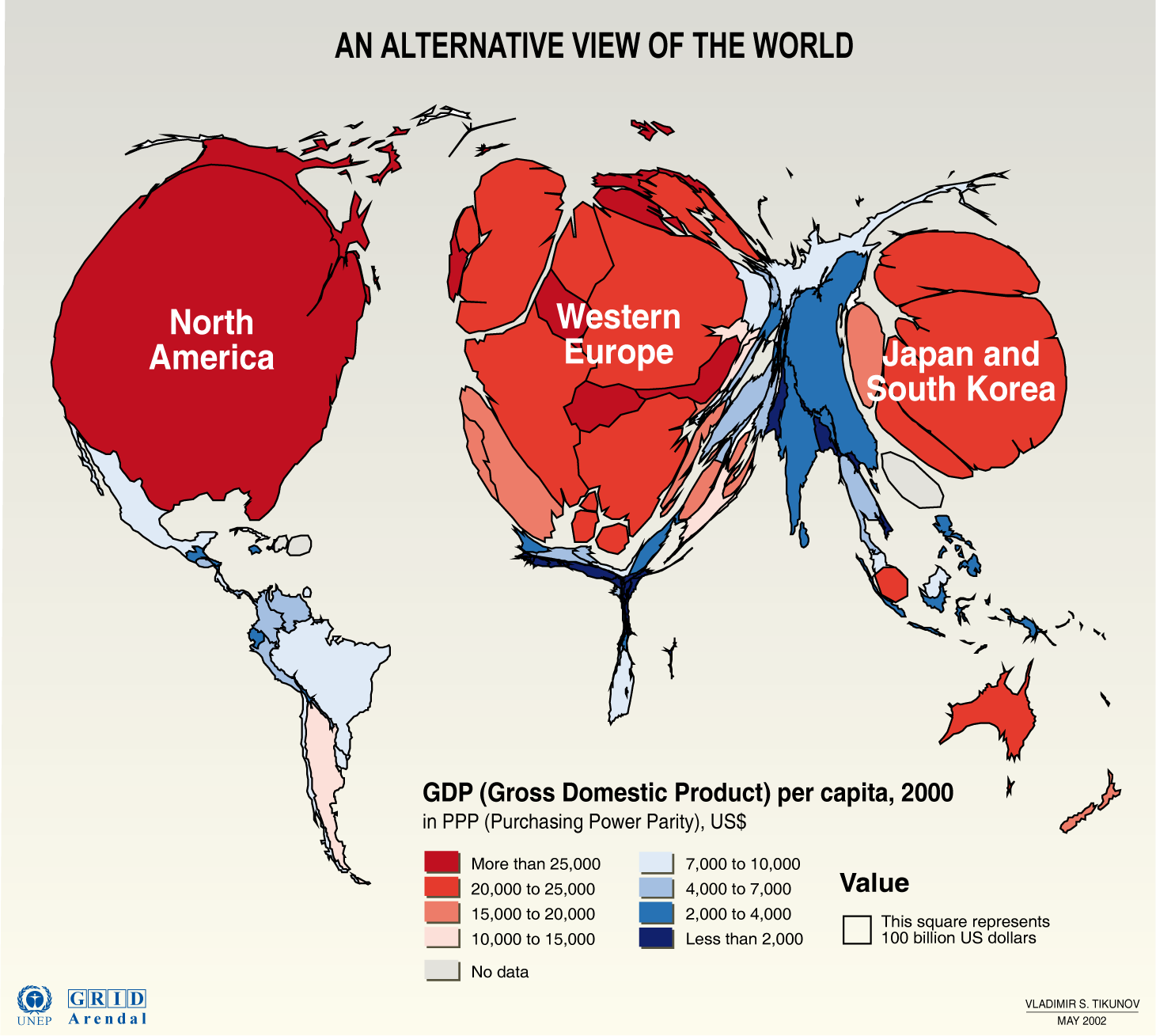
What you see above is 20 years out of date, but it still illustrates the point. It’s a map of the world where the political boundaries have been expanded or contracted based on the per capita GDP.
For a resort complex of this size to work, we are going to need a critical density of existing wealth in our region and the expectation of continued growth. Looks like we’re down to three options: Japan, Western Europe, and North America (not Florida). Japan already has a park and is probably too small to support a second resort complex on the scale we’re discussing. They may also be facing some demographic problems that make a project like this unfeasible. Western Europe has a park and a rail system intricate enough that opening a second larger resort anywhere in the region would cannibalize attendance and likely upset our partners.
At this point you may note that China is an emerging superpower and not in our list.
Thank you for pointing it out; you are a gentleman and a scholar. Maybe you’re a lady, I don’t know your business.
Point one, Disney already has two parks in China. Point two, neither park is wholly owned by Disney. Point three the income disparity in China between the metropolitan coast regions and the rest on the country are staggering and the new middle class is not particularly broad. Point four, let’s see how the next few years shake out (see point three). Beyond that, China is far more regressive in its sexual politics than even Florida, recognizes no right to free speech (personal, corporate, innate, or otherwise), operates concentration camps, and exerts much more control over the businesses they allow to operate. Sure is weird that Disney has TWO parks there.
Well, poop. That puts us right back in North America (not Florida).
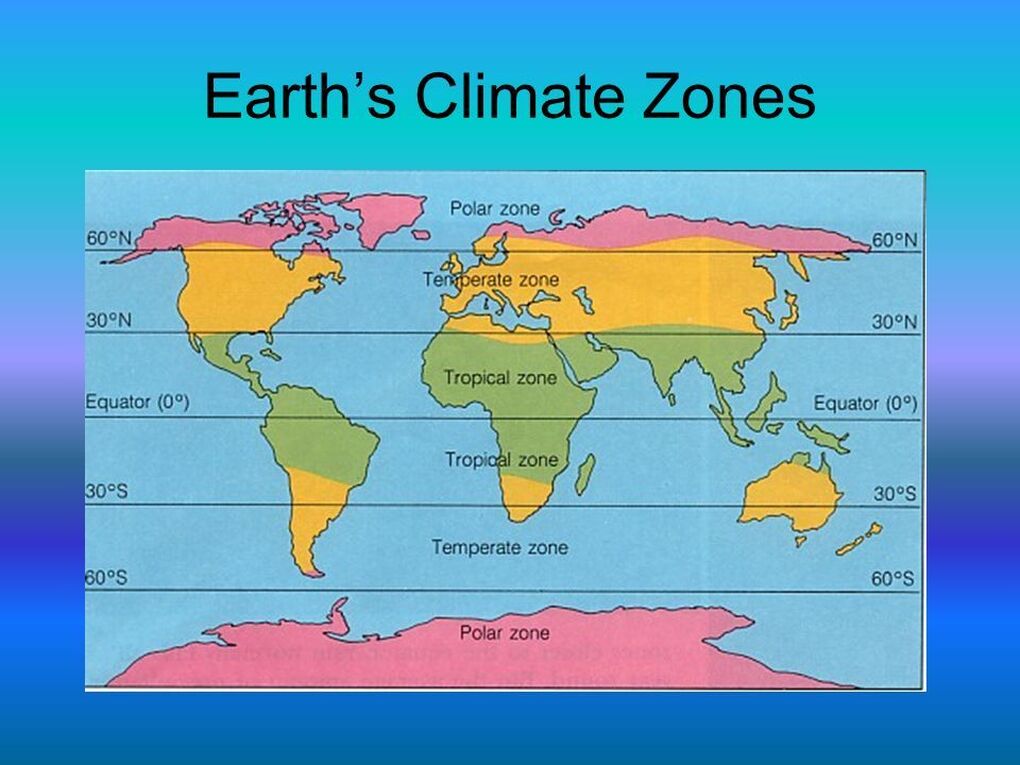
How about the climate? To make something on this scale viable we’ll need a year-round vacation spot. The closer you get to the equator and the poles the more consistent your daily temperatures are. That consistency means vacation planning becomes a little easier. No matter what time of the year you’ll always know how to pack. The farther way you stray the less predictability you have. The idea that a resort complex like this is going to be opening in upstate New York is simply not workable. Orlando may be almost unbearably hot for 3 months out of the year, but it doesn’t have to shut down for the winter.
This bears dwelling on for a moment. Yes, of course amusement parks can be opened in the northern states. Rollercoaster fans can go on and on about places like King’s Island. What tropical and sub-tropical climates offer is a consistency in offerings. Few people are going to ride a roller coaster in a Wyoming January. That means for a park to stay viable in the winter it’s dependent on the indoor and entertainment offerings. If that’s not enough to justify the park staying open year-round, then you start to have staffing issues. A theme park that is open year-round can have a consistency in personnel that is essential to the high-quality experience customers have come to expect from the Disney brand. I have serious doubts that quality like that can be maintained in a workforce that is furloughed three months out of the year (in extreme cases)
Anaheim is at the 34th parallel so let’s use that as our soft northern limit. Even though there are significant climatological differences between the east and west coasts of the United States. To make it easy for our imaginations, think of a line that runs through Los Angeles and Atlanta.
Now that we have a country and some possible regions, we need to know what kind of infrastructure needs to be in place. Fortunately, we have a wonderful movie made by Disney that outlines some of parameters they used in selecting the Florida site. If you’ll be kind enough to refer below, the rudimentary map shows four roads. One of them is an interstate (I-4 running between Daytona Beach and Tampa) and another is a toll road with the capacity of an interstate (formerly called The Sunshine Parkway). Let’s take that to mean we need to be near the intersection of an East/West and North/South Interstate (or equivalent). We’d also like to be near major state or US highways (like the other two roads).
Here’s a map of the US Interstate Highway System. Find me a place south of the line from Los Angeles to Atlanta where two interstates intersect, and people already go for vacations. Sure, you might think that if you build it, they will come, but think about that cluster of restaurants in your hometown. That doesn’t just happen because of zoning laws. Even though restaurants are competitors, they benefit from being one of several options in an area. Have you ever been lucky enough to find a nice little out of the way place to eat. You know the ones… where the owner really has a passion for the job, but they just can’t make a go of it. A lot of the time location is a big part of their problem.
“But, Disney is different! People save for years just to take the family on that once in a lifetime Disney Trip.” You’re right, there’s no denying that. At the same time, a lot of those people spending a week at the Disney resorts are spending a day or two of it in a Universal Park. Synergy helps.
By the way, are you willing to let the cruise business suffer too? Because if we move the parks too far away from a port that can service the ships, we’ll probably lose a percentage of the cruise ship business.
Based on what we’ve outlined we’re down to:
- Texas, between Houston and Galveston
- New Orleans, Louisiana
- Mobile, Alabama
- Savannah, Georgia
- Charleston, South Carolina
Several of those places are more hurricane prone than central Florida, but that’s a manageable risk. The bigger problem for a company making a protest move out of Florida for political reasons is that all five of your options are basically homogeneous on cultural issues, with South Carolina being your best fit politically, but your worst fit geographically being the farthest north.
Of course, here’s the real gag. When Disney bought all that swamp land in the middle of nowhere I-4 and the Sunshine Parkway they were both relatively new roads. Our interstate system is over 60 years old now. You simply aren’t going to find enough undeveloped cheap land near intersections anymore. Even if you could it’s not going to stay cheap very long in the internet era when everyone is going to find out about land purchases by shadowy companies on twitter and YouTube. That means the only option is to get a sympathetic government to use eminent domain to seize private land from individuals and smaller businesses and give it to a corporate behemoth. Almost as much land as Manhattan. That kind of political will simply doesn’t exist.
I think we’re going to have to go back to the leadership team with an unpleasant fact. The Walt Disney World Resort sits at the crossroads of I-4 and the Florida Turnpike, but it stands at the intersection of a man, a place, and a time. Of those three, only the place remains.
