


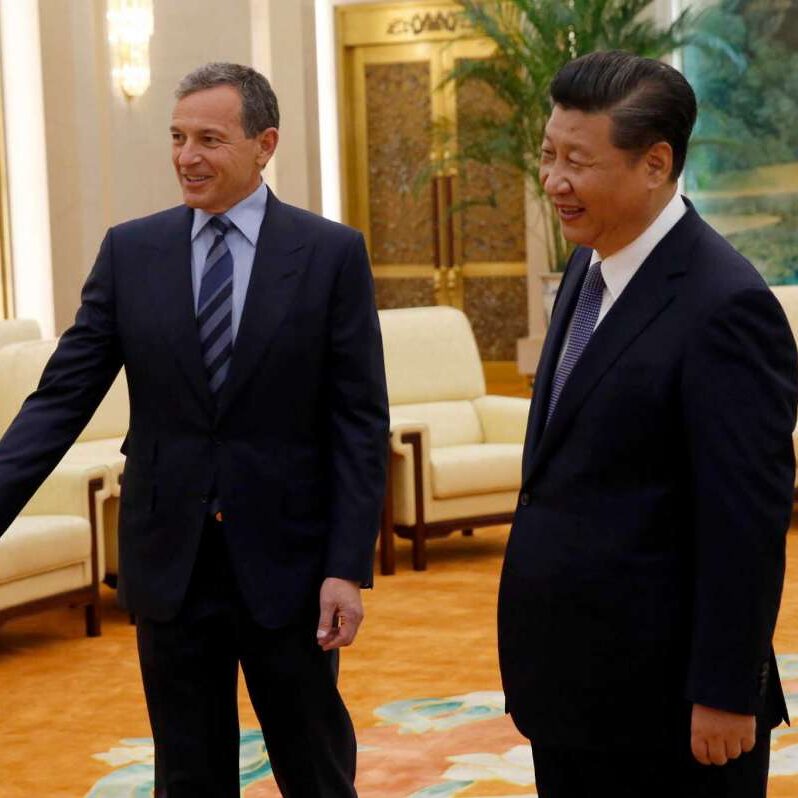
To those of you celebrating Bob Iger as a great warrior in the war for woke, I would like to remind you of one of his most visible of sins.
The live action remake of Mulan is a travesty on all levels.
Let’s get this out of the way: the movie is not great. For most remakes in the series, the Disney company relies heavily on repeating the beats of the original property. “Will they sing that song you love? Will they update your favorite moment? Which comic genius did they bring in to pick up the reins from that lovable animal sidekick? You’ve got to buy your ticket to find out!”
There isn’t much of that here. The songs are missing. The romance is gone (more on that later). Mushu, Cri-Kee, and Khan are nowhere to be found. For whatever reason, the movie follows only the basic elements. Mulan is the daughter of an injured Chinese warrior. In order to fulfill her family’s obligation to serve in the war against the [checks notes] Rouran, Mulan steals her father’s armor and poses as a man.
In the 90s, Mulan raised eyebrows a little bit for it’s gender-bending themes, but today you might assume that Mulan would be trans or even non-binary, discovering in the end that she prefers being a man instead of a woman (or both). The handsome young general would fall in love with not only Mulan, but also her male persona of Ping, awakening in himself (themself?) a bisexual desire that they weren’t aware of before.
Instead, the only woke thread that makes it into the final film is the freshly minted cliche: Mulan is yet another powerful female character that is told to hide her power, only to save everyone in the end by letting her femininity fly free. If that sounds familiar, it’s also the major theme of Captain Marvel, Wrinkle in Time, The Rise of Skywalker, Aladdin, Dark Phoenix, and Shang-Chi, and Turning Red. The list goes on.
Mulan missed their opportunity for LGBTQ representation, but for what purpose? In multiple Live Action reboots, Disney has made sly winks to LGBTQ representation. A fashionista in Cruella talks about his sexuality, the director of Beauty and the Beast told us all about LeFou’s “exclusively gay moment” only for a blink-and-you’ll-miss-it scene where Josh Gad smiles at another male character. There was none of that in this film.
Instead, the production of Mulan prioritized Chinese representation. The film would shoot in China. The lead actors and actresses would be Chinese nationals. The production would be authentically Chinese in a way that a Disney film had never been before. Sounds good, right?
Disney CFO Christine McCarthy has said that thanking China's Turpan Municipal Bureau of Public Security in Mulan's credits has "generated a lot of issues for us."
Besides helping Disney, the Turpan agency also imprisons people in concentration camps.https://t.co/Q60gWrTNue
— cartoonbrew.com – Animation News (@cartoonbrew) September 11, 2020
But that’s where the problems began.
First of all, the film was not considered Chinese enough to avoid criticism by the woke mob. Bob Iger and Alan Horn chose New Zealander Niki Caro to direct the film. On multiple occasions, Caro had to defend her position as a non-Chinese director working with non-Asian crew members to create a Chinese film. But that is to be expected, there is no point at which a film can be “woke enough.”
During the Hong Kong protests, the lead actress of the film Yifei Liu spoke out against the Hong Kong freedom protests, describing the protestors as “shameful.” This was interpeted on social media as the new Mulan supporting police brutality on behalf of the Chinese Communist Party. There was no official response by the Walt Disney Company or Bob Iger, but Yifei Liu was not present when a preview of the film was screened at D23 Expo. The previously care-free consequences of true authenticity in casting were reaching their limits.
If you’re looking for an official explanation of the lack of LGBTQ themes or Bob Iger’s silence, you need look no farther than China. In order for the film to be a true success in the eyes of Bob Iger and the Walt Disney Company board of directors, Mulan had to make it to Chinese theaters. This is an honor bestowed to only a handful of non-Chinese films every year. Chinese censors are infamously fickle, completely rejecting films that they deem harmful for any number of reasons that make no sense from an American perspective.
If a film, it’s cast and crew, or the company behind that film say anything seen as negative by or about the Chinese Communist Party, you can kiss the Chinese box office goodbye. And, the collectivist Chinese Communist Party does not look favorable on non-traditional lifestyles.
The film would also have the bad luck of releasing during the pandemic and straight to Disney+. Subscribers could see the film for a $30 rental fee and the economics of the film worked out from Disney’s perspective. Years later, we are still seeing the ramifications to the theatrical box office.
The most egregious offense of Bob Iger was revealed in the end credits of the film. Under “Special Thanks” the production of Mulan thanked the government of the Xinjiang region, who has been alleged to have committed multiple human rights violations against religious minorities in China, including slave labor, interment, mandatory re-education, and compulsory organ harvesting.
None of these arrangements would have been possible without Bob Iger’s special relationship with the Chinese Communist Party. Iger worked for decades to achieve the construction of Shanghai Disneyland Park and Mulan was just a step along the way. The way business is done in China is relational, not just transactional. Business partners honor each other, respect each other, and then they can do business. To the uninformed public, Mulan is a diverse representation of movies can be when you work hard to let all voices be heard. But in reality it appears that Iger might have made a deal with some truly scary people to get it done. Who have you gotten into bed with, Bob?
So, if you see Bob Iger as a repudiation of woke ideology, you may be right, but in the worst possible way. In the coming months Iger will be doing lots of interviews as he does his part to repair the broken image of the Walt Disney Company. So, if you’re a journalist reading this and you want to ask Bob Iger a truly difficult question, press him on the issue of China. What did he do to make the Chinese Communist Party love him so much? What did he overlook to make things go away? And how much of Disney’s money went toward atrocities?
For all the news that should be fun… bookmark That Park Place. Drop a comment down below and let me know your thoughts!
