


Resident Star Wars expert Lorn Conner takes us on a journey revisiting one of the most important non-movie story from pre-Disney Star Wars. Why does it matter and how does the game narrative impact the franchise now that the EU is non-cannon?
In the original Star Wars Expanded Universe, the post-Return of the Jedi storytelling field was wide open. Early efforts were building the foundations of lore going forward, but with the Star Wars prequels actively in production there were many more questions than answers. The Dark Forces series was much more integral to all lore going forward than is usually realized – and Jedi Knight was in many ways a keystone.
Aftermath
After the successful retrieval of the Death Star Plans, the destruction of the Arc Hammer and the setback of the Darktrooper project, what was next for Kyle Katarn?
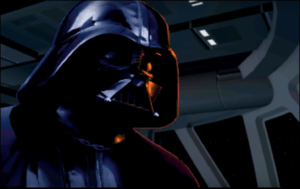
“This is an unfortunate setback. The Force is strong with Katarn!”
Two of the only complaints that Dark Forces received were the lack of lightsaber combat and force powers. It’s likely that this was due to limitations of the Jedi Engine that the game ran on, so a major tech upgrade was featured in the sequel. The Sith engine transitioned to a fully 3d environment, and had some rudimentary dynamic lighting effects, an automatic switch to 3rd person view when using the lightsaber, the aforementioned Force Powers, and FMV video sequences with integrated digital effects for the cutscenes.
(This was the first live-action Star Wars footage shot since Return of the Jedi in 1983, and was a big deal!)
In every way, Jedi Knight was a SIGNIFICANT upgrade over its predecessor. The protagonist was now played by Jason Court to great effect. After the conclusion of the Darktrooper episode, Kyle undertakes a personal mission with the help of Jan Ors to track down the parties responsible for the death of his Father, Morgan Katarn. The quest leads him down paths he never could’ve expected.
Interlude
The answers to Kyles questions touched on areas that the EU of Star Wars had only begun tentatively addressing.
It’s important to remember, this game released BEFORE the Star Wars prequels. At this point, the Jedi Council didn’t exist. We didn’t know anything about the structure of the Jedi, OR the Sith. The word “Sith” hadn’t even been uttered in the original trilogy, though it did exist in script drafts, and the Rule of 2 hadn’t entered the imagination of anyone but George Lucas.
The EU at this point had explored a military campaign against Grand Admiral Thrawn, and Luke’s efforts to build a new Jedi Academy on Yavin IV. Storytelling from the Jedi Academy Trilogy going forward often focused on Lukes students falling to temptation and becoming Dark Jedi – sort of proto-Sith without the benefit of knowing exactly how the Sith differed from the Jedi or how one became a Dark Lord.
In fact, the same was true in Jedi Knight – the opening cutscene shows the aftermath of a brief battle between a custom Super Star Destroyer (Vengeance) against an unnamed Corellian Corvette – and the capture of Qu Rahn, who will be an important figure in the story going forward.
This cutscene introduces Jerec and his Dark Jedi – Yun, Gorc and Pic, Maw, Boc and Sariss. This is notable for two reasons:
- Jedi Knight takes place 5 years after Return of the Jedi. This shows a faction of the Imperial Remnant acting independently to try and gain power and set themselves up as the new rulers of the Galaxy.
- Unlike the Dark Jedi 6, Jerec has ANOTHER title – Inquisitor.
The More Things Change
That’s right – the Inquisitors predate Star Wars: Rebels and the Disney Acquisition. In fact, they were introduced in the West End Games Roleplaying Game as antagonists more closely aligned with the Emperor, and a step up from your garden-variety “Dark Jedi.”
The plot of Jedi Knight eventually reveals that Kyle is force-sensitive, and that his father hid a great secret – the location of “The Valley of the Jedi” where Force Powers could be GREATLY enhanced. This plot device is remarkably similar to the original “Kaibur Crystal” of Splinter of the Minds Eye, but created some unique opportunities to explore concepts that hadn’t existed in Star Wars previously.
The Inquisitors
Like their latter-day counterparts, the Inquisitorious focused on rooting out and destroying any hints of Jedi activity. If any Force Sensitives were discovered, they were to be destroyed or turned over to the Emperor.
The Valley – The First Force Vergence?
In the context of the game, the Valley is not well-described. It is a font of power on an arid world at which the spirits of many Jedi appear to be trapped, and whose power can be harnessed by one who finds it. In gameplay terms, this is really all you need to kick off a quest – but in spin-off materials, this backstory got MUCH more fleshed out (and also much weirder.) (More on this later).
What’s interesting about the Valley specifically here is that Force Vergences had not yet been described because The Phantom Menace wasn’t released until 1999. The Valley is likely categorized as a Force Vergence, but predates the movie by 2 years!
Player Agency in an Alternate Universe?
Like TIE Fighter before it, Jedi Knight wanted to give the player maximum agency to explore their character and Force Powers in the manner they chose. To that end, the game employed light RPG elements that allowed the player to put points into skills – Force Powers were categorized as light side, neutral, or dark side powers. Player choice affected the end of the game, in which the Dark Side Alternate Ending had Kyle sitting on the throne after taking command of the Imperial Remnant.
The canonical ending had Kyle becoming the caretaker of the Valley, finding inner peace after resolving the question of his fathers death, and becoming one of the first generation of new Jedi Knights – though one who was self-taught and not yet directly affiliated with Luke Skywalkers Jedi Praxeum.
The Beginning
As with Dark Forces, Jedi Knight begins with Kyle acting as a mercenary. While investigating the murder of his father, he gets in touch with an information broker droid named 8t88 (itself an in-joke referring to the 8088 processor of early IBM compatible PCs), who informs him that Jerec was a Dark Jedi responsible for the killing.
However, 8t88 is in possession of an encrypted data disk from Morgans farm on Sulon that he cannot decode. When Kyle refuses to tell him how to decrypt the disk, 8t88 double-crossses Kyle, escaping with the disk. Kyle survives the ambush and is forced to track him down.
After becoming injured while retrieving the data disk, Kyle recovers on a rebel Nebulon-B frigate, and has a vision narrated by the spirit of Qu Rahn, telling him of the Valley and the dangers it represents.
“Your path is at a moment of change. Jerec, the man who murdered your father, is a great evil. He searches for the location of a sacred place – The Valley of the Jedi. The Force of thousands of Jedi is trapped here – if Jerec captures this power, he will be a creature such as the universe has never seen! A supernova of stars in a fleeting thought; the eradication of life from a star system in a whisper – will be within his power! Your Father gave his life to protect this power, and now it is a place your destiny must take you! The disk you have in your posession will leads you to the ways of the Jedi. Remember – it will be your path – to the ways of the Force!” – Qu Rahn
Returning to the homestead of his father, Kyle finds that Jerec and his minions have beaten him…he sees them loading up ceiling tiles from his family home and departing, though leaving some rear-guards behind. The Dark Jedi plan to use 8t88 to decipher the tiles.
Sneaking into workshop area of the homestead, Kyle uses the old family droid, WeeGee, to decode the disk. It contains a recording of Morgan telling Kyle that the location of the Valley was hidden on the ceiling tiles that have been stolen, and that Kyle is force-sensitive. Also hidden within the chassis of WeeGee is a lightsaber that once belonged to a Jedi of his acquaintance – Qu Rahn – the last legacy from Morgan to his son.
Kyle tracks 8t88 to Barons Hed, but not before he successfully translates the engravings from the stone ceiling into a holomap, which he transmits to Jerec.
When Kyle bursts in to confront 8t88 for the map, he offers it freely – but the Dark Jedi Yun has been left behind, and destroys it.
After a brief confrontation, Kyle pursues 8t88 yet again to a refueling station where he has been told to expect payment from Jerec for his services. Tapping the droid on the soldier reveals that his head has been severed, and that he must now face the Dark Side Twins, Gorc and Pic.
After dispatching them, Kyle retreives 88’s head and takes it back to Jan. Using her superior slicing skills and hooking the memory core into Weegee, they are able to reconstruct the holomap that will lead Kyle to the Valley.
Upon arrival, Kyle and Jan find that a major Imperial Reclamation Dig has already been set up, and Kyle will have to traverse the canyons of the arid planet to reach a giant elevator tower. After infiltrating the facility, he encounters Maw – another of the Dark Jedi who follows Jerec.
After killing Maw, Kyle is confronted by Jerec and his remaining followers, who have captured Jan. Jerec taunts Kyle, attempting to force him to turn. When Kyle resists his efforts, Jerec blasts him with a bolt of pure force, damaging the gantry and knocking out the repulsorlift holding the massive fuel tanker – and the Moldy Crow – aloft.
Kyle must traverse the fuel tanker he previously navigated backwards at a 45 degree angle while trying to make his way to the Moldy Crow before the ship crashes and is destroyed. It’s the best level in the game, and was a triumph of design at the time.
The Moldy Crow is released, but caught in the massive explosion of the fuel tanker – the turbulence causes a crash, and Kyles ship is lost.
When Kyle comes to, he is confronted by Boc, Yun, and Sariss. Barely conscious, Boc taunts Kyle with his own lightsaber. (A closeup reveals that the lightsaber *may* have been built around a pepper grinder!) Boc destroys the last link Kyle has to his Father and Qu Rahn, but Sariss tires of these games. She sends Boc to tell Jerec that Kyle soon will be dead, but Yun is clearly troubled by what is transpiring, recalling the mercy that Kyle showed him earlier.
When Sariss moves to strike, Yun activates his lightsaber and deflects her blade, but takes the killing stroke himself. Kyle uses Yuns lightsaber to fight Sariss, eventually killing her.
Within the core of the Valley, Boc taunts Jan while Jerec approaches the spirits of the long-dead Jedi. He ascends to meet them, absorbing their power.
When Kyle arrives, he must confront both Boc and Jerec, for the ultimate fate of the Valley.
The New Sith Wars:
While the story was sufficient for a gameplay narrative, significant questions were left unanswered within the game narrative. Most significant of these were – what WAS the Valley of the Jedi? How did the spirits of so many Jedi come to be trapped there?
The answer came from some interesting places, and led to serious additions to canon.
The Phantom Menace introduced the concept of the Rule of Two for the Sith, and this contradicted significant other portions of the EU that had been established at that point. Most significant of these were the Tales of the Jedi comics, during which the origin of the Sith had been explored, and which showed internecine battles between several different Sith Lords, and large-scale battles between armies of Sith and Jedi.
How could the rule of 2 be reconciled against this?
The answer came in the novelization of The Phantom Menace, and the comics series Sith vs. Jedi. The novelization revealed that Darth Bane had instituted the Rule of Two to remain hidden from the Jedi while they plotted their revenge for unspecified past wrongs.
While George never intended for the Sith to have EVER had a large-scale following, and intended for them to be wiped out at the conclusion of Return of the Jedi, previous EU stories had explained the origins of the Sith and the reason for their greivances – and future products (and profits!) would depend upon the continued use of the Sith as antagonists – a major component of the Star Wars formula!
The solution was to explain what happened to reduce large armies of Sith to just two remaining alive.
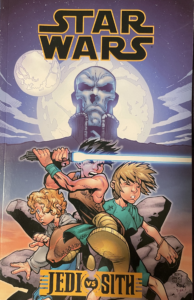
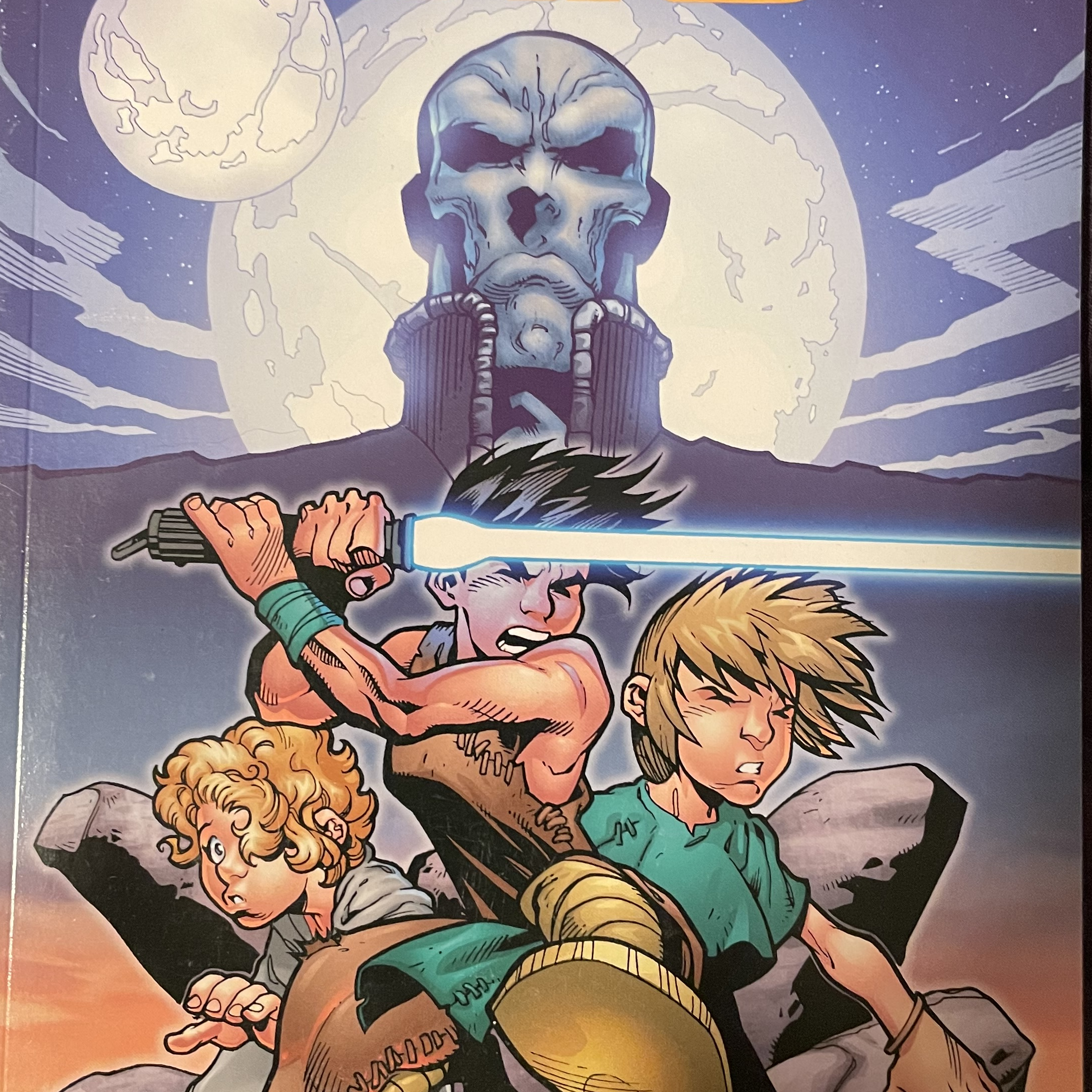
Thus was created the New Sith Wars – which explored the Brotherhood of Darkness and the Army of Light. Prior to the implementation of the Rule of Two, the Sith had settled into a confederation in which all shared power equally. Feeling that this weakened the Sith, Bane hatched a plot to kill all of the Sith in the Brotherhood opposing the Army of Light in a protracted battle on the planet Rusaan – uncovering an ancient Sith Technique that would simultaneously kill AND trap the souls of all caught in the blast radius of the ritual – The Thought Bomb.
Bane would go on to take his first apprentice – Zannah. Both would adopt the ancient title “Darth” that had been abandoned by the New Sith – a contraction of “Da”rk Lord of the Si”th”, explaining another plot discrepancy when it was revealed in the prequels that Darth was a title and not a name.
The aftereffects of the Thought Bomb created the Valley of the Jedi, where it would remain for 1,000 years before being rediscovered by Morgan Katarn and Qu Rahn – who later passed their findings to Kyle.
Further Explorations of the New Sith Wars & The Rule of Two:
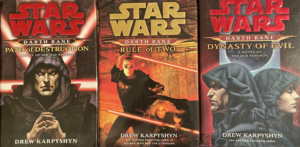
The New Sith Wars and the Rule of Two were further explored in the Darth Bane trilogy, by Drew Karpyshyn. Famed as the lead writer on Knights of the Old Republic, he retconned some elements of the Jedi vs. Sith comics and tied Darth Banes discovery of the Thought Bomb to the holocron of Darth Revan from those games.
This was retconned further to attach to the ritual conducted by Tenebrae/Darth Vitiate/Emperor Valkorian at various points in the SWTOR era – cementing his power and extending his life after the fall of Naga Sadow in ancient times, and allowing the founding of a new (old?) Sith Empire.
Expansion:
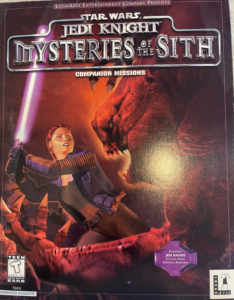
The Jedi Knight game was popular enough to generate a spin-off expansion – Mysteries of the Sith.
The main protagonist was switched to Mara Jade, who had become a very popular character following the Thrawn trilogy of novels. Herself now exploing the force independently (and with a mercenary background from the opposite side of the force spectrum), it made sense to pair her training to Kyles after she left Luke Skywalker at the end of the novels.
The first two levels the player plays as Kyle, but he then discovers mysterious ties to the Sith in an ancient temple on Dromuund Kaas, which he goes to explore. (This was also established as the Capital Planet of the Sith Empire in the Old Republic Timeframe – planet was chosen from this obscure reference.)
Kyle is corrupted by the Dark Power of the Ancient Sith Temple, but Mara tracks him back to the planet and redeems her with compassion after a series of connected adventures.
The expansion did away with the FMV cutscenes of the first game and contained a few gameplay enhancements, and was generally well-received.
The person who titled the expansion was quite surprised to hear Mace Windu utter the line “This could be the key to unravelling the mystery of the Sith” – while unconnected to the game, it must’ve given him a tingle to hear that line when the Phantom Menace was released.
Legacy:
Besides all of the spin-off retcons and foundation that was laid by Jedi Knight, it’s most obvious modern inspiration is Jedi: Fallen Order.
While a much more somber game, Cal Kestis takes on the role of untrained Jedi Archaeologist, exploring ancient tombs and temples while solving the mystery of the Zeffo and what became of them in the galaxy. The Zeffo *may* be the modern-day canon version of the Rakata from the Knights of the Old Republic game, but it remains to be seen if they will factor in to the sequel.
While the tone of the Dark Forces and Jedi: <Subtitle> games are quite different, they both include a focus on lightsaber combat and force abilities, and both have been extremely well-regarded in their time.
Jedi Knight may be the most important but obscure source of old EU lore that exists, and I’ve enjoyed exploring this game with you. Do you have memories of playing the game back in release, or the modern day?
Tell me about it down below!
For all the latest news, rumor and leaks… as well as incredible retrospectives on franchises we love… keep reading That Park Place. As always, drop a comment down below.
