



As Americans debate the merits of the H-1B visa, it’s important to remember that Disney, one of the largest entertainment companies on the planet, has a history of using the visa program to replace qualified American workers with cheap foreign labor.
Recently, the debate surrounding H-1B visa programs has surged to the forefront of American discourse, significantly amplified by high-profile comments from tech magnate Elon Musk.

Elon Musk via AutismCapital on X
READ: Disney’s Christmas Day ‘Snow White’ Preview Sees Another Massive Dislike Ratio
Following a contentious exchange on social media, Musk staunchly defended the H-1B system, noting its pivotal role in the success of major American corporations. This fervent endorsement has reignited longstanding debates about the delicate balance between leveraging global talent and safeguarding domestic employment opportunities.
Amid this heightened awareness, scrutiny of corporate practices, particularly the utilization of H-1B visas to replace qualified American workers, has intensified.
Disney, a titan in the entertainment industry, has found itself under the microscope in the past for practices that many argue exploit these visa provisions. The company’s strategy of outsourcing and importing cheaper labor has sparked serious concerns about its broader implications for the American workforce. As citizens grapple with the complexities of immigration and employment laws, Disney’s history serves as a pivotal case study in understanding the real-world impacts of H-1B visa policies on both businesses and American employees.
Elon Musk’s Influence on the H-1B Debate
Elon Musk’s recent remarks have significantly influenced public perception of the H-1B visa program.
According to an Axios article, tensions escalated when Musk ally and DOGE co-lead Vivek Ramaswamy criticized American “mediocrity” culture on social media. Musk defended Ramaswamy, leading to a bitter exchange between opposing sides within the Republican Party.
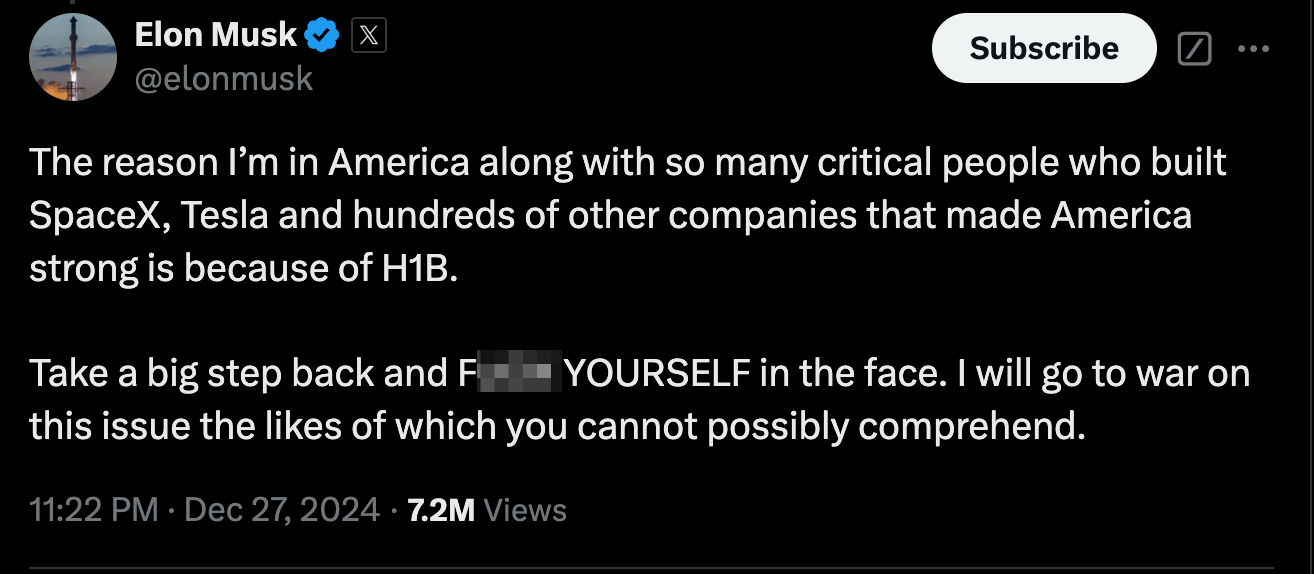
Elon Musk posts on X in defense of the H-1B visa – X, @ElonMusk
On Friday, Musk intensified his stance, labeling MAGA adherents critical of immigration and the tech community as “contemptible fools” and “racists” who could potentially doom the Republican Party if not removed from its ranks.
Just before midnight on Friday, Musk fervently defended the H-1B program in all caps, declaring it essential to the success of his and other major American companies. He vowed to “fight to my last drop of blood” to maintain America as a meritocracy, emphasizing his readiness to go to war over what he perceives as a critical issue for the nation’s economic future.
UPDATE: Elon Musk agrees with Scott Jennings’ proposal on H-1B visas.
The proposal:
– Reform and restrict the current H-1B system. No more abuse: no choosing foreigners in jobs easily filled by qualified Americans
– Accept the proven geniuses: the top 0.1%-1% from other nations,… https://t.co/4T7NmGbBLN— Eric Daugherty (@EricLDaugh) December 28, 2024
However, Musk has also voiced support for reforming the H-1B program to avoid abuse of the program.
Understanding the H-1B Visa Program
The H-1B visa program, as defined by the U.S. Department of Labor, allows employers to hire nonimmigrant workers in specialty occupations requiring highly specialized knowledge and at least a bachelor’s degree or its equivalent. The primary intent of the H-1B provisions is to assist employers who cannot otherwise obtain the necessary business skills and abilities from the US workforce by authorizing the temporary employment of qualified individuals not otherwise authorized to work in the United States.

An overview of the H-1B visa program from the US Department of Labor – DOL.Gov
READ: ‘Wicked: For Good’ Will Feature a Song Co-Written by Star Cynthia Erivo, But is That a Good Thing?
To protect similarly employed US workers, the law mandates that employers attest to the Department of Labor that they will pay H-1B workers wages at least equal to the actual wage paid to other employees with similar experience and qualifications or the prevailing wage for the occupation in the employment area, whichever is higher. This is supposed to ensure that the employment of H-1B workers does not adversely affect the wages and working conditions of US workers.
Disney’s History with H-1B Visas: A Case Study
Restructuring and Outsourcing: The 2014 Disney Example
In October 2014, Disney announced a significant restructuring of its global technology organization aimed at supporting future innovation and new capabilities.
Behind this ostensibly positive language was a strategic move to outsource a substantial portion of its IT operations. This decision resulted in the termination of approximately 250 Disney tech workers, all given a ninety-day notice period. These employees were offered a “stay bonus” of 10% if they remained in their roles for the full ninety days until their official termination.
Epcot Spaceship Earth Walt Disney World Orlando 2010. Photo Credit: chensiyuan, CC BY-SA 4.0 <https://creativecommons.org/licenses/by-sa/4.0>, via Wikimedia Commons
However, this bonus came with a significant condition: the employees were required to maintain “continued satisfactory performance of your job duties.” In practice, this meant that the workers had to train their replacements, a process involving thirty days of job shadowing, thirty days of parallel working, and thirty days of monitoring. The replacements were temporary workers from overseas, all of whom were H-1B visa holders.
Leo Perrero, one of the displaced workers, described the experience to 60-Minutes, stating:
“Never in my life did I imagine, until this happened at Disney, that I could be sitting at my desk and somebody would be flown in from another country, sit at my same desk and chair, and take over what I was doing. It was the most humiliating and demoralizing thing I’ve ever gone through in my life.”
Notably, there was no indication that the American employees were underperforming. Perrero was even commended for his “superior skills” and “outstanding” work, which the company acknowledged had saved it thousands of dollars in a review that came after his notice of severance.
Legislative Background and Legal Loopholes
The H-1B visa was created alongside the Q visa through the Immigration Act of 1990, with the goal of being “generally restrictive and reflecting a desire to protect U.S. workers.”
Prior to 1990, the broader H1 visa had allowed individuals of “distinguished merit and ability” to perform temporary services in the U.S. However, Congressman Bruce Morrison criticized the H1 visa for allowing entry of too many people not vital to the U.S. economy. This led to the creation of more specific visa categories under the 1990 Act, such as the H-1B for specialty occupations, the O visa for extraordinary applicants, and the P visa for athletes and entertainers.

Looking up at The Hollywood Tower Hotel (The Twilight Zone Tower of Terror) at Disney-MGM Studios at Walt Disney World, December 2004. Photo Credit: The original uploader was Techclub at English Wikipedia., CC BY-SA 3.0 <http://creativecommons.org/licenses/by-sa/3.0/>, via Wikimedia Commons
Despite these safeguards, Disney exploited legal loopholes by using staffing firms HCL and Cognizant to hire H-1B workers. Since the Labor Condition Application (LCA) requires employers to attest that hiring H-1B workers will not adversely affect the working conditions of similarly employed U.S. workers, HCL and Cognizant could make these attestations independently.
Disney, not being the direct employer, was not bound by these specific attestations. So, it was allowed to outsource its IT department without directly violating H-1B regulations.
Furthermore, under the American Competitiveness and Workforce Improvement Act of 1998 (ACWIA), H-1B-dependent employers face additional requirements, including prohibitions on displacing US workers within a 180-day window and obligations to recruit U.S. workers for H-1B positions.
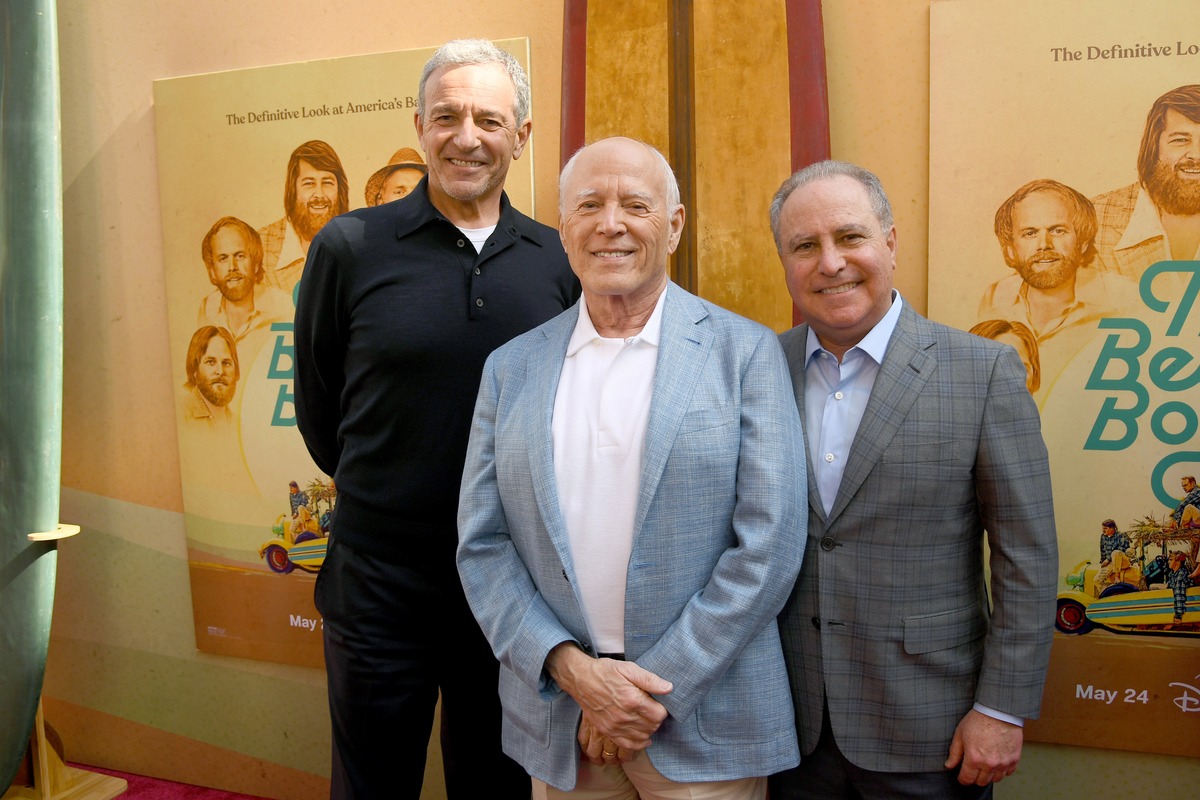
LOS ANGELES, CALIFORNIA – MAY 21: (L-R) Bob Iger, CEO, The Walt Disney Company, Frank Marshall and Alan Bergman, Co-Chairman, Disney Entertainment attend the world premiere of Disney+ documentary “The Beach Boys” at the TLC Chinese Theatre in Hollywood, California on May 21, 2024. (Photo by Alberto E. Rodriguez/Getty Images for Disney)
However, Disney circumvented these restrictions by hiring through staffing firms that qualified for exemptions. Specifically, workers earning at least $60,000 a year or holding a master’s degree or higher were exempt from displacement provisions, allowing HCL and Cognizant to replace American workers without triggering ACWIA’s safeguards.
Legal Challenges and Corporate Accountability
Two of the displaced Disney workers filed federal lawsuits against Disney, HCL, and Cognizant, alleging that the companies colluded to displace American workers with H-1B visa holders. They contended that the companies failed to comply with legal requirements to ensure that hiring H-1B workers would not adversely affect similarly employed U.S. workers and improperly displaced American employees.
Below, you’ll find a video in which a fired Disney worker breaks down into tears while testifying about losing his job and being forced to train his replacement.
WATCH: Former Disney employee breaks down in tears, exposing how Disney callously replaced an entire group of IT workers with foreign labor brought in under the H-1B visa program.
pic.twitter.com/2oI6PCon0i— CatholicVote (@CatholicVote) December 27, 2024
However, these lawsuits failed to survive motions to dismiss.
The courts ruled that since HCL and Cognizant employees were not directly employed by Disney and met the exemption criteria, there were no legal grounds to prove that the hiring process adversely affected the original American workers. As a result, the legal system upheld the companies’ actions, highlighting the limitations of existing laws in preventing such corporate maneuvers.
Broader Implications for the American Workforce
Disney’s actions are not isolated. The company’s use of H-1B visas to replace American workers exemplifies a broader trend where corporations leverage visa programs to cut costs, often at the expense of domestic employment.
Disney is just one of many companies exploiting loopholes in H-1B for their own benefit at the expense of the American people. For example, Chippendale’s (not to be confused with Disney’s Chip & Dale) used H-1B to bring in a male exotic dancer from Australia.
Chippendales used a special U.S. work visa program to bring an Australian dancer to Las Vegas because we’re not producing enough high-level strippers domestically. pic.twitter.com/H5ivjPQr35
— Las Vegas Locally 🌴 (@LasVegasLocally) December 28, 2024
READ: Disney Lucasfilm Spent Over Half a Billion Dollars on Andor Budget: Where is This Money Going!?
Empirical data indicates that when U.S. workers are replaced by H-1B visa holders in large-scale departmental overhauls, the new noncitizen workers often earn substantially less than their American counterparts. This wage disparity highlights the potential for exploitation within the H-1B system, where the original intent of supplementing the U.S. labor market is subverted for financial gain.
Panorama of the west facade of United States Supreme Court Building at dusk in Washington, D.C., USA. Photo Credit: Joe Ravi, CC BY-SA 3.0 <https://creativecommons.org/licenses/by-sa/3.0>, via Wikimedia Commons
Professor Ron Hira has described the H-1B program as having been “perverted” from its original purpose.
Former Congressman Bruce Morrison echoed this sentiment, bluntly stating, “The H-1B has been hijacked as the main highway to bring people from abroad and displace Americans.”
These criticisms highlight a fundamental issue: the H-1B visa program, while designed to fill gaps in the U.S. labor market, is being manipulated by corporations like Disney to reduce labor costs and undermine the domestic workforce.
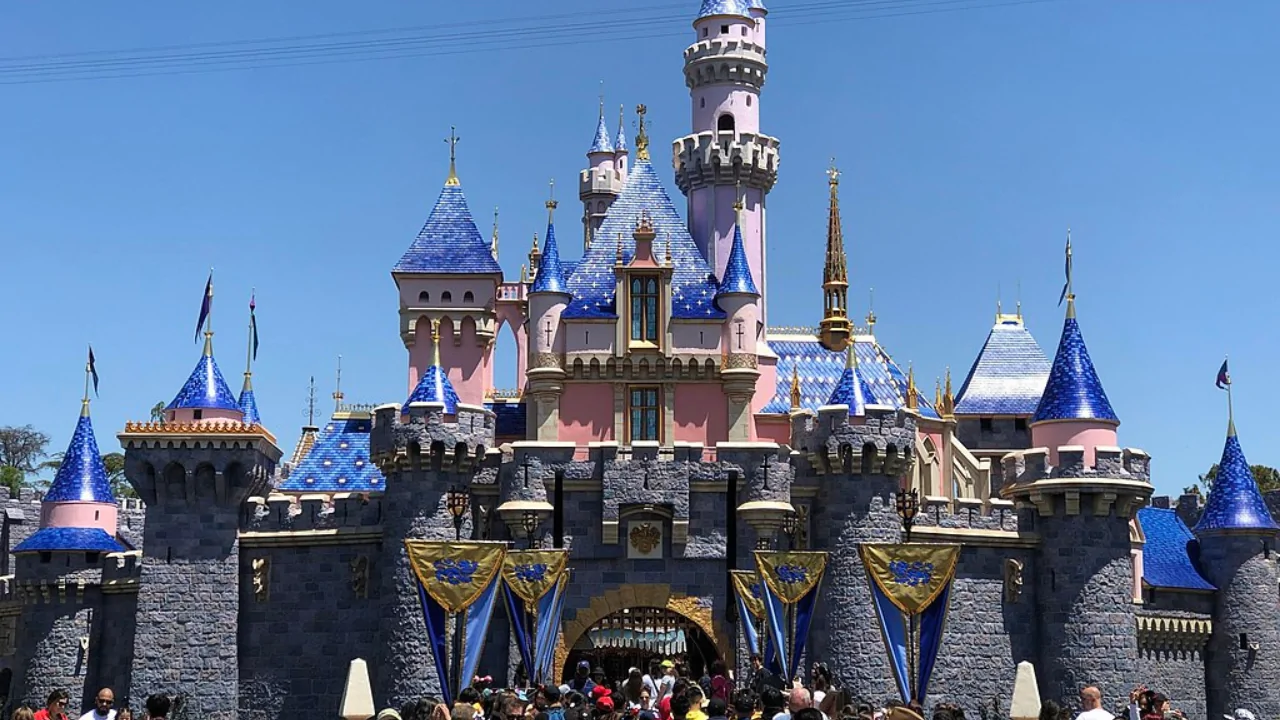
Sleeping Beauty Castle in 2019 after refurbishment. Photo Credit: CrispyCream27, CC BY-SA 4.0 <https://creativecommons.org/licenses/by-sa/4.0>, via Wikimedia Commons
Disney’s case shows the need for comprehensive policy changes to close existing loopholes that allow companies to exploit visa programs for financial gain at the expense of the American workforce.
As public awareness grows and the discourse becomes more polarized, the push for corporate accountability and legislative action becomes increasingly critical. Ensuring that the H-1B visa program fulfills its intended purpose of supplementing the US labor market, rather than undermining it, is paramount for the future of both the American workforce and the nation’s economic health.
Do you believe Disney abused the H-1B visa program? Do you agree or disagree with Elon Musk on this topic? Sound off in the comment section below and let us know!
UP NEXT: RUMOR: Paramount Reportedly Developing Power Rangers Movie Reboot With Hasbro
