


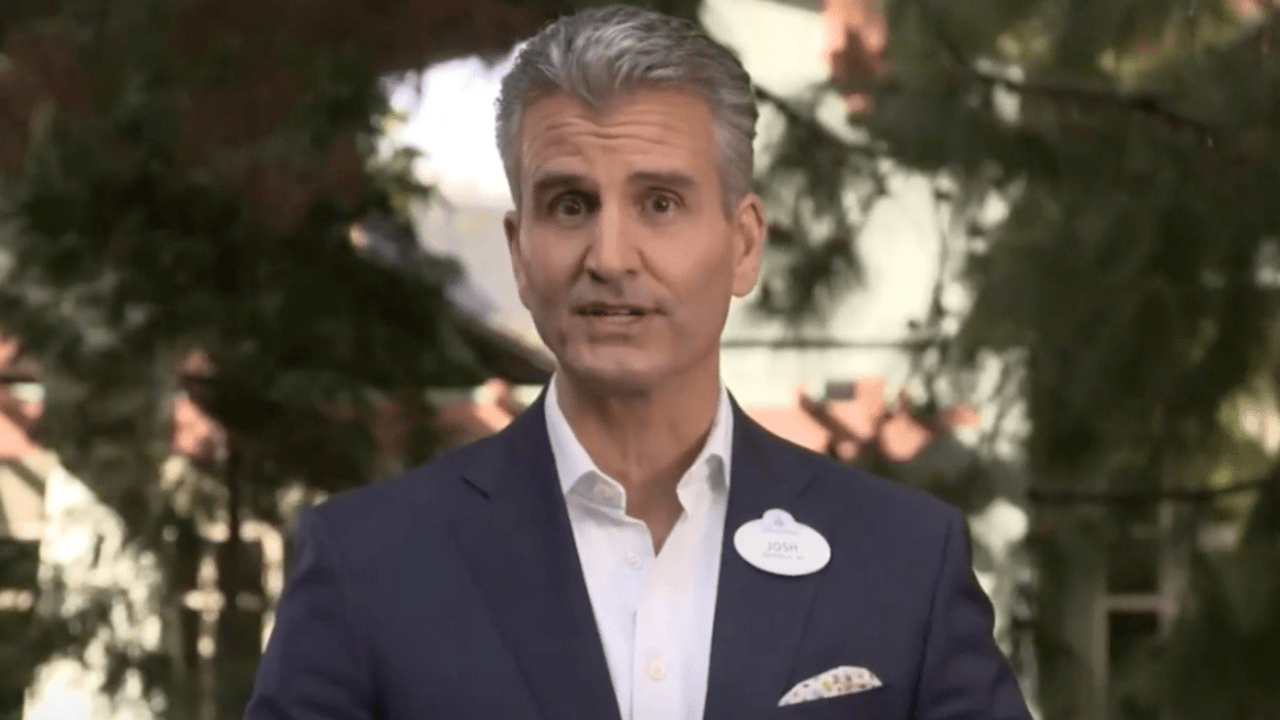
For the second time, Disney has handed off the CEO crown in a way that is rocky at best. Now, Disney Company stock is down just about 50% in the past five years and investors have reasons for worry.
Josh D’Amaro officially took over as chief executive of The Walt Disney Company on March 18, 2026, succeeding Bob Iger as CEO, though Iger is staying on as senior adviser and a Disney board member through December 31, 2026. Since that handoff, Disney’s stock has softened: DIS closed at $99.42 on March 18, and by midday on March 27 it was trading at $93.13, a drop of about 6.3%. When considering that Disney was at $112 at the end of January, this is a precipitous fall. That does not prove the decline happened solely because Iger left the CEO seat, but it does show that Wall Street is now judging Disney in a new phase of the transition.
Worse, some are wondering if Iger’s swift departure (he was supposed to stay on through the year) is an indication he knew headwinds were choppy ahead.
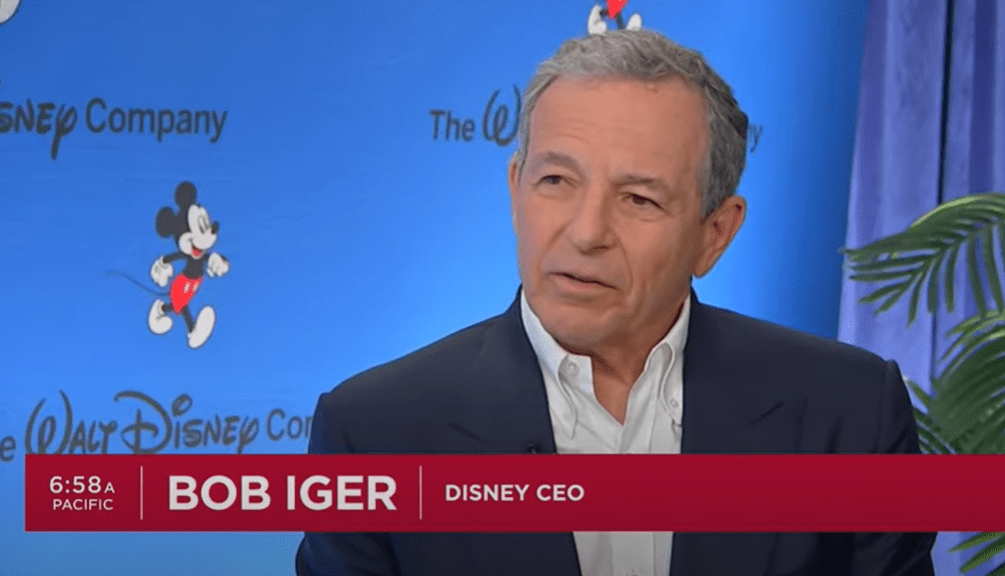
Bob Iger via CNBC Television YouTube
READ: Fox McCloud Actor Announced as Glen Powell Joins The Super Mario Galaxy Movie
The problem for D’Amaro is that he inherits a company whose earnings mix is still unbalanced. In Disney’s fiscal first quarter of 2026, revenue rose 5% to $25.98 billion, but total segment operating income fell 9% to $4.6 billion. Experiences generated $3.309 billion of that operating income, up 6%, while Entertainment fell 35% to $1.1 billion and Sports dropped 23% to $191 million. In other words, Experiences supplied roughly 72% of Disney’s segment operating income for the quarter. That is a strength, but it is also a concentration risk: if investors decide the parks engine cannot keep carrying the rest of the company, the stock can rerate quickly.
Moreover, D’Amaro is now running a company that has lost major investments just in the last week. Questions abound regarding whether or not Epic Games can deliver on a Fortnite Disney universe after firing 1,000 employees.
The Sora integration into Disney Plus was a huge component of Disney’s strategy for streaming and artificial intelligence. It’s gone now. Reports are that Disney had no foreknowledge whatsoever of the forthcoming closure of Open AI’s video generation system. And, of course, Disney could partner with another leading video generation company, but one of the few is owned by mortal enemy Elon Musk, and the other is run by Google (Gemini) which Disney would have almost no leverage over whatsoever.

A sign honoring Disney CEO Bob Iger at Castaway Cay – Photo Credit: That Park Place
That is why the $80 to $89 range matters. Disney’s 52-week range is $80.10 to $124.69, so an $80 print would amount to a near retest of the yearly low, while even $89 would leave the stock stuck near the bottom end of its range. For a new CEO, that would be more than a technical blemish. Reuters described D’Amaro as taking over while Disney faces a declining TV business and brand fatigue, and Disney itself has warned that fiscal 2026 will include international visitation headwinds at its domestic parks as well as pre-launch and pre-opening costs in Experiences. A move into the $80s would signal that investors no longer believe parks momentum alone can offset the weaker parts of the portfolio. And remember, it was Josh D’Amaro who saved Disney with the Abu Dhabi Disneyland announcement he last time the stock looked at crash-territory. Now, with kinetic action in the Middle East, worries abound even about that investment!
But back to a Disney that could land down in the $80-80 range per share:
The first danger in that scenario is renewed governance pressure. Disney only recently emerged from a bruising activist campaign in which Nelson Peltz and allies attacked the company’s succession planning, strategy, and creative direction. Reuters also noted that activist investors were already building positions around the time of the leadership transition. If the stock sinks back toward its lows under D’Amaro, the succession debate that Disney tried to close could reopen in a harsher form, with louder calls for restructuring, asset moves, or tighter board oversight.
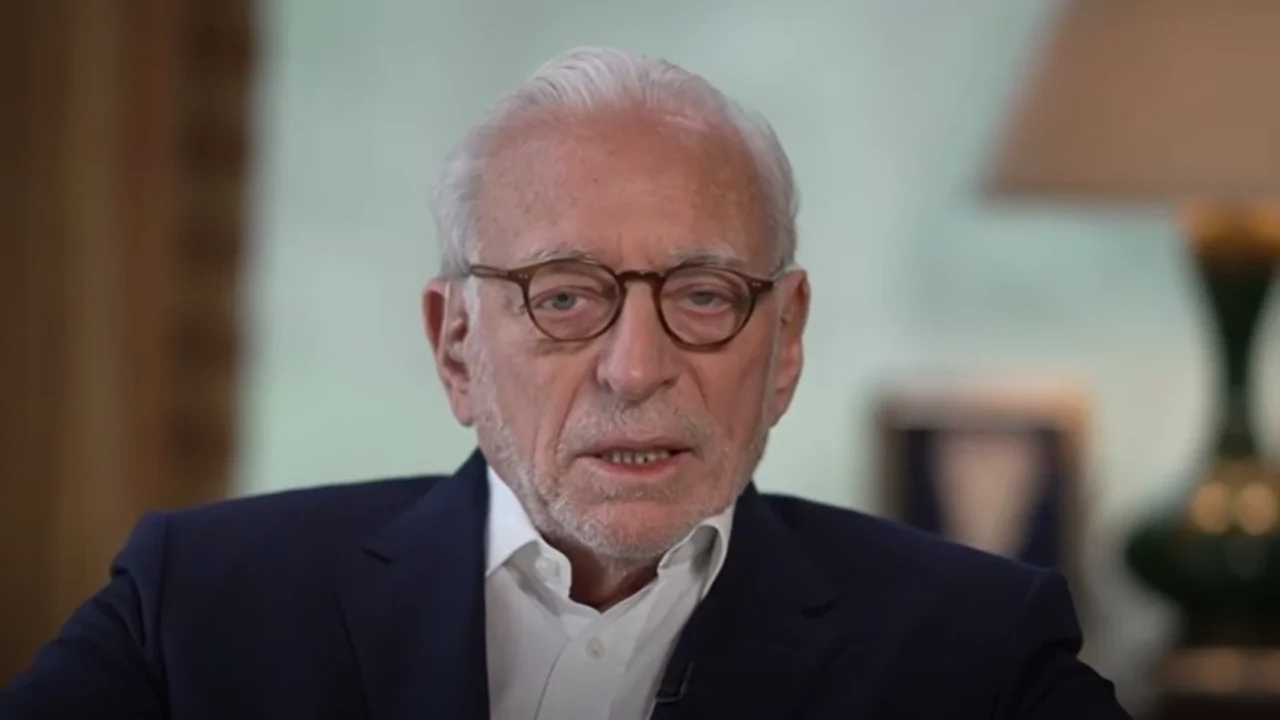
Nelson Peltz via CNBC
The second danger is capital-allocation pressure. Disney still says it expects about $19 billion in fiscal 2026 cash from operations and remains on track to repurchase $7 billion of stock. But the latest quarter was not especially forgiving beneath the headline guidance: cash provided by operations fell to $735 million, free cash flow was negative $2.278 billion, cash and cash equivalents were $5.678 billion, and total borrowings stood at $46.64 billion at quarter-end. A stock in the low $80s would not create an immediate liquidity crisis by itself, but it would make every use of cash more contentious — buybacks versus debt reduction, streaming investment versus discipline, park expansion versus balance-sheet caution.
The third danger is narrative risk, and for Disney that may be the most important one. Under Iger, investors could still frame Disney as a turnaround led by a proven fixer. Under D’Amaro, a slide into the $80s would look more like a verdict on the handoff itself. By the March 26 close, Disney was already about 24% below its 52-week high, and the stock had logged four straight down days. If that weakness extends into the $80s, the market is likely to conclude that D’Amaro has not yet convinced investors he can translate his parks success into a credible company-wide growth story spanning film, streaming, television, and sports.
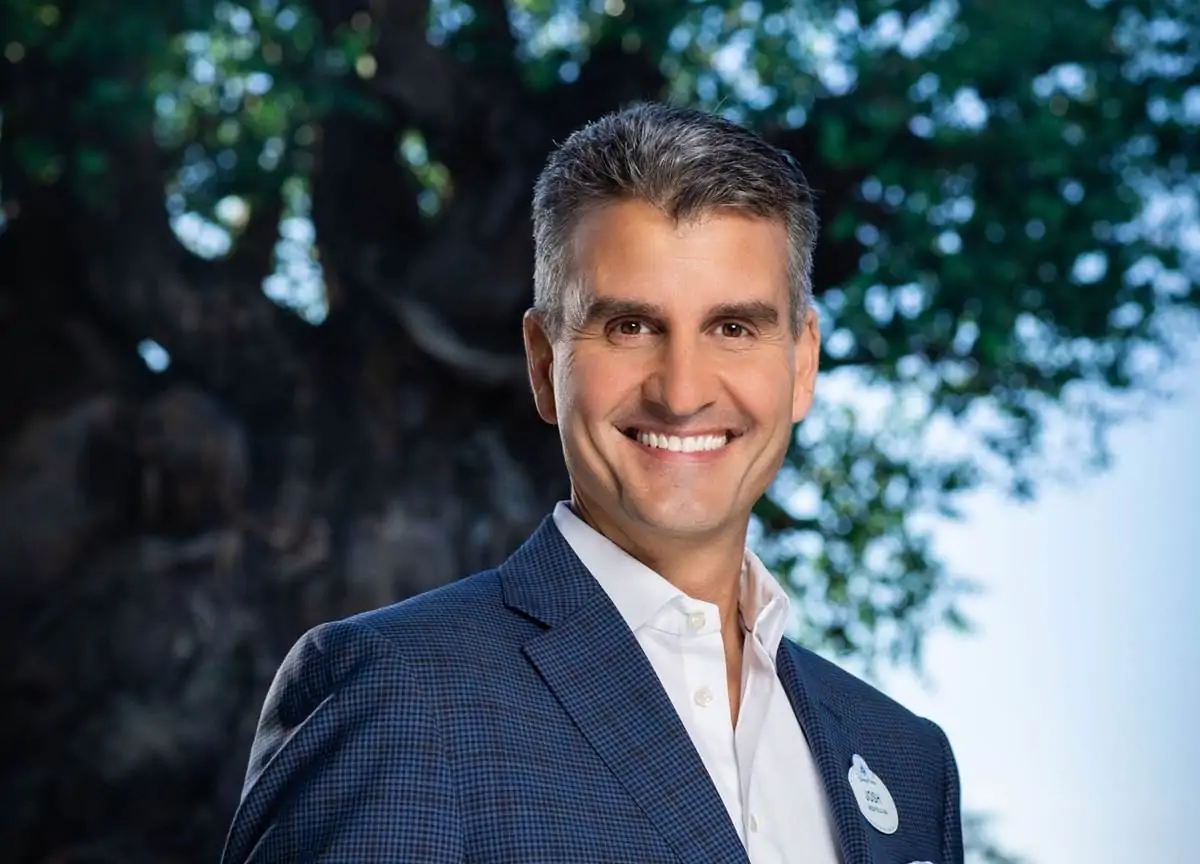
Josh D’Amaro by the Tree of Life – Disney
The real danger, then, is not that Disney suddenly becomes distressed at $80 a share. It is that the company loses strategic altitude. A stock in the $80s would tell the market that Disney is no longer being valued as a broad entertainment turnaround, but as a company with one standout division and too many unresolved questions elsewhere. For a new CEO in his first months, that would be a difficult place to lead from.
