



Fans have circulated a theory that Capcom’s science fiction game Pragmata may be an effort to improve Japan’s declining birth rate. The idea has spread through online discussion spaces and gaming communities. It interprets the game’s character dynamics and setting as symbolic rather than literal.
What is Pragmata?
Pragmata is a newly-released science fiction action game developed by Capcom. The company announced it in 2020 and has released trailers and development updates since then. The game takes place in a lunar research facility after a systems failure. An astronaut and a humanoid android child named Diana serve as the central characters.
READ: Rebel Wilson Branded a “Bully” as Defamation Trial Begins
Gameplay focuses on cooperation between the two characters. The astronaut handles exploration and combat. Diana assists with hacking and environmental control. Capcom has presented this dual-character system in promotional material.
The Game and Real-World Birth Rates
The theory really started gaining traction when fans began focusing on Diana herself. She’s not just an android—she looks and behaves like a little girl, which immediately changes how players view the dynamic. Instead of just a gameplay mechanic, the relationship starts to feel personal and paternal.
Some players have pointed out that the astronaut doesn’t come across as just a partner or teammate, but more like a protector. You’re guiding her, keeping her safe, and in many ways stepping into a quiet father-figure role. That shift—from cooperation to caretaking—is what’s fueling a lot of the conversation.
It’s that emotional undercurrent, more than anything else, that’s led people to connect the game to broader ideas about family, responsibility, and generational bonds.
According to a fan theory, Capcom’s Pragmata is secretly Japan’s clever plan to fight its birth rate crisis.
You play as a spacesuit-wearing “Space Dad” protecting cute little Diana.
Their wholesome father-daughter bond is so touching that many players say the game actually… pic.twitter.com/LlIyL8kAIm
— Pirat_Nation 🔴 (@Pirat_Nation) April 19, 2026
Japan’s demographic situation forms the broader context for these interpretations. The country’s birth rate has remained far below the level needed to maintain population stability for decades. The population has also declined for multiple consecutive years due to fewer births and an aging society.
The causes of this trend are widely documented. High living costs, long working hours, job insecurity, and childcare expenses contribute to delayed marriage and lower birth rates.

Diana and Hugh in Pragmata – Capcom
READ: Ryan Reynolds Claims Deadpool Will be a Supporting Character Going Forward
In response, the Japanese government has introduced multiple policies to encourage childbirth. These include expanded child allowances, subsidized childcare services, and reduced financial burdens for families with children.
Other initiatives have focused on improving work-life balance. These include parental leave expansions, childcare infrastructure investment, and efforts to make parenting more compatible with employment.
Fan Theory
At the heart of this theory is something much simpler—and honestly, much more powerful. A lot of players aren’t looking at Pragmata like some abstract social commentary. They’re reacting to how it feels to play.
Diana isn’t just a tool or a side character. She’s a little girl. And the moment that clicks, the entire experience shifts. You’re not just solving puzzles or surviving on the moon—you’re looking out for her. You’re making sure she’s safe. You’re the one standing between her and whatever’s out there.
That’s why so many fans have started calling it a kind of “fatherhood simulator.” Not in a literal sense, but in the way it quietly puts you into that role. Protective. Responsible. Invested. It’s not about mechanics at that point—it’s about the bond.
And that’s really where the theory takes off. Because once players start feeling that connection, it’s easy to see why some interpret the game as tapping into deeper ideas about family, responsibility, and what it means to care for the next generation.
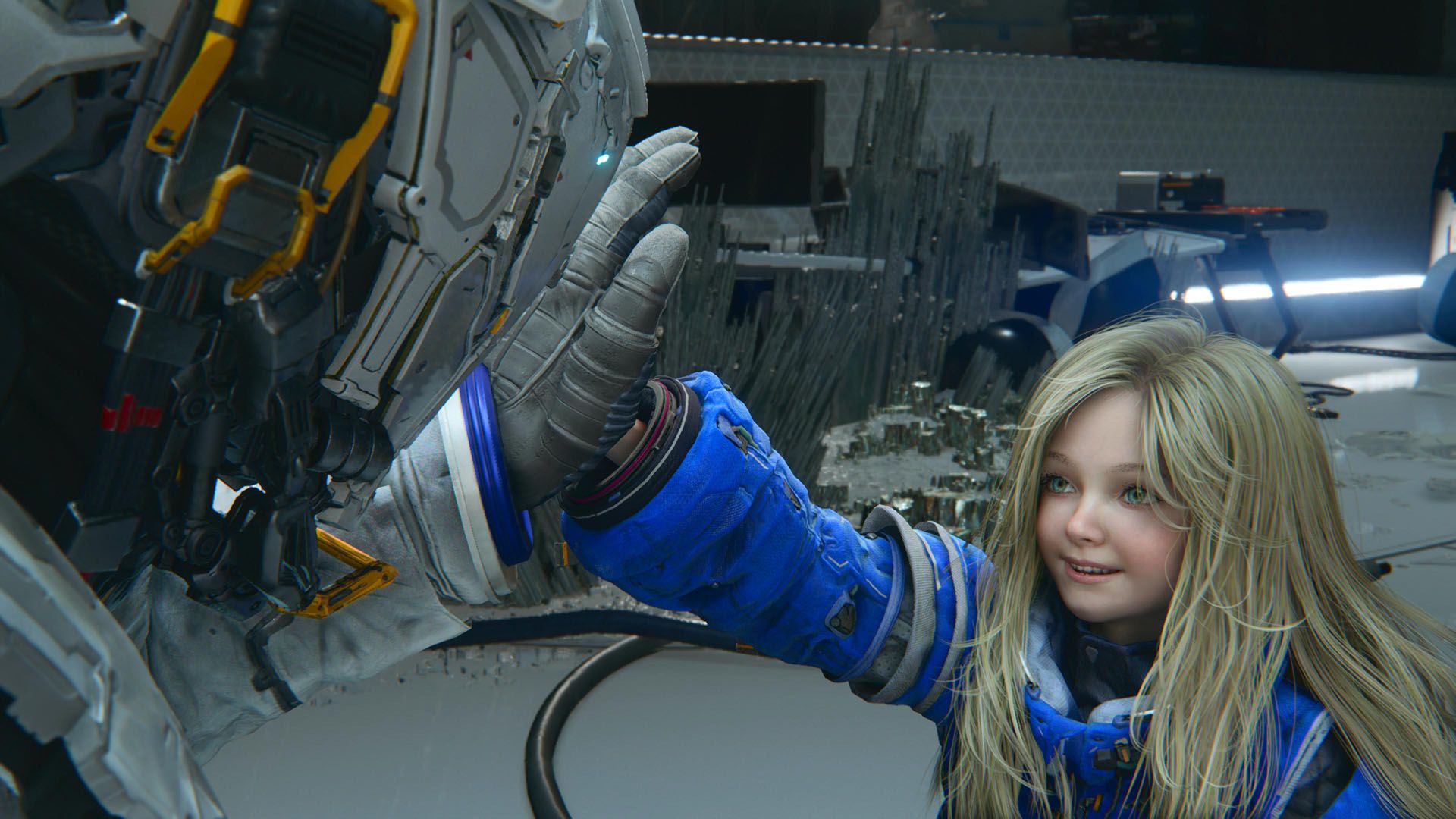
Hugh and Diana in Pragmata – Capcom
Capcom has described Pragmata as a science fiction adventure focused on survival, artificial intelligence, and cooperative gameplay. Public materials emphasize mechanics and setting rather than social themes.
Despite these discussions, readings of Pragmata vary widely. Some players view it as a straightforward science fiction survival story. Others focus on its themes of isolation, technology, and cooperation in a hostile environment.
What do you think of the theory that Pragmata aims to reverse Japan’s declining birth rates? Have you tried the game yet? What are your thoughts? Let us know in the comments below.
UP NEXT:
