



In the wake of Red Thread Games releasing Dustborn, it was revealed the developer received funding from the European Union as well as the Norwegian Film Institute. Now, it’s being reported that the U.S. government spent over a quarter of a million dollars on a “counter-disinformation game.”

A screenshot from Dustborn (2024), Red Thread Games
Former World of Warcraft Team Lead Mark Kern aka Grummz reported that Dustborn received 14 million kroner or $1.4 million from the Norwegian Film Institute as well as $150,000 euros from the Creative EU grant program.
Dustborn used far more government money than has been previously reported.
The Norwegian Film Institute funded the game for 14 million kroner, or nearly 1.4 Million USD. This is in addition to the 150,000 Euros from the Creative EU grant program.
Dustborn is basically an antifa… pic.twitter.com/bNQxPqtPlq
— Grummz (@Grummz) August 26, 2024
Following this report, Craig Skistimas aka Stuttering Craig, who owns and hosts the Side Scrollers Podcast shared that the United States government funded a “counter disinformation game” to the tune of $275,000 back in 2021.
He wrote on X, “Everyone is laughing at Norway & the EU for funding Dustborn but a quick search shows the US also provided $275,000 of funding for a “new counter-disinformation game.
Everyone is laughing at Norway & the EU for funding Dustborn but a quick search shows the US also provided $275,000 of funding for a “new counter-disinformation game” pic.twitter.com/av5G0zXCcB
— Stuttering Craig (Official) (@StutteringCraig) August 28, 2024
In fact, a document from the U.S. Embassy The Hague Public Affairs Section of the U.S. Department of State issued a notice of funding for the game.
This notice stated, “The U.S. Embassy The Hague Public Affairs Section announces an open competition for organizations to submit applications to 1) produce an English- and Dutch-language pilot version of a counter-disinformation game (requirements below), 2) produce a French version of the game, 3) produce one additional translation into a European, Asian, and/or African language, to be determined at a later date 4) host the game on the company’s own servers, and 5) develop and implement data collection and analysis methodologies to demonstrate the project’s achievement of expected results, and 6) promote games to target audiences. Please carefully follow all instructions below.”

A screenshot from Dustborn (2024), Red Thread Games
READ: Access Media Attempt To Convince Gamers To Buy ‘Dustborn,’ It Is Not Working
The document noted, “Digital games have proven to be an effective tool in building cognitive resistance to disinformation across diverse environments and cultural contexts. The U.S. Embassy in The Hague is accepting proposals for the development of a digital game that incorporates active inoculation theory1 along with other digital media literacy education methods in a fun, interactive experience targeting global internet users ages 15 and up. Primary gameplay should simulate the experience of engaging in common disinformation and propaganda activities, while educating the user on digital literacy applicable in the real world.”
“Successful proposals will incorporate active inoculation theory and address current disinformation and propaganda tactics. The delivered product should be modular, scalable, and expandable so that later iterations could address additional problem sets, such as violent extremism and health misinformation. The game will be piloted simultaneously with players in the United Kingdom and the Netherlands, and lessons learned from these pilots will inform the final version of the game intended ultimately for global audiences,” it stated.

A screenshot from Dustborn (2024), Red Thread Games
It appears the game was indeed funded as a number of Congressmen including Michael T. McCaul, the Chairman of the House Foreign Affairs Committee, Brian Mast, Christopher H. Smith, Darrell Issa, Maria Elvira Salazar, Keith Self, Cory Mills, and Ken Buck sent a letter to Secretary of State Anthony Blinken regarding the game and other issues related to the Global Engagement Center.
The Congressmen wrote, “The GEC continues to stray from its founding mission through its subsidized censorship of free speech and disfavored opinions — particularly by established conservative media and individuals — through grants, parnterships, and awards to entities including the Global Disinformation Index, the Institute for Strategic Dialogue, the Atlantic Council’s Digital Forensics Research Lab, and Moonshot CVE. The GEC also appears to take the official position that populism — whether at home or abroad is an affront to democracy and the First Amendment rights of all Americans.”
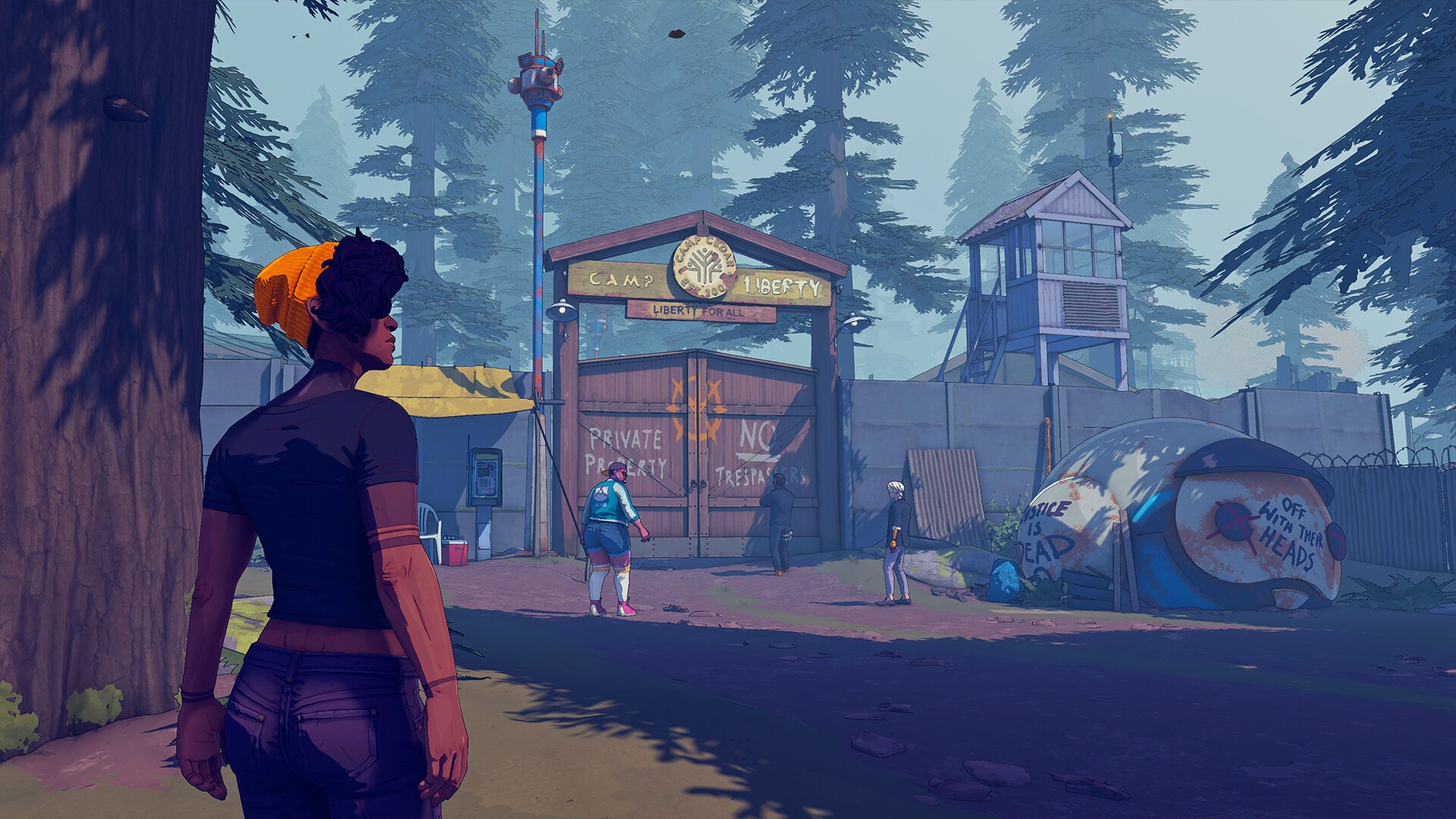
A screenshot from Dustborn (2024), Red Thread Games
READ: Alyssa Mercante Receives “Final Filing” from Smash JT and Attorney Ron Coleman in Unraveling Lawsuit
It then listed a number of examples including the video game, “In 2021, the GEC spent $275,000 producing a ‘counter-disinformation video game’ that programmed audiences to associate citizen critiques of government waste, fraud, and abuse with a social media disinformation campaign.”
It continued, “In 2020, the GEC produced a similar ‘counter-disinformation video game’ explicitly targeting ‘political misinformation,’ apparently modeled off the U.S. 2020 presidential election cycle.”
The letter then noted, “In the above “counter-disinformation video games,” the GEC selected and supported the University of Cambridge Social Decision-Making Lab, whose recent ‘disinformation research’ includes:
- Targeting U.S. conservatives
- Targeting “climate change deniers”
- Targeting “vaccine skeptics”
- Targeting “election deniers”

A screenshot from Dustborn (2024), Red Thread Games
According to a report from Real Clear Policy, the game in question was called Cat Park and a leaked memo from the State Department explained, “Cat Park builds on the success of the first game funded by GEC, Harmony Square. Cat Park inoculates players against real world disinformation by showing how sensational headlines, memes, and manipulated media can be used to advance conspiracy theories and incite real-world violence.”
It adds, “The game, available now in English, Dutch, French, and Russian (with more language versions to come based on post requests), helps players discern between reliable and unreliable information.”

A screenshot of Harmony Square from Games for Change YouTube
READ: Activision And Blizzard Attempt To Rebrand “Diversity, Equity, and Inclusion” To “Inclusive Growth”
A toolkit produced for the game and published in October 2022 stated, “In a study conducted by the University of Cambridge, people who play Harmony Square ‘find misinformation significantly less reliable
after playing, are significantly more confident in their assessment, and are significantly less likely to report sharing misinformation…'”
It’s unclear how the State Department defines misinformation. The toolkit does reveal that Dutch studio Tilt developed the game.

A screenshot of Cat Park (2022), Tilt
Tilt seemingly came into existence in 2021 at the same time the State Department funded Cat Park. On the company’s website it clearly states it opposes “hate speech.”
It reads, “At Tilt, we believe that the world should be a safe and inclusive place for everyone, regardless of race, religion, gender, or sexual orientation. That’s why we’re on a mission to make the internet a safer place by combating and detecting online hate speech.
It also shares its definition of hate speech, “We define hate speech as abuse that is targeted at a protected group or at its members for being a part of that group. Protected groups are groups based on age, disability, gender identity, race, national or ethnic origins, religion, sex or sexual orientation, which broadly reflects Western legal consensus, particularly the US 1964 Civil Rights Act, the UK’s 2010 Equality Act and the EU’s Charter of Fundamental Rights. Based on these definitions, we approach hate speech detection as the non-binary classification of content as either hateful or non-hateful. Our research is multi-lingual.”
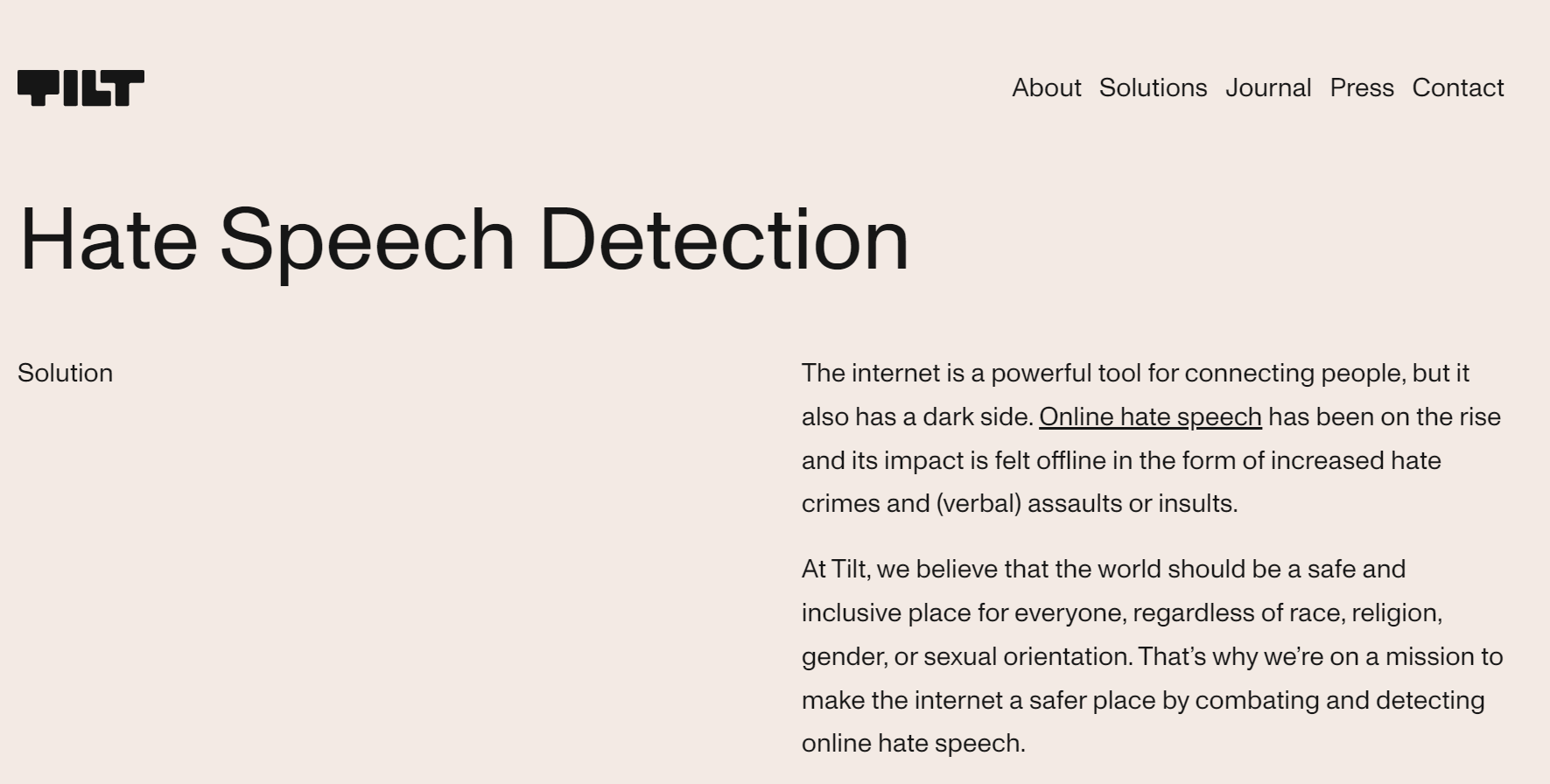
A screenshot from Tilt’s website
A contactor with the U.S. State Department’s Global Engagement Center named Davor Devcic did an entire breakdown of the game in a video published to YouTube on September 2022.
In the video Devcic shared, “Cat Park is based on research into the Theory of Active Inoculation, pioneered by University of Cambridge’s Social Media Decision Making Lab. Much as vaccinations are intended to work by exposing subjects to an innocuous strain of a virus in order to trigger an immune response, empirical studies indicate that the controlled experience of disinformation through a game can build cognitive resistance to disinformation in the real world. This concept is also known as Prebunking.”
He added, “We can leverage games like Cat Park to proactively educate ourselves about common disinformation techniques to we can be better prepared to spot fake news no matter what form it takes.”
The Foundation for Freedom Online heavily criticized the game and the initiative in general describing it as “behavioral modification propaganda games intended to make young people around the world view populist content online as being de facto ‘disinformation.'”
The organization added, “It is almost as if the government is using the video game of Cat Park to get young people to subliminally believe that opposing the government is only done by disinformation purveyors. How convenient for the government that this government-funded game has such a plot!”

A screenshot from Dustborn (2024), Red Thread Games
What do you make of the U.S. government funding a game whose main purpose is to propagandize teenagers?
