


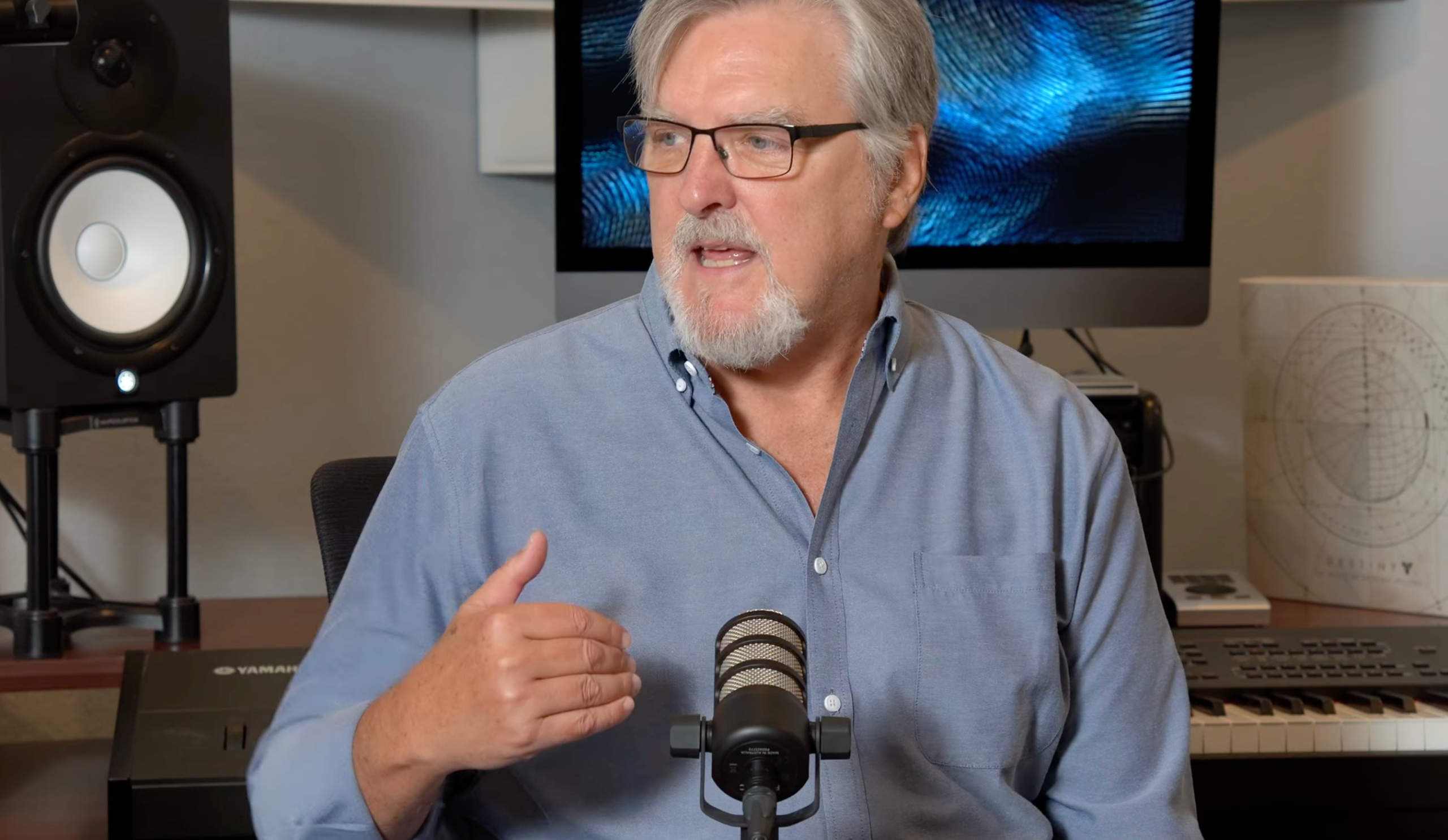
Marty O’Donnell has pledged to defend gamers’ ownership rights if voters send him to Congress, arguing that publishers may be engaging in conduct that is “next to fraudulent” when they sell products without providing consumers the control or ownership they reasonably expect.
O’Donnell, the former Bungie composer and audio director best known for creating the music of Halo and Destiny, addressed the subject during an episode of The Marty O’Donnell Show with co-host Jonas J. Campbell.
READ: Universal Studios Japan is Reportedly Getting an Expansion
Campbell asked whether O’Donnell would stand up for gamers’ rights in Congress and consider legislation giving players greater control over the products they purchase.
“Yes,” O’Donnell answered. “The solutions are not completely obvious and readily apparent, but there has to be some kind of solution. Because it’s essentially a bait-and-switch situation that isn’t fair to the consumer when you’re purchasing something and you think you have some sort of control or ownership over something, and it turns out you don’t. That, I think, is next to fraudulent and should be dealt with. I think this is an area where the government could come up with some guidelines and guardrails to prevent what appears to be fraudulent behavior on the part of publishers.”
O’Donnell Takes The Gamers’ Rights Debate To Congress
O’Donnell is the Republican nominee in Nevada’s 3rd Congressional District, where he will challenge Democratic Rep. Susie Lee in the November general election.
O’Donnell secured the Republican nomination in June. The district is expected to produce one of Nevada’s most closely watched congressional contests.
His statement to gamers represents something rarely heard from a major congressional candidate: an explicit acknowledgment that video game ownership can be a federal consumer-protection issue.

Marty O’Donnell speaking with attendees at the 2018 PAX West at the Sheraton Seattle Hotel in Seattle, Washington. Photo Credit: Gage Skidmore from Peoria, AZ, United States of America, CC BY-SA 2.0 <https://creativecommons.org/licenses/by-sa/2.0>, via Wikimedia Commons
For years, publishers and digital storefronts have used the familiar language of buying and purchasing while their terms of service provide consumers with something more limited—a license to access software under conditions established by the platform holder.
That distinction becomes important when a publisher removes content, closes a storefront, switches off authentication servers, or otherwise makes a purchased product unusable. Consumers may pay the full price normally associated with ownership without receiving the practical control that traditionally accompanied buying a physical product.
O’Donnell’s “bait-and-switch” description speaks directly to that discrepancy.
PlayStation Is Eliminating Discs For New Games
The issue has become considerably more urgent following Sony Interactive Entertainment’s decision to discontinue physical discs for future PlayStation releases.
Sony announced in July that physical-disc production for all new games released on PlayStation consoles will end in January 2028.
“Following this date, new games will be available on PlayStation Store and at retailers in digital formats only,” the company stated.
Sony said the change would not affect games released on disc before the January 2028 cutoff. Existing discs are not being deactivated, and games scheduled to receive physical releases before the deadline can still do so.
The PlayStation logo – YouTube @PlayStation
READ: Howard Stern Signs Big Deal With Warner Bros. After Decimating Staff With Layoffs
The policy will, however, eliminate the option of purchasing a playable disc for new PlayStation games after the transition. Retailers may continue selling boxed products or download codes, but those products will provide digital access rather than a conventional physical copy.
Sony characterized the decision as a response to consumer preferences, claiming that its community’s general preference for digital media “significantly outpaces physical discs.”
Going all-digital nevertheless removes several choices that physical buyers currently possess. A disc can ordinarily be resold, lent to another player, purchased secondhand, or retained without depending entirely upon the continued operation of a particular digital storefront.
A digital license generally can’t be resold or transferred and may remain tied to an account, a platform’s authentication system, and contractual terms that the platform holder controls.
Sony’s decision therefore provides an immediate example of the problem O’Donnell described. Consumers will still be told they are “buying” games, but they will have less control over those purchases than they enjoyed in the physical market.
Xbox Adds Digital Access To Physical Games
Microsoft, meanwhile, has taken a notably different approach to the relationship between physical and digital games.
Xbox announced a new disc-to-digital feature on August 26. The program allows owners of supported Xbox One and Xbox Series X games to claim a corresponding digital entitlement by inserting the disc into a compatible Xbox console and launching the game.
Once claimed, the digital entitlement can provide access to Xbox Play Anywhere and Xbox Cloud Gaming when those features are supported. Microsoft said the physical disc will continue working exactly as it did before the digital entitlement was added.
“We’re starting with thousands of titles, and we’ll continue to add more over time,” Xbox stated.

Asha Sharma at Microsoft Ignite 2024 – Microsoft Events, YouTube
The feature entered testing through the Xbox Insider program on August 31. Microsoft says most Xbox One and Xbox Series X disc-based games will support it, although not every title will initially be eligible.
Xbox described the initiative as part of a “broader commitment to game preservation” and said it wants players to have greater confidence that their purchases will remain with them for years.
The program doesn’t constitute a promise that Microsoft will manufacture physical games indefinitely, nor does a digital entitlement necessarily possess all the characteristics of an independently owned physical copy. Its continued operation may still depend upon Microsoft’s accounts, servers, participating publishers, and licensing systems.
It does, however, demonstrate that publishers don’t necessarily have to force consumers to choose between physical ownership and digital convenience. Xbox is allowing supported physical purchases to unlock additional digital benefits without deactivating or confiscating the original disc.
That approach stands in sharp contrast with PlayStation’s plan to eliminate discs for new releases altogether.
Gamers Are Paying Ownership Prices For Limited Licenses
The fundamental question raised by O’Donnell isn’t whether every game must be released on a disc. It’s whether publishers are being sufficiently honest about what consumers receive when they press a button labeled “buy.”
If a transaction provides only a conditional and potentially revocable license, lawmakers could require that limitation to be disclosed more prominently before payment. Congress could also examine minimum functionality requirements, mandatory end-of-support plans, offline access, account termination, software preservation, and the transferability of digital products.
Those possibilities would require careful consideration, particularly for online games that can’t function indefinitely without active servers.

A screenshot of Master Chief via Halo YouTube
O’Donnell’s underlying principle is straightforward: A company should not market a transaction like a conventional purchase while concealing the extent to which the buyer lacks control over the product.
PlayStation’s coming withdrawal from physical media ensures that this debate isn’t going away. Xbox’s disc-to-digital initiative demonstrates that companies can provide consumers with more options when they decide preservation and flexibility are priorities.
Whether Congress will eventually establish enforceable ownership protections remains uncertain. O’Donnell, however, is promising gamers that at least one prospective member intends to bring their concerns with him to Washington.
How do you feel about Marty O’Donnell potentially defending gamers’ rights in Congress? Sound off and let us know!
UP NEXT: Sherman Bros Tribute Removed From Disneyland Main Street
