


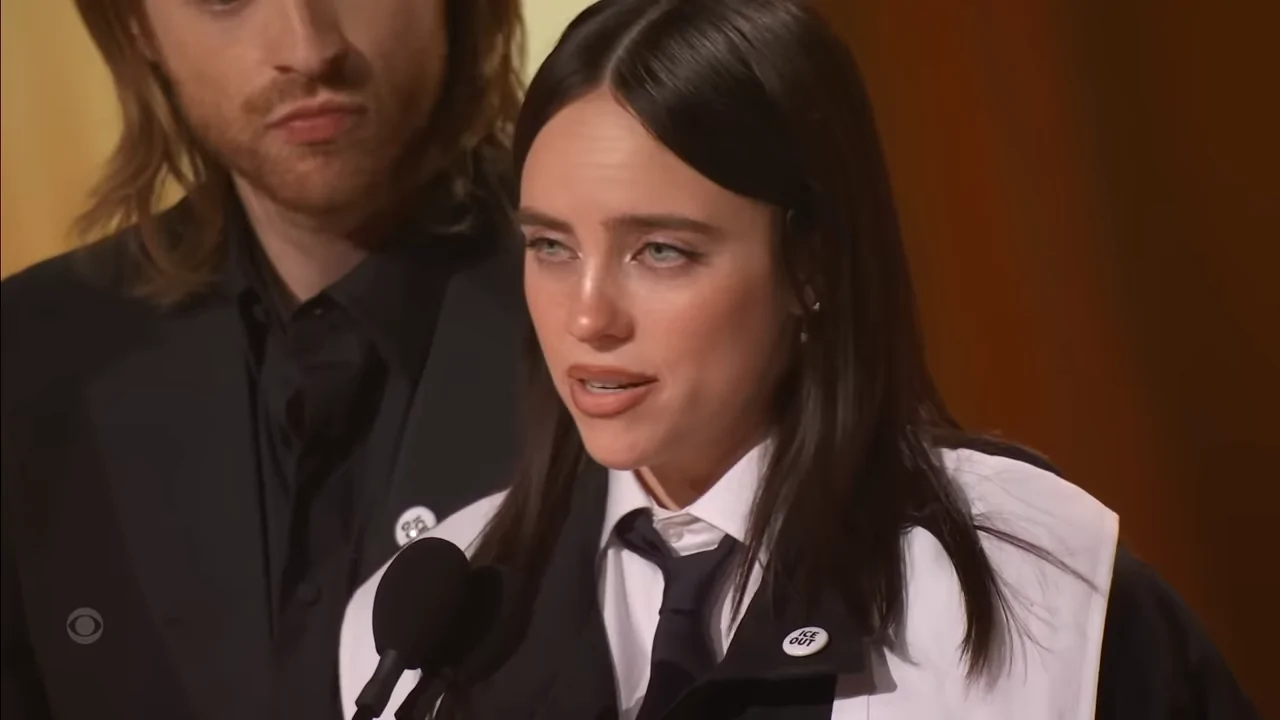
The fallout from the Billie Eilish “stolen land” Grammy speech is escalating — and now it’s moved beyond social media criticism into potential legal theatrics.
A Los Angeles law firm has publicly offered to represent the Tongva tribe (the Native tribe that once laid claim to the land upon which her multi-million dollar Hollywood mansion sits on) in an effort to evict the pop star, citing her own political rhetoric as the basis for the challenge.
And yes — they’re offering to do it for free.
Law Firm Steps In After “Stolen Land” Speech
According to reporting from 77 WABC Radio, Sinai Law Firm announced it is prepared to take action against Eilish on a pro bono basis following her remarks at the Grammy Awards.
In a public statement, the firm said: “Sinai Law Firm is offering to evict Billie Eilish from her Los Angeles home on a pro bono basis on behalf of the Tongva Tribe.”

Billie Eilish sits for a Vanity Fair Interview – Youtube, Vanity Fair
The firm framed the move as a response to Eilish’s political messaging — specifically her now-viral declaration during her acceptance speech: “No one is illegal on stolen land.”
While critics initially treated the remark as standard celebrity activism, the new legal angle reframes the conversation entirely — asking whether public moral declarations should carry real-world consequences.
Property Rights vs. Political Rhetoric
The Tongva tribe has already confirmed that Eilish’s Los Angeles property sits on their ancestral land — a point that drew widespread attention in the immediate aftermath of her speech.
Now, the Sinai Law Firm appears to be leaning directly into that contradiction, positioning its offer as a test case of ideological consistency.

Billie Eilish sits for a Vanity Fair Interview – Youtube, Vanity Fair
The firm described itself as a leading eviction practice in the county and stated it would represent the tribe at no cost.
Importantly, no formal legal filing has been confirmed. As of now, the announcement functions more as a public challenge than an active lawsuit.
Still, the optics are unmistakable.
When Activism Hits Home — Literally
This is where the backlash against Eilish has sharpened.
Celebrity political commentary often operates in the abstract — sweeping moral statements delivered from award show stages, social media feeds, or magazine interviews.
Billie Eilish says “f*ck ice” during her #Grammys acceptance speech: “Nobody is illegal on stolen land. We need to keep fighting and speaking up. Our voices do matter.” pic.twitter.com/Sz1um3afYJ
— Variety (@Variety) February 2, 2026
READ: Former Disney CEO Michael Eisner Congratulates Josh D’Amaro Amid Leadership Change at Disney
But critics argue Eilish’s rhetoric becomes harder to defend when applied to her own lifestyle.
If America is “stolen land,” and if property ownership on that land is therefore morally compromised, then what responsibility does that place on individuals who benefit from that ownership?
That question has fueled the hypocrisy narrative surrounding the singer.
The Hypocrisy Argument Gains Steam
Eilish’s critics aren’t just questioning her words — they’re questioning the absence of action behind them.
The Tongva tribe previously stated that Eilish has not contacted them regarding her “stolen land” property, despite publicly invoking the concept of Indigenous land displacement.

Billie Eilish sits for a Vanity Fair Interview – Youtube, Vanity Fair
That gap between rhetoric and engagement is now being amplified by the law firm’s offer.
It reframes the issue from symbolic activism to tangible accountability:
- If the land is stolen…
- If Indigenous claims are morally valid…
- If public figures should acknowledge that reality…
…then what does restitution actually look like for those who have taken up the social cause as Eilish has?
The eviction proposal — however unlikely legally — forces that conversation into the spotlight.
Legal Reality vs. Political Theater
To be clear, legal experts would likely consider an eviction attempt on ancestral-land grounds extraordinarily difficult, if not impossible, under current U.S. property law.
Modern homeownership operates under established legal title systems, not retroactive tribal land reclamation at the individual property level.
Which is precisely why many observers view the law firm’s announcement less as a serious legal maneuver and more as political commentary wrapped in legal branding.
In other words: activism meeting counter-activism.
No Response From Eilish
As of publication, Billie Eilish has not publicly responded to the law firm’s offer or the broader backlash surrounding her comments.
Whether she addresses the controversy — or lets it fade like most award-show political moments — remains to be seen.
Billie Eilish’s $14,000,000 built on stolen American land in Los Angeles.
Billie Eilish should be illegal. pic.twitter.com/8vhDShuGmF
— Concerned Citizen (@BGatesIsaPyscho) February 2, 2026
But one thing is clear: Her “stolen land” line may have drawn applause inside the Grammys venue…
Yet outside that bubble, it’s now fueling legal headlines, public scrutiny, and a growing debate about whether celebrity activism comes with any obligation to live by the principles it promotes.
How do you feel about Billie Eilish and her “stolen land” hypocrisy? Sound off in the comments and let us know!
UP NEXT: David Ellison Warns of “Monopolistic” Netflix in Open U.K. Letter as Paramount Pushes WBD Bid
