



The expanded universe of Star Wars was largely relegated to the archives of fiction when Disney bought Lucasfilm. But those archives hold some of the best storytelling you’ve never seen.
In 1996, Lucas Licensing embarked on a multimedia project the likes of which had never been seen before. With Shadows of the Empire, merchandising would produce all of the materials that would normally accompany a movie release – except for the movie. The effort boasted toys, books, comic books, model kits, posters, trading cards, statues – and one very special item – a soundtrack, by Joel Neely.
The story produced was a first of its kind in other ways – for the first time, a novel would take place before the climax of the original trilogy, between The Empire Strikes Back and Return of the Jedi. Darth Vader and the Emperor would be available to an expanded universe author for the first time, The Black Sun criminal syndicate would be introduced, and Luke would build his replacement lightsaber prior to his quest to retrieve the frozen Han Solo from Boba Fett before his delivery to Jabba the Hutt on Tatooine.
But what does this have to do with The Epic of Gilgamesh and Mandalorians?
The soundtrack was an amazing work. Joel McNeely referenced John Williams themes, but the tracks on the album had his own distinct style.
Joel wanted a verbal component to some of his tracks (most notably Imperial City), and requested that Ben Burtt write some verses in a guttural germanic style that could be sung by the choir for portions of the album. The result was Dha Werda Verda – The Rage of the Shadow Warriors. Liner notes for the album contained the text of the fragment of poem, as well as notes on their in-universe history:
Dha Werda Verda
Booten wooten lanlock vootem. Al a sinkee dunken pooten.
Achta werda verda roll. Poonka dunkee loten cho.Leeber soong whar tung tach picta. Manner manner migta
richta. Schelencht varn toom-soing pa ho-grunten. Gersh ve
dala funken mimpa. Droitt! Ta Gropen wettkampf Zunken!Bettelung seeck da mindy cooten. Parta blax dha scunken drassen.
Manner manner, mitteltouse manner. Dha Dhazz jedoch. Land zu land offt letza. Unun Nung.
Manner manner. Durchsprung Nocha. Immer hauk gewordenspa.
Zeeetoof en poof. Olaffka begonnenspah. Var var goopinski.von moglodite. Kortzva.
Verto verto taplasko ta verto.
vom zoomenfest. Va va voomenfest. Kopocka locka hatta statan. Schel Tha noobin rest du common.
Morbskurtz!Kaffee kaffee zum doom kaffee. Ausbroll mobist manner mockha! Ssstrung tartung tha stroong tartung! Wo-cha nickschat hobbentrose.
Jungclaus dha spricken. Impoort ga kunginshock!
Kungach. Noplenkacht. Kungar Kungar. Ale Da Kungare!
Liner Notes:
Much has been written on this famous text. We are indebted to the discoveries of space merchant and explorer Mungo Baobab (see The Adventures of Mungo Baobab, Lucasfilm 1986) who found and preserved the Roonstones. Encoded into the crystal structure of the Roonstones was the earliest known text of Dha Werda Verda. It is considered original, and was translated in the Baobab Archives.
The text was written five millenia before Coruscant’s warlike primitive ancestors, a warrior race called the Taungs, invaded and conquered the indigenous peoples.
Dha Werda Verda recounts in epic poem fashion the legendary story of a battle between the Taungs and the vanquished people, the Battalions of Zhell. The tide of the final battle was turned when a sudden volcanic eruption rained destructive ash onto the Zhell, smothering their city. The plume of ash rose kilometers into the sky, and cast a giant shadow over the land of the Taungs for two standard years. Thousands of years of continual construction have turned the original site of the epic battle into Imperial City. Henceforth, the Taungs became down as “Dha Werda Verda”, i.e. The Warriors of the Shadow or in some translations, Dark Warriors.
The Taungs themselves saw the shadow as a symbol of their destiny and adopted the Dark Shadow Warrior identity throughout their conquests.
The text would not be spoken verbatim in the soundtrack, but snippets of it were chanted, giving a sense of the just how ancient Coruscant truly is.
Dha Werda Verda, Translated
And so upon his pyre burned the Doom of Ulmarah, and the warrior bands stood as ragged as bandits, in zigzag lines of mourning. With the dawn the flat-faced Zhell would come, cackling and howling, oozing mirth and tricks, and find the shade of the Doom departed and the Taungs unprotected.
And so with the dawn would our woe be revealed. Our once-bright armaments would become stacked grave goods, trophies for Zhell children. Our flesh would become smoke given to uncaring gods, and the sky would forget our names.
With death upon him Rexutu the Unconquerable prepared to be stripped of all by his enemy, but vowed that his honor would be the last to be torn away. And so the Unconquerable gathered his kinsmen and his oath girdlings alike. They polished their fearsome helms, that they might flash even in the weak sun of Notron. They rewrapped the hilts of their weapons and pounded straight the shafts, that they might slake their thirst in Zhell ichor a final time.
Assembled they ascended, in taut Taung lines, to the high place where the Reaver had staked his standard before it was cast down into the mire. They gazed out over the gathering places and walking ways of Great Zhell where they scaled peak and cradled valley, the line of lights ordering the night. They unfurled the Taung banner, reversed, a reckless thing snapping in the dark, awaiting Zhell eyes. And they performed ceremonies of leave-taking, for now they had died to the world and must be remade among the stars.
When the dawn came the Zhell awakened and saw the Taungs upon the high place and were afraid, for the morning light caught the glint of helms and weapons and created phantom warriors, made of dazzle and distance. But the cleverest of them were not deceived, and saw how few we were. And so they assembled without haste, merry in mockery, and prepared to march. And in the high place we awaited death.
But then came a shaking of the ground, and the sun’s wan light was eclipsed by a bright and terrible fire that exploded from the rock. The patterns of Great Zhell shivered and broke. And after this came darkness, as the very air turned to black ash. The Zhell fell on their faces in terror, and from the high place we ran in haste to meet them, and we were cloaked in shadow.
The Maker had come to unmake, and the Taungs would be His instruments.
The Taung were, of course, the original Predator-like race of original Mandalorians. The conquest of the Battalions of Zhell marked the rise of Mand’alor the First. These progenitor Mandalorians were eventually forced off of Coruscant and migrated to Roon, where this fragment of a portion of the epic was preserved (likely during the reign of Mandalore the Ultimate.)
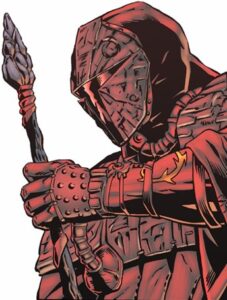
Over the millenia, the Taung slowly began to die out, even as the Mandalorians welcomed other races into their ranks. Recognizing that their time was nearing an end, a new adaptation of the original poem was created in Mando’a:
Rage of the Shadow Warriors
Taung sa rang broka Mando’ade ka’rta.
Dha Werda Verda a’den tratu,
Manda’yaim kandosii adu.
Duum motir ca’tra nau tracinya.
Gra’tua cuun hett su dralshy’a.Kom’rk tsad droten troch nyn ures adenn.
Dha Werda Verda a’den tratu,
Manda’yaim kandosii adu.
Duum motir ca’tra nau tracinya.
Gra’tua cuun hett su dralshy’a.
Rage of the Shadow Warriors – Translated
The ash of the Taung beats strong within the Mandalorians’ hearts.
We are the rage of The Warriors of the Shadow,
The first noble sons of Mandalore.
Let all those who stand before us light the night sky in flame.
Our vengeance burns brighter still.The gauntlet of Mandalore strikes without mercy.
We are the rage of The Warriors of the Shadow,
The first noble sons of Mandalore.
Let all those who stand before us light the night sky in flame.
Our vengeance burns brighter still.
4000 years down the line, members of the Cuyval’Dar – “Those who no longer exist” – 100 Mandalorians recruited by Jango Fett to train Clone Soldiers adapted the ancient Rage of the Shadow Warriors into a call to arms for the Republic. The new iteration replaced some of the original imagery to both recognize their heritage going all the way back to the Taung, and to repoint their loyalty to their Jedi generals in battle.
Vode An
Taung sa rang broka jetiise ka’rta.
Dha Werda Verda a’den tratu,
Coruscanta kandosii adu.
Duum motir ca’tra nau tracinya.
Gra’tua cuun hett su dralshy’a.Kom’rk tsad droten troch nyn ures adenn.
Dha Werda Verda a’den tratu,
Coruscanta kandosii adu.
Duum motir ca’tra nau tracinya.
Gra’tua cuun hett su dralshy’a.Vode An – Translated
The ash of the Taung beats strong within the Jedi’s heart.
We are the rage of The Warriors of the Shadow,
The first noble sons of Coruscant.
Let all those who stand before us light the night sky in flame.
Our vengeance burns brighter still.The gauntlet of Coruscant strikes without mercy.
We are the rage of The Warriors of the Shadow,
The first noble sons of Coruscant.
Let all those who stand before us light the night sky in flame.
Our vengeance burns brighter still.
Etain liked Gett. He didn’t treat her as an omniscient military genius, but as just another being stuck in a hard place without a lot of choices. She could hear a faint sound coming from his helmets audio feed. When she concentrated, she could hear singing, and so held out her hand for the helmet. She’d tried on Atins’ once, and and been stunned by the welter of data it flung at the wearer. Helmet held close to her head, she could make out strong male voices, a chorus of them singing an anthem she had heard snatches of, but rarely had the chance to listen to: Vode An. They were singing in the privacy of their own helmet comlinks, retreating into their world, like Omega Squad did from time to time. She could hear nothing outside the helmet of course, and she felt oddly excluded, but they were not her “Brothers All”, however much she wished to be a part of something greater than herself – even more than the Jedi Order.
They were gearing up for battle.
Bal kote, darasuum kote,
Jorso’ran kando a tome…It sounded less martial and more of a lament to her ears right then. She’d have to ask General Jusik for a translation. He was very much the Mando’a speaker these days. She handed Gett his helmet back and gave him a nod of thanks.
“It’s not just the Force we need with us today Commander,” she said. “It’s reliable kit and accurate intel.”
“Always is General,” he said. “Always is.”
He slipped his helmet back on and sealed the collar. She knew without asking that he had started singing – completely silent to her, but once voice to his brothers. – Triple Zero, Book 2 of the Republic Commando Series, by Karen Traviss
Both Rage of the Shadow Warriors and Vode An were tracks created by Jesse Harlin for the Republic Commando game in 2005, prior to the release of Revenge of the Sith. Leaning into the Mandalorian origin of the clones, he hearkened back to the poetic tradition created for the Imperial City track of Shadows of the Empire – 9 years later, disparate sources of Mandalorian history united to create a touchstone of a fictional culture – an Epic that the Mandalorians drew strength and inspiration from, and helped to form a bond of brotherhood between each member of the Clan.
For all the latest news and info that should be fun, keep reading That Park Place. As always, drop a comment down below.
