


In his first interview since conceding to David Ellison’s Paramount Skydance, Netflix co-CEO Ted Sarandos opened up about his company’s pursuit of Warner Bros. Discovery—and why it chose to step aside. The conversation offered insight into executive decision-making, Netflix’s posture toward Washington, and the company’s strategy moving forward.
Industry Impact
The months-long battle for Warner Bros. Discovery ended Thursday night when Netflix said it would not raise its bid for the legacy studio. In a joint statement, Netflix co-CEOs Ted Sarandos and Greg Peters said “We’ve always been disciplined, and at the price required to match Paramount Skydance’s latest offer, the deal is no longer financially attractive, so we are declining to match the Paramount Skydance bid.”
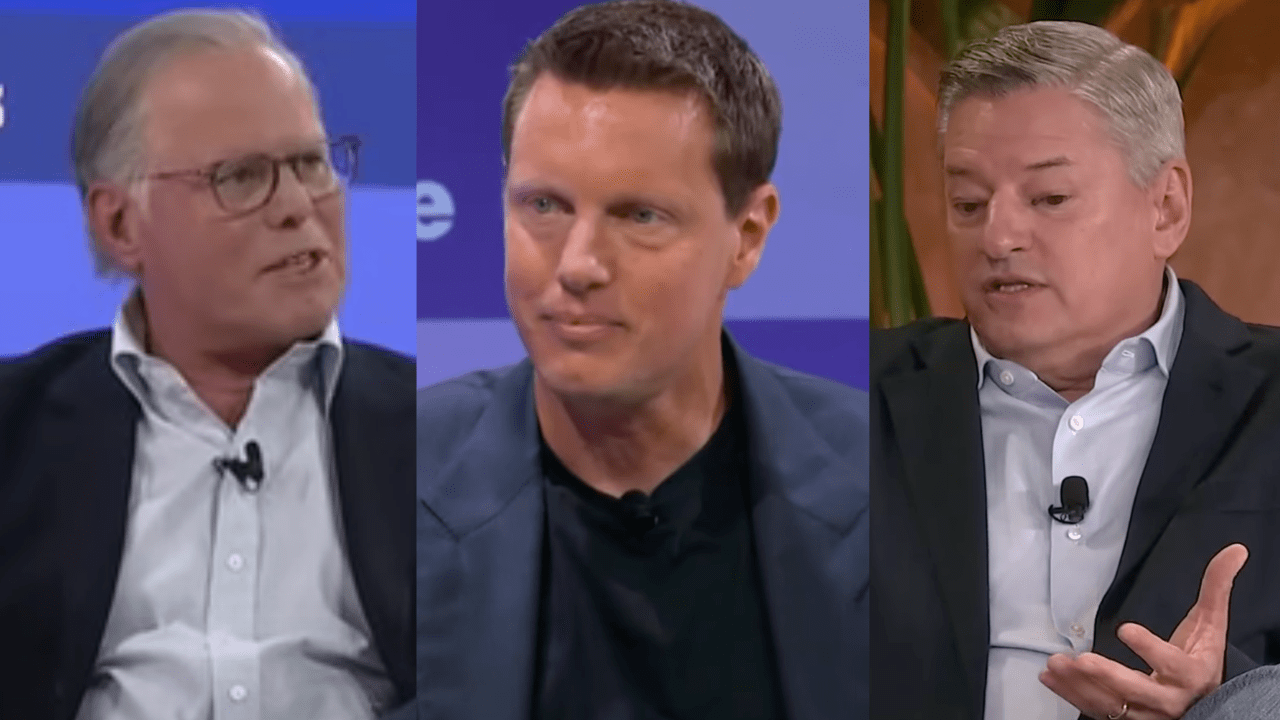
Warner Bros. Discovery CEO David Zaslav, Paramount Skydance CEO David Ellison, and Netflix CEO Ted Sarandos – Photo Source: YouTube, New York Times Events; YouTube, Bloomberg Podcasts; YouTube, WSJ News
READ: Rumor: Tom Cruise May Have Helped Stop Netflix from Buying Warner Bros.
Variety reports that Sarandos sat down with Lucas Shaw at Bloomberg for the interview. The CEO described his competitor for Warner Bros. as “unusual, yeah, unusual, irrational, whatever words you want to use in that.” He added, “It’ll be fascinating to see the next steps. I have been on the record a lot in the last two weeks talking about what I think the future looks like. I’m confident in our future that we’re not impacted by all that.”
By “all that,” Sarandos appeared to be referring to potential job cuts at Warner Bros. as part of post-merger consolidation. He predicted that there will be “less production, less people working.” However, he noted that the changes coming to Hollywood may be to his company’s advantage, adding that for the sake of the industry he hoped he was wrong.
Ideological Concerns
Bloomberg also asked Sarandos if political pressure from the Trump White House was a factor in exiting the bidding war. “It’s a lot cheaper to make noise than it is to actually raise your bid,” he said. “So they tried that path first. Once it was clear that we weren’t in the CNN business, it was a lot less interesting. He didn’t care that much more about our deal.”
Notably, Netflix was only pursuing the studio assets of Warner Bros., and not the networks like CNN, which were scheduled to be spun off into a new company. That said, some conservative advocacy groups and Republican lawmakers were concerned about what they saw as the progressive ideological bent of Netflix. They argued that Netflix taking ownership of Warner Bros. would greatly expand its cultural influence.
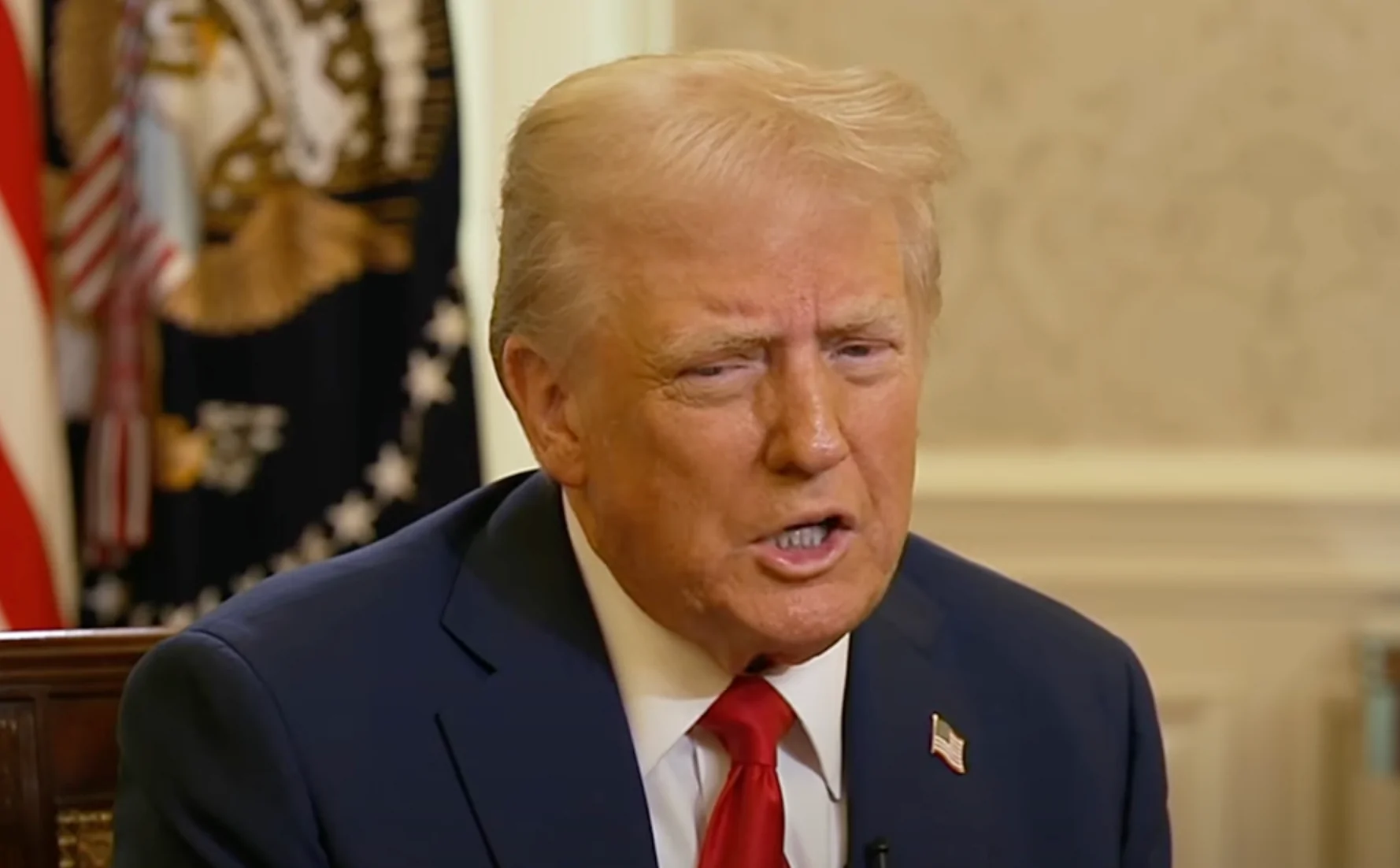
Donald Trump sits down at an interview with Sean Hannity – YouTube, Fox News
READ: Tampons in the Netflix Men’s Room Reportedly Helped Derail Failed Warner Bros. Deal
Additionally, President Trump called on Netflix to fire board member Susan Rice after she said once Democrats were back in power it would not “end well for” any law firms, universities, or media corporations that decided it was in their own self-interest to “take a knee to Trump.”
According to Fox Business, Sarandos told Bloomberg that while he addressed the issue with Rice, he never considered removing her from the board. Some analysts suggested regulatory approval could have faced additional scrutiny under the current administration—an obstacle Netflix ultimately chose not to test.
The Future
Ultimately, Sarandos maintained that the decision to walk away was purely financial. “We had a very tight range that we’d be willing to pay and made that offer back when we closed this deal,” he said. “I’m happy where we got in and happy where we got out.” He added that once his company saw Paramount’s Thursday night offer and the details of the deal, they accepted it as superior. “We knew exactly what we were going to do.”

Newflix Co-CEO Ted Sarandos – CBS News
READ: Paramount-Warner Bros. Deal Will Unite ‘Friday The 13th’ Franchise Rights
Sarandos emphasized financial discipline and strategic restraint, portraying Netflix as focused on business fundamentals rather than political dynamics and contrasting its approach with what he described as “unusual” bidding behavior from its competitor.
At the same time, if Ellison successfully integrates Warner Bros.’ film franchises and production infrastructure, Netflix could face intensified competition not just in streaming volume, but in audience loyalty.
Why do you think Netflix exited the bidding war? Let us know in the comments!
