



There is a joke in Spider-Man No Way Home that was clearly put in as an olive branch to a demographic that has been utterly hated by movie producers for about a decade now. Rather than reviling sixty-five percent of the American population that call themselves Christians, Spider-Man features a casual joke about youth pastors. When I heard it in the theater, I heard a hearty laugh from the audience, but I knew what it was really about. A joke like that doesn’t make it into the script unless you’re trying to do something more than get a cheap laugh; the joke itself requires a wardrobe adjustment. This was clearly an attempt by Sony to say “everyone is welcome” to enjoy Spider-Man, even Christians.
It reminded me of what Disney was game for just a few years ago. Eight years ago in Ironman 3, Tony Stark doesn’t crash land in some international land that Disney wants to woo. No, Tony Stark lands in Chattanooga, Tennessee. And there is no pandering when he lands there; he is helped by a young boy who is portrayed very well. It’s the same sort of thing as when you watch Ghostbusters Afterlife and it takes place in the American Heartland, specifically Oklahoma (although shot in Alberta, Canada). There’s no reason for derision and divisiveness towards most of America, but that has been the flavor of the decade for much of Hollywood.

For Spider-Man, the box office results are in and they’re phenomenal. The word of mouth is going to keep this movie churning at record-breaking paces. And it’s being won all across the United States, not just in coastal elite areas.
An interesting thing is happening this Christmas, though. In one corner, we have Spider-Man and its effort to be exactly what fans want, totally free of social agenda, and not a bit of modern-day political messaging. It’s just pure fun and archetypes. It definitely has something to say (specifically that healing villains is preferable to killing villains), but that moral isn’t a contentious commentary on current politics. However, in the other corner, we have a newcomer: The Matrix Resurrections. This one is full-on, one-hundred percent about modern-day commentary and totally all-in on hating at least half of America. Look no further than the writers’ statements about the film:
From Bounding Into Comics vis a vi The A.V. Club:
[Matt] Schimkowitz then noted that “The scenes with the Analyst [Neil Patrick Harris] were especially pointed, as “he’s using some of the terminology of right-wing radicalization like the conservative retort ‘facts don’t care about your feeling,” leading him to ask [Aleksandar] Hemon and [David] Mitchell, “Was it empowering to write a rebuttal to the weaponization of Lana and Lilly’s work?”
…
He then clarified, “But we did not set out to get into arguments with right-wingers.”
“I think, at some point, there was a joke about Red Pill and Blue Pill, and Lana decided that she did not want to give any credence to that position, even a semblance of dialogue with that,” he recalled. “There’s nothing to talk about with that.”
“It’s like having debates with creationists,” Schimkowitz replied. “By inviting them to the podium, it’s a tacit endorsement that the idea is up for debate.”
And:
“My personal position is I don’t discuss things with Nazis and fascists.”
“There’s nothing to talk about,” he maintained. “One of us is just going to be left standing, and I want it to be me and my people.”
Well, that’s one way to sell your movie. I’m not sure that calling conservatives “nazis” and “fascists” is a great idea. Not only does it make at least a third of the country (world?) want to avoid seeing what you’ve produced, but it’s likely going to drive away moderates as well. Do you really want to create a film that is targeted to one-third of the world’s population (or less)? Additionally, when you talk about “one of us is going to be left standing,” that’s the sort of totalitarian statement that really heads into “evil” territory. When you start boiling people down to a category and then insisting that your category should prevail, you’ve entered into something more dangerous than The Matrix imagines.
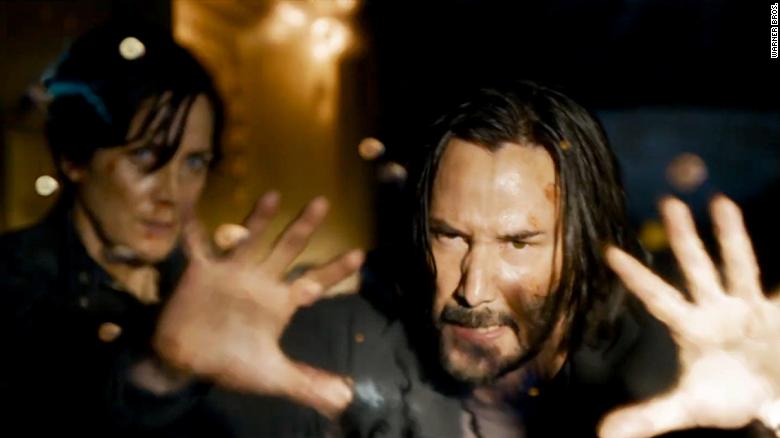
But we’re going to see how these two strategies play out. Spider-Man is a very popular franchise. The Matrix is a franchise that changed the world and should have ever bit the financial driving power. Which movie — er, which strategy — is going to prevail at the box office? I have a feeling only one movie is going to be left standing, and it isn’t the one launching today.
Investors and film executives, take note.
