



In a long-gone world where fans yearned for Star Wars but content was scarce, one video game blazed a path forward for building lore in a galaxy far, far away.
There is so much accumulated lore and legends surrounding Star Wars, that it’s sometimes difficult to remember what things were like after the original movies came out. This is the second in a series of articles that seeks to explore the impact of the Dark Forces series on Star Wars canon as a whole.
The Dark Times
At the conclusion of the original Star Wars trilogy, George Lucas was exhausted. A journey of nearly 10 years was completed, but not entirely to the satisfaction of the creator of the saga. What had begun as an overly ambitious project had been shepherded by Lucas through grueling deadlines. Entirely new technologies had been created to accomplish his vision. State-of-the-art though they were, they did not live up to the images in his head. Depending on which George Lucas you believe (and at what time), it was either the conclusion of the entire story, the middle part of a 9-part saga, or perhaps only the midpoint of a 12-part series with some mainline entries and other interludes.
Whatever the case, Return of the Jedi went through several more complicated drafts before Lucas decided that enough was enough. The story was simplified to conclude on this final episode, and Star Wars would go dormant.
The movie series had changed Hollywood forever – but at the cost of Lucas’ health and marriage.
Licensees weren’t ready
The Star Wars brand was highly coveted by licensees. Kenner especially had a lot riding on the vintage toy line, and even came up with a pitch for stories to take place after the movies that they could build new toys around. The story would involve the return of Atha Prime, (geneticist and ruler of the Dark Worlds) from imprisonment after the death of the Emperor. This character would be revealed to be one of the architects of the Clone Wars, and ally to Grand Moff Tarkin (who would be revealed to have survived the Death Stars explosion). The Rebel Alliance would have to face off against Tarkin and Prime as a new round of Clone Wars engulfed the galaxy.

This was a fun little pitch, and a lot of really unique toys were mocked up, but the it was ultimately rejected. The Kenner Power of the Force Line had run from 1977 until 1985. With the shuttering of the toy line and nothing new coming from the Ewoks or Droids animated series, Star Wars was effectively a dead property.
The one exception was the West End Games Roleplaying Game Guides and supplements, licensed in 1987. These products kept the brand alive for a niche group of gamers – and ultimately became much more important because of it.
A New Hope, and an Heir to an Empire
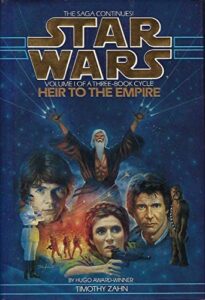
Lucy Autrey Wilson was not ready to give up on Star Wars. She had been a personal assistant to George since the early days of Lucasfilm, and though the creator thought that Star Wars was behind him, Lucy kept pressing Howard Roffman (director of licensing) to let her start a publishing initiative. With her tenacity, Lucy wore Howard down, and he finally went to George to ask permission. George didn’t expect there to be an audience left with interest for the property, but he gave them permission to find a suitable author to do a book trilogy.
The result was the Thrawn Trilogy – and the results were explosive. Multiple print runs were made as the books went flying off the shelves.
Coincidentally, Lucasfilm had also licensed Dark Horse comics to create their vision of an “after Return of the Jedi Scenario” – this became “Dark Empire”, and detailed the fall of Luke Skywalker to the Dark Side and the return of the Cloned Emperor. Weirdly, this became the seed of “The Rise of Skywalker” – somehow an even WORSE version of that story.
Nevertheless, Lucasfilm took notice – there was suddenly a massive amount of interest in Star Wars. The timeline of events is interesting.
Star Wars: Power of the Force Line (Vintage) – 1977-1985
West End Games Star Wars RPG: 1987
Star Wars: Heir to the Empire – May 1, 1991
Star Wars: Dark Empire – December, 1991
Star Wars: Dark Force Rising – May 1, 1992
Star Wars: The Last Command – April 1, 1993
These were the first new publications in the newly created Star Wars EU. There was almost a one year gap between each of the Zahn Novels, with Dark Empire being a 6-issue mini-series released bi-monthly starting December 1991.
The interest in Star Wars publishing was a success, and Bantam Spectra commissioned more novels to begin building out the timeline and to fill in some story gaps that existed now between the movies, the Zahn novels, and the Dark Empire Comics series. A foundation of new Star Wars lore was being built – mostly informed by the West End Gaming material that was published for the roleplaying games. The authors of each book or series was provided with a wealth of material on ships, specs, factions, and personalities that was used to build the fabric of the Expanded Universe.
Star Wars: The Truce at Bakura – December 1, 1993
Star Wars: Jedi Search – February 1, 1994
Star Wars: The Courtship of Princess Leia: April 1, 1994
Star Wars: Dark Apprentice: June 1, 1994
Star Wars: Champions of the Force: October 1, 1994
Star Wars: The Crystal Star – December 8, 1994
Post 1994, the pace of book publication increased rapidly. Up to this point, Bantam and Lucasfilm had been relatively cautious – creating an EU with consequences was uncharted territory, and some things had been unexplained in the movies. (To wit – the word “Sith” is not uttered a single time in the original trilogy.)
Gamers Rule!
It’s interesting to contrast the pace of publication with what was going on with Star Wars gaming in this same period.
Super Star Wars: November 1, 1992
X-Wing: February 15 1993
Super The Empire Strikes Back: June 1, 1993
Doom: December 10, 1993
Super Return of the Jedi: June 22, 1994
TIE Fighter: July 17 1994
Dark Forces: February 28, 1995
Lucasfilm Games (later renamed Lucasarts) was directed NOT to produce Star Wars games when the publishing house was created. The studio was to stand on their own two feet and create original titles. With the introduction of the Star Wars novel line, an exception was made.
Lucasarts dipped their toe into Star Wars gaming with Super Star Wars, for the Super Nintendo Entertainment System. Soon to follow was X-Wing, which received critical acclaim.
The Super series of games was continued with Super The Empire Strikes Back, and Super Return of the Jedi.
TIE Fighter was released in 1994, and somehow managed to exceed its predecessor in nearly every way. Receiving several game of the year awards, it is still spoken about as one of the greatest examples of gaming ever produced.
But in the middle of all of this, a new game hit the scene that rocked the industry:
It wasn’t the first, but Doom practically created the First Person Shooter craze. Seeing the massive success they had achieved with their prior games, (and likely due to the number of unauthorized .WADs being created using Star Wars imagery), Lucasarts began work on Dark Forces – their answer to Doom.
A New, New Hope
Kyle Katarn was introduced as the protaganist – a former stromtrooper-turned-mercenary working for the Rebel Alliance to both retrieve the Death Star Plans, and seek out and destroy the Darktrooper project. The project was turned around in a couple of years and featured flat sprites for enemies (similar to Doom), but introduced verticality and multiple mission objectives to the genre.
What little backstory was given for Kyle was mostly included in the manual, and set up the relationship between Kyle Katarn and Jan Ors, his mission officer.
The game was another success, and one of the first CD-ROM titles produced by Lucasfilm. This new technology allowed higher-end cutscenes to be produced, thanks to the storage available on the format.
The major complaints surrounding the game involved the lack of lightsaber combat and force powers, which likely wouldv’e taxed the engine the game ran on. Both features were introduced in the sequel, Dark Forces 2: Jedi Knight.
Ancilliary Products
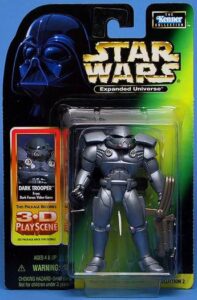
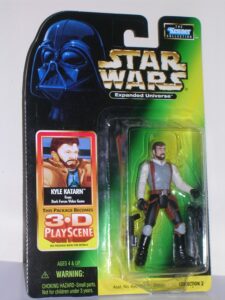
The revived Power of the Force action figure line produced two figures adapted from Dark Forces: Kyle Katarn, and a Darktrooper. The cardback for Kyle featured a retouched image of Kyle from the Dark Forces video game, which added a moustache and beard to try and match his depiction in the later game, Jedi Knight.
While not a particularly good representation of either character, they’re a nice little vintage piece and curiosity for any fan collection.
When Dark Forces 2: Jedi Knight was released, Dark Horse Comics produced 3 hardcover novellas by William C. Dietz to tell a truncated version of the story of Dark Forces and Jedi Knight.
Full-cast audio dramas was also produced by Highbridge Audio, and mastered by Tom Vogeli (also responsible for mastering the NPR Star Wars Radio Dramas.) These are my favorite spin-offs of the Dark Forces material, and I highly recommended them to anybody who enjoys full-cast audio productions with sound effects.
The first in the series was titled Dark Fores: Soldier for the Empire.
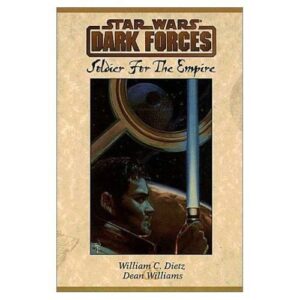
Soldier for the Empire Hardcover (New/Amazon)
Soldier for the Empire Audio CDs (Used/Amazon)
Legacy
The greatest legacy created by Dark Forces can be traced to Rogue One, the Andor series, and the appearance of the Darktroopers in The Mandalorian.
The heist of the Death Star Plans has been told in many mediums, but the Disney Canon version is a very solid replacement.
It’s not hard to see that Cassian was directly inspired by the mercenary aspect of Kyle Katarn – it’s interesting that this was explored in the Andor series, with Nemik specifically providing a moral rationale for the nascent rebellion working with non-aligned mercenaries for the fulfillment of the cause.
While Kyles backstory would be more deeply explored in Jedi Knight, the gist was that he had formerly been a student at the Imperial Academy, and joined the stormtrooper corps when he was told that his father had been killed in a Rebel Raid. When information is leaked to him by Jan Ors that his father was a rebel sympathizer and had secretly been killed by Imperials, Kyle goes AWOL and begins working with the Rebellion.
Andors backstory is different, but bears similarities – rather than losing his father, Cassian loses his mother-figure. This swap was likely at the behest of Kathleen Kennedy – modern Lucasfilm has wasted no opportunity to create absent or deadbeat fathers, an unfortunate and toxic attitude.
Even so, I would not be surprised if we find that the crashed “Republic” ship seen at the beginning of season one was carrying something related to the Separatist War effort – the toxic fumes released likely led to Marvaas heatlh issues. If this is explored in season 2, I wouldn’t be surprised if Cassian associates the Separatists with the Rebellion and at least in part blamed them for her health issues.
Also swapped were the primarily protagonist and mission officer:
Kyle Katarn became Cassian Andor and Jan Ors became Jyn Erso.
Cassian even inherited Kyles trademark Bryar Pistol – which was great to see in live action.
Finally – there would be no Darktroopers without Dark Forces – all in all, not too bad for a game that is now relatively obscure.
For more in-depth analysis and histories of the fantasy worlds we love, keep reading That Park Place. As always, drop a comment down below and let us know your thoughts!
