



In a recent escalation of tensions surrounding the removal of adult-themed games from digital platforms, Valve Corporation, the operator of the popular Steam storefront, has directly challenged Mastercard in its denial of involvement in pressuring platforms to censor or remove mature content.

Eve in Stellar Blade (2024), Shift Up
This controversy, which began with campaigns by activist groups and has rippled through the gaming industry, highlights the complex interplay between payment processors, content policies, and free expression in digital marketplaces.
As of August 5, 2025, the debate continues to unfold, with implications for developers, consumers, and the broader ecosystem of online content distribution.
Background: The Purge of Mature Content on Steam and Itch.io
The issue traces back to July 2025, when both Steam and the indie-focused platform Itch.io began removing or de-indexing hundreds of adult-oriented games from their stores.
Valve introduced new guidelines prohibiting “certain types” of content, stating that these changes were necessary to comply with rules from payment processors like Mastercard and associated card networks.

Eve in Stellar Blade (2024), Shift Up
In a statement to PC Gamer, Valve explained, “We were recently notified that certain games on Steam may violate the rules and standards set forth by our payment processors and their related card networks and banks. As a result, we are retiring those games from being sold on the Steam Store.”
Similarly, Itch.io announced on its blog that it had come under scrutiny from payment processors regarding mature content, emphasizing the need to prioritize relationships with these partners to continue operations. The platform temporarily de-indexed all of games that fell under that umbrella but later began re-indexing free ones while seeking alternative payment solutions comfortable with such material.

Tifa in Final Fantasy VII Remake (2022), Square Enix
This affected thousands of titles, many of which featured explicit themes or other mature elements, though developers argued the content was legal and consensual in depiction.
The catalyst for these actions appears to be a targeted campaign by the Australian non-profit group Collective Shout, which describes itself as fighting against the objectification of women and the sexualization of girls in media.
In July 2025, Collective Shout published an open letter accusing Steam and Itch.io of hosting offensive games and urged Visa, Mastercard, and PayPal to stop processing payments for such platforms. The group claimed victory after the removals began, stating on their blog, “We raised our objection to r**e and in***t games on Steam for months, and they ignored us for months.”

A screenshot from Final Fantasy XVI (2024), Square Enix
Critics, including gamers and developers, have accused Collective Shout of waging a “culture war” against sexual expression, as noted by Itch.io co-founder Leafo in a social media post.
The backlash has been intense, with gamers flooding payment company call centers with complaints, leading to accusations of censorship of legally protected content. Rival storefront GOG even launched a “FreedomToBuy” campaign, offering 13 free mature games and publicly opposing censorship.
Mastercard’s Denial and the Role of Payment Rules
On August 1, 2025, Mastercard issued an official statement titled “Clarifying recent headlines on gaming content,” denying any direct evaluation of games or requirements for restrictions on platforms like Steam or Itch.io.
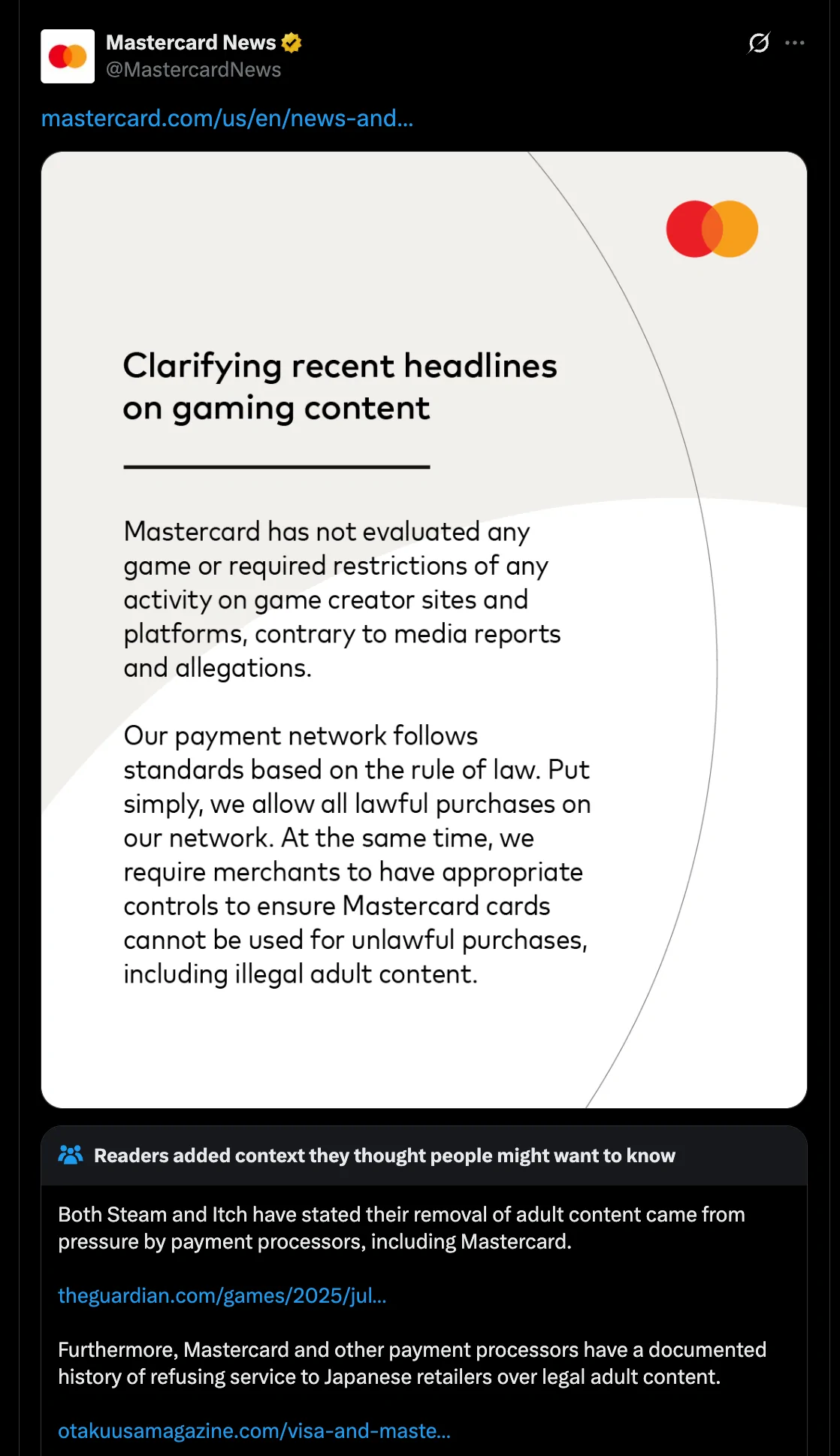
A community note on an X post by Mastercard – X, @MastercardNews
The company stated, “Mastercard has not evaluated any game or required restrictions of any activity on game creator sites and platforms, contrary to media reports and allegations. Our payment network follows standards based on the rule of law. Put simply, we allow all lawful purchases on our network. At the same time, we require merchants to have appropriate controls to ensure Mastercard cards cannot be used for unlawful purchases.”
This response came amid growing media scrutiny and public outcry, with Mastercard emphasizing that its policies are grounded in legality rather than moral judgments. However, the statement does not explicitly address indirect pressures through intermediaries, nor does it clarify what constitutes “illegal” content beyond broad legal standards.
Valve’s Rebuttal: Indirect Pressure and Brand Risk
Valve quickly refuted this Mastercard claim, providing a statement to Kotaku on the same day.
A Valve spokesperson asserted, “Mastercard did not communicate with Valve directly, despite our request to do so. Mastercard communicated with payment processors and their acquiring banks. Payment processors communicated this with Valve, and we replied by outlining Steam’s policy since 2018 of attempting to distribute games that are legal for distribution. Payment processors rejected this, and specifically cited Mastercard’s Rule 5.12.7 and risk to the Mastercard brand.”

A screenshot from Final Fantasy XVI (2024), Square Enix
Rule 5.12.7, outlined in Mastercard’s official rules, prohibits transactions that are illegal or, “in the sole discretion of the Corporation, may damage the goodwill of the Corporation, or reflect negatively on the Marks.”
It specifically calls out sales of products or services that are “patently offensive and lacks serious artistic value,” providing examples such as images of nonconsensual behavior, exploitation of a minor, and more. Violations can lead to fines, audits, or termination of services.

A scene from Final Fantasy VII Rebirth (2024), Square Enix
Valve’s 2018 policy, referenced in their response, marked a shift toward allowing “everything” on Steam except content that is illegal or “straight up trolling,” aiming to distribute games legal in their jurisdictions. The company argues that the removed games fell within legal bounds, but the invocation of Rule 5.12.7 suggests Mastercard views certain content as a brand risk, even if not outright illegal.
This “patently offensive” clause is subjective and has been criticized for potentially enabling broad censorship, as it doesn’t require meeting strict legal tests for obscenity like the U.S. Miller Test, which evaluates whether material appeals to prurient interests, depicts conduct offensively, and lacks serious value.
Broader Implications and Stakeholder Perspectives
Developers of affected games, often small indie teams creating niche adult-oriented titles, have reported significant financial losses and expressed frustration over vague guidelines that force self-censorship.
From Collective Shout’s perspective, the campaign is a success in combating what they see as harmful content that normalizes threats against women. Their efforts have previously targeted other media, and they maintain that their objections are limited and don’t include all adult material.

Eve in Stellar Blade (2024), Shift Up
Conversely, advocates for free expression argue that this sets a dangerous precedent, allowing payment processors—essential gatekeepers for online commerce—to act as de facto censors.
Legal experts note that while “patently offensive” content may not be protected if obscene, much of the delisted material likely passes constitutional muster in the U.S., where Steam is based.
As platforms like Itch.io explore alternative processors and gamers continue their advocacy, the outcome could reshape how mature content is handled in digital spaces. Valve’s pushback signals a willingness to challenge payment giants, but without direct dialogue, resolution remains uncertain.

Eve in Stellar Blade (2024), Shift Up
Mastercard has reiterated its commitment to lawful transactions, but the gray area of “brand-damaging” content leaves room for ongoing conflict.
How do you feel about this statement from Valve on Mastercard? Sound off in the comments and let us know!
UP NEXT: Billie Eilish Canceled by her Own Side as Progressives Turn on Liberal Activist Singer
