



The Acolyte showrunner Leslye Headland confirmed that the last three episodes of the show’s first season will not explore Qimir’s background as a Sith.

Scene from Lucasfilm’s THE ACOLYTE, season one, exclusively on Disney+. ©.
In an interview with Entertainment Weekly, Headland was asked, “Are we going to learn more of the Stranger’s backstory, either through flashbacks or dialogue, to learn about how he came across this path?”
She responded, “Because it’s Osha’s story, you don’t know much about the Stranger’s background and you’re not really going to learn much about it.”
“But there are a bunch of things in episode 6 and episode 8 that are really big clues as to why he is the way he is and why his philosophy is the way that it is,” she added.

Osha (Amandla Stenberg) in Lucasfilm’s THE ACOLYTE, season one, exclusively on Disney+. ©.
READ: ‘The Acolyte’ Showrunner Leslye Headland Casts Doubt On A Second Season Being Made
Headland would go on to explain how she came up with Qimir’s mask, “When we were designing the costume, I said very early on, ‘I don’t want him to wear armor besides the gauntlet and the helmet.’ That’s the Cortosis and how he uses them, but he doesn’t have any armor.”
“And my costume designer was like, ‘Well, why?’ And I said, ‘Why would you wear armor if you don’t plan on getting hit? He has that level of confidence of just like, ‘No one’s going to land anything on me.'” she added.
The answer makes no sense given he is indeed wearing armor in the helmet and the gauntlet and did indeed use them to deflect lightsaber blows.
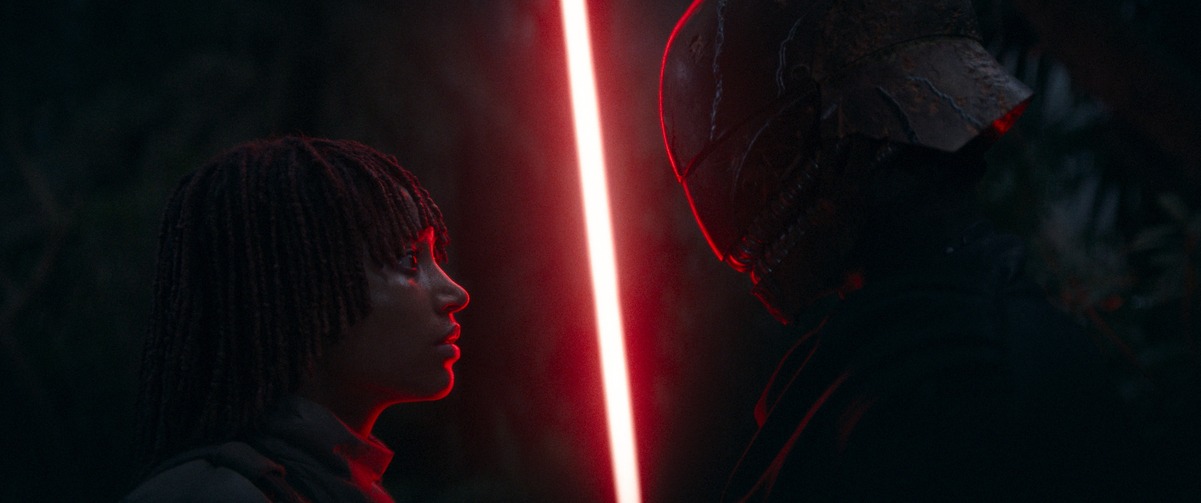
(L): Osha (Amandla Stenberg) in a scene from Lucasfilm’s THE ACOLYTE, season one, exclusively on Disney+. ©2024 Lucasfilm Ltd. & TM. All Rights Reserved.
Nevertheless, Headland would also discuss the final line of the episode. Qimir covers Osha with a coat and says, “What extraordinary beings we are. Even in the revelation of our triumph, we see the depth of our despair.”
Headland explained the line, “My co-showrunner Jason Micallef wrote that line, and I always thought he was talking about himself, and that is something that’s going to end up coming up for the two of them in the next episode — there is no triumph without despair. There is no good without bad. There is no light without dark.”
She elaborated, “His philosophy is that it seems that his existence is meant to balance a particular amount of good that exists in the galaxy. His history and his philosophy and his experience in the world is something that he will be able to share with Osha, which is not as simple as ‘I’m the bad guy, and the Jedi are the good guys.’”

(L-R): Mae (Amandla Stenberg) and Qimir (Manny Jacinto) in Lucasfilm’s THE ACOLYTE, exclusively on Disney+. ©2024 Lucasfilm Ltd. & TM. All Rights Reserved.
This could be an interesting dynamic if it was well written, but everything Headland and her team of writers have shown so far is terrible writing. Instead, it’s more likely that this idea will further reinforce the false idea of the Force that Dave Filoni injected into Star Wars during The Clone Wars and particularly during the Mortis Arc that the Force is kept in balance by having equal sides light and dark.
In the show’s third season episode “Overlords” a character named the Father states, “A family in balance, the light and the dark, day with night, destruction replaced by creation.
He adds, “Too much dark or light would be the undoing of life as you understand it.”
Following a test that Anakin completes that involves taming the Father’s children, the Daughter and the Son, the Father informs him, “But this is yours. It has been foretold. The Chosen One will remain to keep my children in balance.”
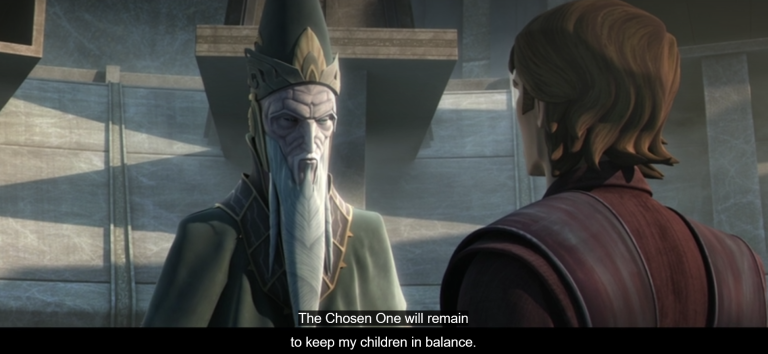
The Father and Anakin Skywalker in Star Wars: The Clone Wars “Overlords” (2011), Lucasfilm
In the next episode “Altars of Mortis,” Filoni doubled down with the Son appearing to Anakin in a vision. The son instructs Anakin, “How simple you make it…light and dark as if there is one without the other. Aligned, you and I can restore balance wherever we go, peace to the universe.”
The Son would then shout in fury at Anakin after he rejected his offer stating, “We will destroy the Sith and the Jedi.”
In the third episode “Ghosts of Mortis” a narrator reinforces this idea, “Obi-Wan Kenobi, Anakin Skywalker, and his Padawan Ahsoka Tano are caught in the middle of a treacherous battle between good and evil. The scales now tipped toward the Dark Side, our three warriors must guard against attack as they plan their escape.”
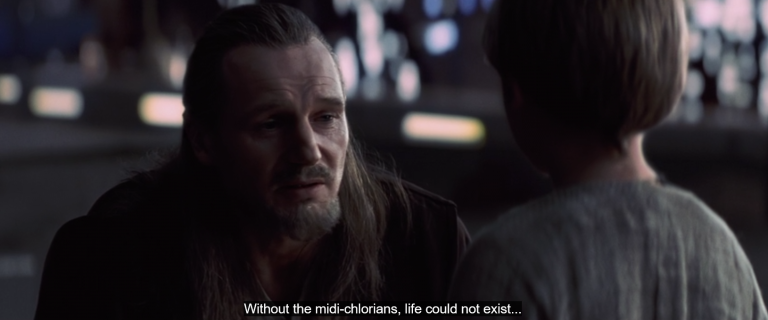
Liam Neeson as Qui-Gon Jinn and Jake Lloyd as Anakin Skywalker in The Phantom Menace (1999), Lucasfilm
This is not how the Force operates. Ironically, George Lucas made this abundantly clear in a writers meeting for Star Wars: The Clone Wars.
He said, “The core of the Force. I mean you got the Dark Side and the Light Side. One is selfless. One is selfish. And you want to keep them in balance. What happens when you go to the Dark Side is that it goes out of balance, and then you get really selfish and you forget everybody.”
“And, ultimately, you lead yourself, because when you get selfish you get stuff or you want stuff and when you want stuff and you get stuff then you get afraid somebody’s going to take it away from you whether it’s a person, or a thing, or a particular pleasure, experience. Once you become afraid that somebody’s going to take it away from you or you’re going to lose then you start to become angry especially if you’re losing it. And that anger leads to hate. And hate leads to suffering. Mostly on the part of the person who is selfish because you spent all your time being afraid of losing everything you’ve got instead of actually living,” he explained.
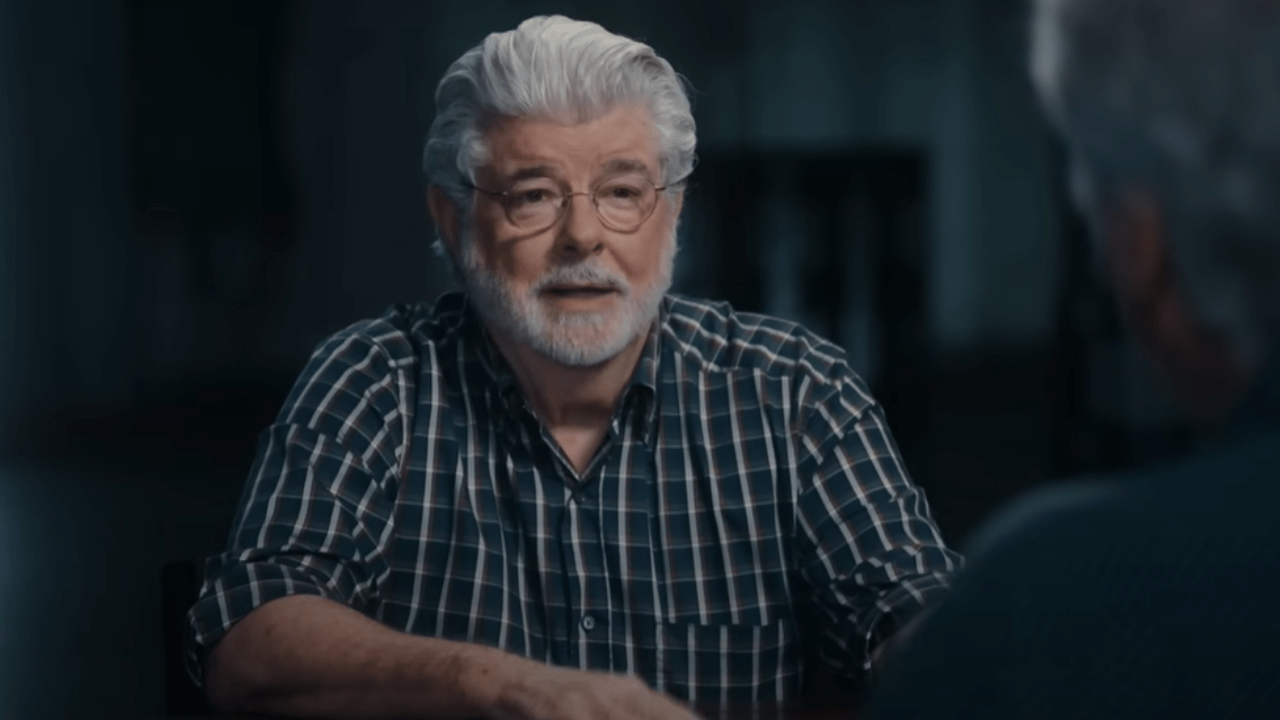
George Lucas via AMC+ YouTube
In contrast, he noted, “Where joy, by giving to other people, you can’t think about yourself and therefore there is no pain. But the pleasure factor of greed and of selfishness is a short-lived experience. Therefore you’re constantly trying to replenish it. But, of course, the more you replenish it the hard it is to sort of…so you have to keep upping the ante.”
“You’re actually afraid of the pain of not having the joy. So that is ultimately the core of the whole Dark Side, Light Side of the Force. And everything flows from that,” he elaborated.
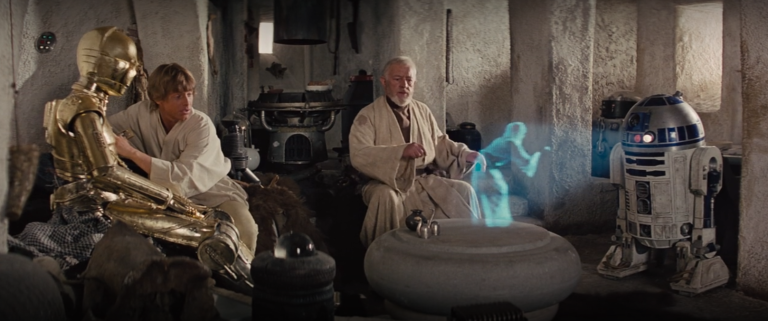
Mark Hamill as Luke Skywalker, Carrie Fisher as Princess Leia, and Alec Guinness as Obi-Wan Kenobi Star Wars: A New Hope (1977), Lucasfilm
Lucas then detailed, “Obviously, the Sith are always unhappy because they never get enough of anything they want. Mostly their selfishness centers around power and control. And the struggle is to be always able to let go of all that stuff.”
“And that’s the problem with Anakin, ultimately, is that you’re allowed to love people, but you’re not allowed to possess them. And what he did is that he fell in love, and then married her, and then became jealous, and that he saw in his visions that she was going to die, and he couldn’t stand losing her. So, in order to not lose her he made a pact with the devil to be able to become all powerful. But of course, when he did that she didn’t want to have anything to do with him anymore. So he lost her,” he said.

David Prowse and James Earl Jones as Darth Vader and Mark Hamill as Luke Skywalker in Star Wars: Return of the Jedi (1983), Lucasfilm
“Once you are powerful being able to bring her back from the dead, well if I can do that I can be emperor of the universe, I can get rid of the Emperor, I can do everything, I can make everything the way I want it. And once you do that, you’ll never be satiated,” Lucas relayed. “You’re always going to be consumed by this driving desire to have more stuff and be afraid that others are going to take it away from you. And of course they are because every time you get two Sith together– you have the Master, you have the Apprentice and the Apprentice is always trying to recruit another Apprentice to join with him to kill the Master.”
“And the Master knows that basically everybody below him wants his job,” he stated.

Mark Hamill as Luke Skywalker in Star Wars Episode IV: Return of the Jedi (1983), Lucasfilm
Lucas then declared, “The only way to overcome the Dark Side is through discipline. The Dark Side is pleasure, biological, and temporary, and easy to achieve.”
“The Light Side is joy, everlasting, and difficult to achieve. A great challenge. Must overcome laziness, give up quick pleasures, and overcome fear which leads to hate,” he finished.
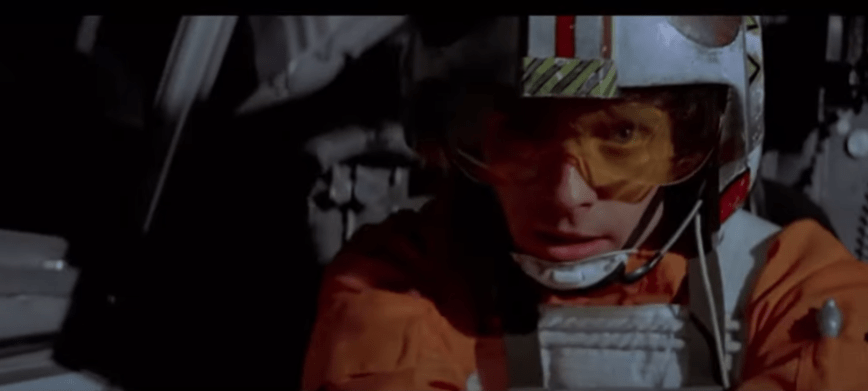
Mark Hamill as Luke Skywalker in Star Wars (1977), Lucasfilm
The idea that Qimir believes that his freedom to be evil counterbalances the Jedi and what is supposed to be good could be well written. You could have an interesting philosophical debate or at least a sinister conversation between him and Osha as he tries to pull her to the Dark Side and corrupt her. It could be similar to how SIdious seduced Anakin during the opera scene in Revenge of the Sith or even how Vader attempted to seduce Luke in The Empire Strikes Back.
Obviously, it would be a bunch of lies, but would have a glean of truth in order to tempt Osha, but to also show how sinister he is.
However, as noted above it’s highly unlikely anything like this takes place given what we’ve already seen from the show.
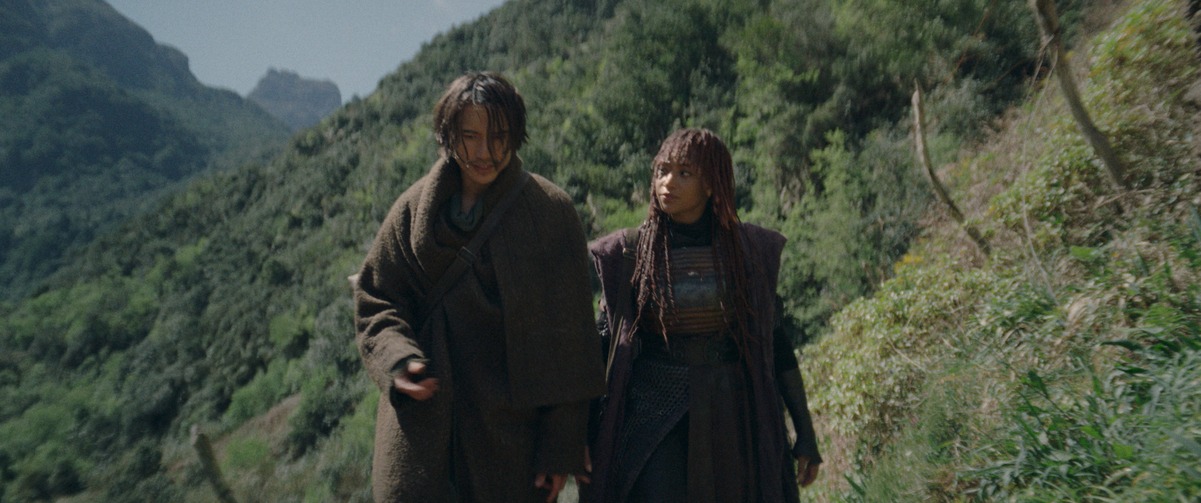
(L-R): Qimir (Manny Jacinto) and Mae Aniseya (Amandla Stenberg) in Lucasfilm’s THE ACOLYTE, season one, exclusively on Disney+. ©2024 Lucasfilm Ltd. & TM. All Rights Reserved.
What do you make of Headland’s comments?
NEXT: George Lucas Blasts Disney For Not Understanding Star Wars And The Force
