

The “Stop Killing Games” movement just hit 1 million signatures in the European Union—triggering a mandatory response from lawmakers and setting the stage for a public hearing in the European Parliament. But as the campaign, spearheaded by YouTuber Ross Scott, gains global momentum, the video game industry has fired back.
In a newly published rebuttal, Video Games Europe—a lobbying organization representing nearly every major AAA game publisher—has come out firmly against the campaign’s demands. Their stance is blunt: players do not actually own the games they buy, and publishers must retain the freedom to shut games down when they see fit.

A screenshot from The Crew (2016), Ivory Tower
“All video games, whether digital or physical copies, are licensed,” the group states in their official response. “As is the case with virtually all digital works when consumers purchase online games, regardless of the country of sale, what they acquire is a personal license to access and play the copy of the game they have purchased in accordance with the game’s terms of service. The consumer does not acquire ownership of that video game. These clear intellectual property rights underpin the entire market and enable the strong investment that the industry has seen for decades. There is no legal uncertainty about the status quo of video games.”
According to the group, since consumers purchase a “personal license” to access a game and not the game itself, that license can be revoked under the game’s terms of service, including when online functionality is shut down.
Industry Backlash to Preservation
The “Stop Killing Games” petition, launched in 2024, demands that developers be required to preserve games in a playable form, even after official servers are shut down. Supporters argue that permanently removing access to purchased titles—especially those that could function offline—is a violation of consumer rights.
Video Games Europe disagrees, calling such expectations “disproportionate” and warning of severe consequences for the industry if they are enforced by law.
Key art for Fortnite Chapter 5 Season 2 (2024), Epic Games
Imposing a legal obligation to continue server support indefinitely, or to develop online video games in a specific technical manner that will allow permanent use, will raise the costs and risks of developing such games,” they said. “It will have a chilling effect on game design, and act as a disincentive to making such games available in Europe. It is far from a trivial modification or a simple addition to the game dev
The group argues that mandating private servers or offline modes would require “significant engineering and architectural challenges,” especially in games where online features are tightly integrated into the core gameplay.
“Creating a private-server compatible version would be a prohibitive cost, in some cases years or decades after the game’s initial release when only a small audience remains,” they claimed.
Safety and Legal Concerns
The document also raises concerns about player safety, content moderation, and potential legal risks if companies are forced to release game code or enable community-run servers.
“Requiring games to run on private servers would result in the inability for games companies to continue to protect players from illegal or harmful content or conduct,” they warn. “Releasing game code… could expose games companies and consumers to bad actors, malware, data breaches, and DDOS attacks.”
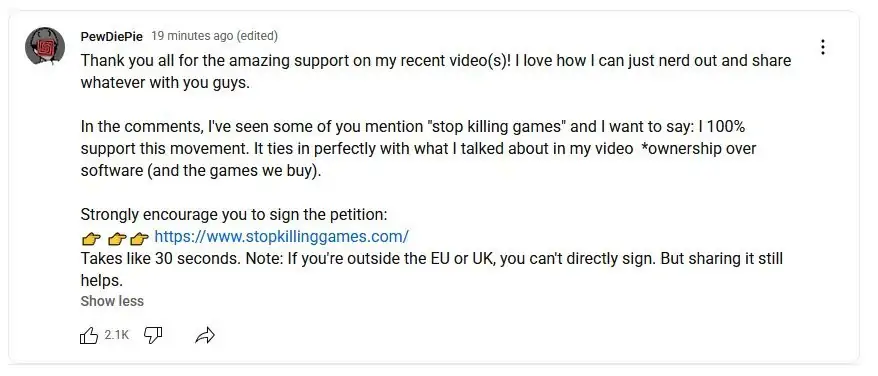
PewDiePie throws support behind the Stop Killing Games movement. – YouTube, PewDiePie
They also argue that these changes would undermine intellectual property rights, damage brands, and open the door to unauthorized versions of games competing with official releases.
“Mandating games companies to keep their online games operable post-official support would undermine their rights and autonomy in deciding how their intellectual property is utilized.” the document states.
Who’s Behind the Pushback?
This opposition to SKG is coming from the top of the industry.
A screenshot from the trailer to Mario Kart World – YouTube, Nintendo of America
Video Games Europe’s board includes representatives from:
- Sony Interactive Entertainment
- Microsoft
- Nintendo of Europe
- Ubisoft
- Activision Blizzard
- Electronic Arts
- Take-Two Interactive
- Bandai Namco
- Epic Games
- Square Enix
- Warner Bros. Games
- Embracer Group
- Level Infinite (Tencent)
- And regional lobby groups like UKIE, SELL, and game.
Virtually all of these companies operate live-service games and many have engaged in delisting titles or removing online access—making their vested interest in preserving the status quo obvious.
What Happens Next?
Because the petition passed 1 million verified signatures in the EU, the European Commission must now formally respond. Ross Scott will be invited to speak at a public hearing in the European Parliament—a rare opportunity for gamers to directly challenge the industry’s dominance over digital access.
In the meantime, Scott has warned that some signatures may not meet the EU’s validation standards and is encouraging supporters to continue signing at StopKillingGames.com to build a buffer.

A screenshot from The Crew Motorfest (2023), Ubisoft Ivory Tower
While publishers claim they support game preservation efforts “in museums and exhibitions,” they draw a hard line when it comes to consumer access.
As the battle between preservationists and publishers heats up, one thing is clear: this fight is no longer just about games—it’s about who really owns digital content in the modern age.
Are you surprised the gaming industry is trying to squash “Stop Killing Games?” Sound off in the comments and let us know!
