


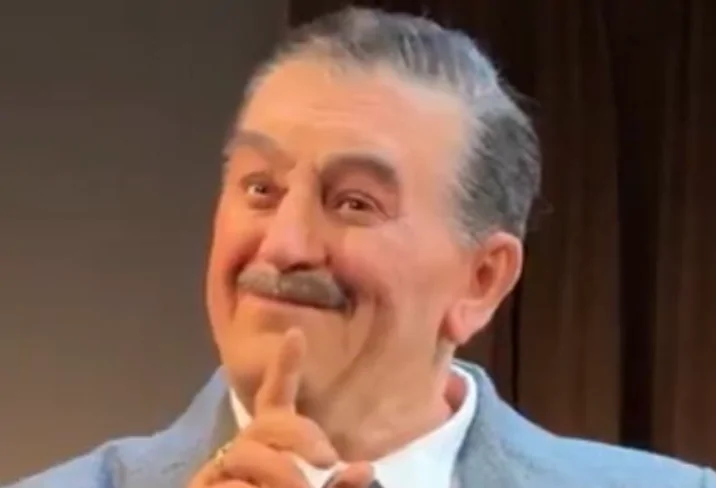
The Walt Disney animatronic made his family weep in agony at its awful appearance and ask Disney CEO, Bob Iger, to stop it from appearing. Now that the general public knows what it looks and sounds like, we understand.
Disneyland’s highly anticipated new attraction, Walt Disney – A Magical Life, featuring an audio-animatronic figure of Walt Disney himself, is generating controversy both inside and outside the Disney family. While the exhibit is intended to celebrate the 70th anniversary of Disneyland, it has instead sparked emotional backlash from Walt’s granddaughter, Joanna Miller, and a mixed reception from the public.
Miller has been vocal in her opposition, describing the figure as “robotic grampa” and accusing Disney of “dehumanizing” her grandfather. In an interview with the Los Angeles Times, she explained that her discomfort with the project stems from a deep connection to Walt’s legacy and a desire to see him remembered as a real person rather than a mechanized representation. “He’s ours,” she said. “We’re his family.” Upon first seeing the figure, she recalled breaking down in tears, saying, “It didn’t look like him, to me.”
The response seems to be (predictably) overwhelmingly negative towards the Walt animatronic.
For those conflicted, ask yourself:
Take away the setting, the clothing, and the setup from the show… Can a person off the street still recognize the subject when randomly asked? pic.twitter.com/8VUz2s7wSD
— Dre (@VashSky) July 14, 2025
Miller said she raised these concerns directly with Disney CEO Bob Iger and the Imagineering team. Although she appreciated Iger’s kindness during the meeting, she ultimately remained unconvinced. “They’re different people,” she said. “He’s a businessman, grampa was an artist.” She also noted that her late mother, Diane Disney Miller, had similarly opposed turning Walt into an animatronic, reportedly rejecting the idea for the Walt Disney Family Museum in San Francisco.
However, family sorrow is only part of the story. Since its official reveal to the public, reception to the animatronic has been notably mixed… at best. While some fans described the experience as touching and praised the emotional weight of hearing Walt’s artificial voice in a recreated office space, others were left unsettled. Critics online have used words like “horrifying” and “low-key scared” to describe the robotic figure, with many pointing to its bulky facial features and uneven voice integration as primary issues.
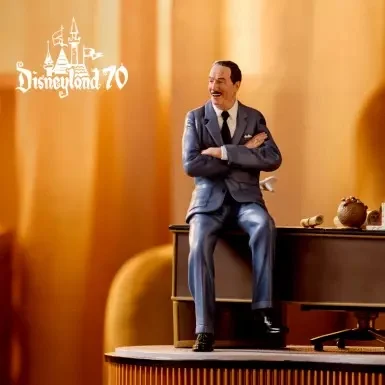
A Walt Disney talking figurine being sold by Disney – Disney Store
Several theme park analysts and bloggers have added to the critique. Theme Park Insider described the figure’s head as “too wide,” and pointed out that the audio—pulled from various archival recordings—created a disjointed effect, oscillating awkwardly between young and older Walt. Disney Tourist Blog gave the animatronic credit for its fluid movement and skin detailing, but ultimately called the face “about 80% accurate,” noting the bloated look detracted from immersion. Laughing Place, while more forgiving, acknowledged that the figure appears more convincing in person than on camera, though still not quite lifelike.
Despite these criticisms, the technology behind the animatronic is impressive. It is Disney’s most advanced human Audio-Animatronic to date, featuring expressive eye movement, realistic gesturing, and even a slight “glimmer” in the eyes. Rather than using AI to replicate Walt’s voice, the company relied entirely on original archival audio. Yet even this detail drew criticism, as the editing and speaker placement reportedly result in variable sound clarity depending on one’s seat in the theater.
Okay, so we’re not crazy, the new Disneyland animatronic looks basically nothing like Walt Disney. pic.twitter.com/mZ0RmZNgyo
— Hollywood Horror Museum (@horrormuseum) July 15, 2025
The new attraction temporarily replaces Great Moments with Mr. Lincoln, a show originally envisioned by Walt Disney for the 1964 New York World’s Fair. Disney once touted that animatronic figure as “so lifelike, you might find it hard to believe.” Ironically, it is now Walt himself being reimagined in a similar way—though with less universal praise. Disney has announced that the Lincoln show will return in about a year and rotate with the Walt Disney exhibit on a shared schedule. Frankly, many hope that Lincoln evicts the new Walt animatronic. It may be technically impressive, but it’s obviously offensive to a significant number of people, including the Disney family.
In the end, Walt Disney – A Magical Life raises an important question: how do you preserve the legacy of a man who was famously human, imaginative, and deeply personal, without reducing him to a technological novelty? As Joanna Miller put it, “It’s important that I speak out.” Her sentiments—and the mixed fan response—suggest that corporate founders cannot be mechanized, no matter how advanced the animatronics may be.
