


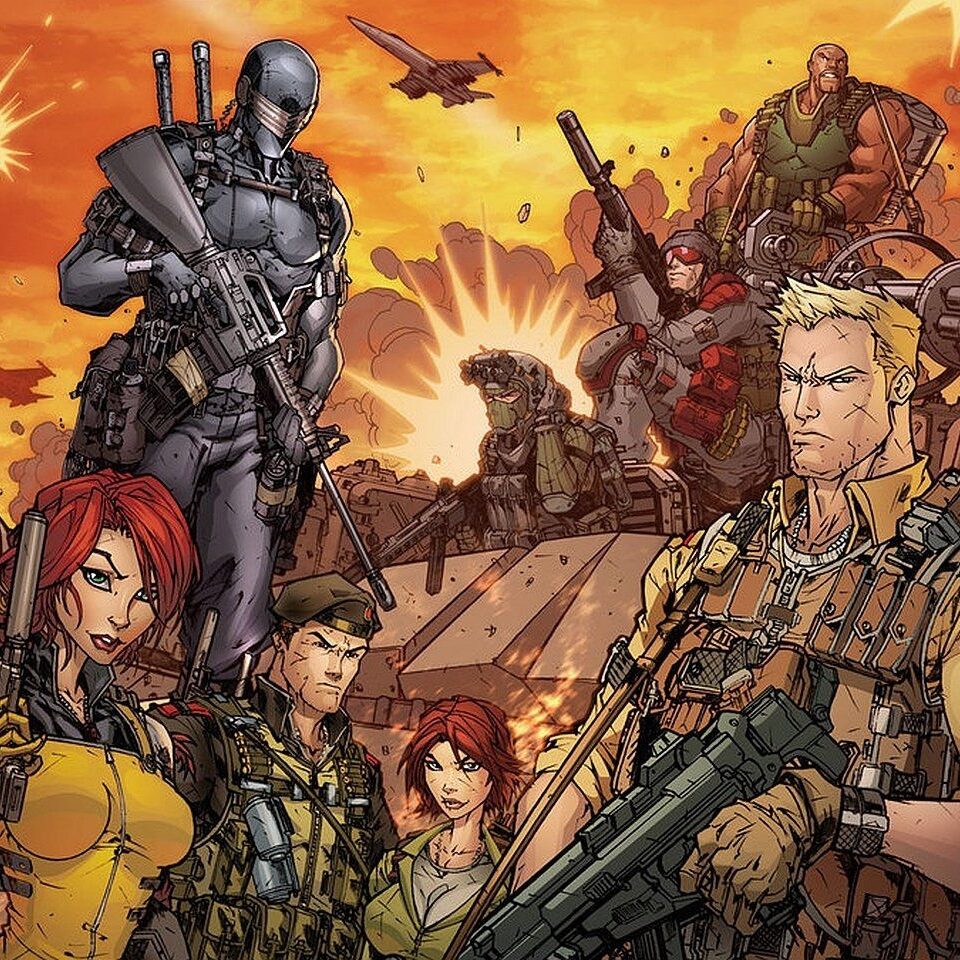
Toys are the actors in a stage of the young child’s mind. What we choose to put in front of our kids is important and corporations spend long periods of time planning out their offerings.
The following article is provided wholly by a number of toy industry insiders collaborating to explain what is going on with franchises like GI Joe in a world that is in conflict with many traditional pop culture icons. While we have confirmed the identity of at least one insider with decades of very high-level experience, we keep all identities anonymous and scrub revealing information so that their careers can continue without reprisal.
The last Joe movie is a great example of what happens when Entertainment get involved in a project. The general dynamic is that when Entertainment is in the room, Toy guys end up going to the back of the bus. A pain in general, but it’s especially wrong in the case of Joe, where Toy knows the IP, with Entertainment basically just visiting for the sake of the project.
Of course, they need to be there and without their exposure there can’t be enough lift for a major toy project (trad advertising could do a bit, especially sku specific, but not enough. Not even close).
The dynamic is that Entertainment when dealing with a “toy” property start off with the premise that the IP needs to “mature up” or be actualised in some way. It needs to be “interpreted”. Also, truthfully, deep down they are ashamed of making a project “to sell toys” Oh, they don’t say that up front – they say all the right things initially, but it emerges almost without fail as they go through their production process. They usually end up using the IP as some sort of skin for their project – include names, visual icons, key IP signposts – but it ends up being their own ideas dressed up as the IP. That does not end well, and won’t end up well on Joe. This is what happened with the last film. I should ad that TV and especially animation are usually bigger team players, maybe because they don’t have as much stardust to blow into marquis-management’s faces.
Quick note about Mattel’s Entertainment supported (re)launch of He-Man: While the intel is 3rd source, apparently their project is currently a total fail with respect to the forecasted ROI, with the post-mortem being good Toy with the Entertainment not lining up. No new audience recruited, with a small blip on the secondary show (there were actually two shows, with the flagship being the mess, thought the smaller more kid show was perceived as not bad). The main show was misaligned to the point that the two main toy sellers and IP identifiers where not only secondary in the show, but were off character to the point of IP damage. If that’s the way with Joe, then pull the plug, hard stop, conserve resources and stick to the collector market, with no major launch; steady as she goes with no glory.
Anyway, to make this work, Entertainment needs to be in line with IP (uh, no kidding, sad, but it needs to be said because the winds to blow things off course are strong).
Sigh: before we go further we need to get into the following, and it’s a shame: While Pawtucket is not Burbank, Hasbro is nonetheless packed with activists. Packed. The whole Wizards of the coast situation is one particularly shameful example … discussion for another day, but most teams have them. Usually, the activists are in the softer roles like HR or Marketing – they’re not the designers, sculptors, engineers, those with the talent to make a toy a Toy. Still, they are everywhere. Worse, many of them, though they won’t admit it except within their circles, put their activism before what’s best for sales. The Marketing side in particular has some really cringe staff that are total misfits for the brands for which they have responsibilities. They also cannot be fired – not that Hasbro has any intention of doing that.
Therefore, while the statement is that Brand needs to be the active cannon custodian, well that’s assuming the activists within the brand teams can be side-stepped. Big If, which might not be possible today, unfortunately. The following is therefore internal talk from ex- and current toy guys, minus any activism (though again, reality is that they need will need to be taken into account)
Here’s the talk from some true, non-activist toy people:
- The overall project should be animated, with 2 season x 18 episodes up front commit, with option for a 3rd. It’s important for major accounts to see the second season already committed to for a number of reasons, including the self-preservation that if the launch is soft, well then second season will flush out the close-outs. Animation is more cost effective with respect to the story-to-toy presentation (cost of talent, vehicle presentation). Weapons are high tech, no bullets … parachutes deploying when a plane gets shot down etc. You know the drill.
- Each season should be episodic in nature, with multiple arcs overlaying an overall background story. Episodic is the way to go to sell Joe – not one single story. A recent mapping had an average of 6/9 multi-episode arcs over a season, each tying into certain characters. These arcs allow the needed character focus and exposure not possible with a 90 minute single-story movie presentation, either live action or animated. At this point, to pass to the torch to today’s gen it’s almost a from scratch proposition so you need the screen time.
- Repetition is key – oh, creatives they hate this. To sell toys you need to drive a point home multiple times. Sure, this can be clunky if executed in a ham-fisted way. Here, Entertainment truly need to get creative – and effort and care would need to be taken in a modern story telling context in order to not hinder perceptions. Still, you need repetition. Make it work.
- Toy will provide the villain and Joe shortlists for the season. An idea batted around was to consult collectors and fans in some way with respect to key past storylines (animation, comics) to populate most of the show, leaving room for fresh episodes starting in season 2. It was also a way to generate good will. Stick to source as much as possible. And yes, absolutely and obviously, the scripts will end up being boy centric. You can insert your best Joe story here, but it will have a variation of this formula : Joe vs Cobra x handful of focus characters x character equipment x vehicles x environment x sci-fi element. The Hama formula often had smaller character moments & dramas taking place within larger stories, which is pretty standard scripting (not hard back then, but today ?). Heroes and villains need intros/origins with enough gradual exposition so that at the end of season one has been exposed to say the equivalent of the text that we had on the back of the cards on our 80’s figures for each. You need this to feed the play pattern.
- Wanna sell a playset, say a Cobra base? Repeatedly show the control room, the throne room and vehicles hangars and take off bays. Then in individual episodes show particulars like a training room, a special secret laser, or the dungeons that Snake needs to escape from, etc. Build the base in the show … then build it as a toy.
- Screen time needs to be 50/50 between heroes and villains – a key to sparking the good versus evil conflict driven play pattern. Fortunately Joe is villain rich, including relationships between villains.
- Real American Hero: Don’t soft pedal it, flont it ! The « USA » patriotic foundation of GI Joe is where much of its strength comes from. The business case will be majority domestic, so you have to maximize it; flag iconography, vehicle markings, etc.
- Words like “Terrorism”, etc will understandably not be used, but no problem, it’s surprisingly easy to get the idea across anyway.
- One of the big internal fears is showing the military as glamorous and fetishizing it’s associated insignia, ranks, gear, equipment, etc on a big stage. They need to get over this hang up, or no mass project. The fact that many key people at Hasbro, including influential alumni, realize that Top Gun Maverick could easily be distilled down into a 3 episode GI Joe arc (Tom Cruise not withstanding) could help. Terminal List, etc. Also, yes, institutions are not only good, but if they are worth the bad guys attacking them than they are easily worth the good guys defending them.
- Theme songs and catch phrases oh my! Depending on your view of the franchise, these make you either smile or cringe. These are key parts of the brand identity and pop up unaided in focus groups all the time. They need to be leaned into, period.
- In toys, stereotypes are really only a short-hand to characterization. On Joe, with very few true exceptions, these don’t need to be changed. Rather they should be explained in-story (why does this or that character talk a certain way, look a certain way, etc). Explain and move on.
- Admittedly, media focus is on entertainment, not toys so while a toy could be considered a “stereotype” (by a vocal minority of non-consumers) it won’t make social media. However, if its part of a mass Entertainment project then yes, it will likely unfortunately pop. Fortunately Joe has all the diversity already baked in, with the exception of alphabet. Unfortunately saying that alphabet is not pertinent in a kids show and we don’t need any won’t fly 100%. PR defenses need to be baked into the Entertainment.
- PR defenses: these should center around the Joes periphery, with no alteration to the Joes themselves (don’t touch core IP). One idea batted around had the Joes answering to a female, person of color President of the United States. Another is creatively bringing back a version of the back in the day PSA’s. There are a couple more creative ideas that could allow just enough defense, to play the card if needed, without deviating the story telling. Because it would be a kids show, you wouldn’t need that much, but Defense will need to be present
- Sidebar: Marquis-management’s nightmare is dumb, unfounded, headlines like “Hasbro Facing LGBTQ Criticism For New GI Joe Animated Show”, or anything of the like. It should be remembered that any deviation in stock price, even minor, would easily wipe-out with multipliers any Joe sales contributions to the company. Protecting the stock from headlines is, sadly, a huge first line consideration.
There’s a few more, but the above are some of the main ideas and criteria batted around. Without the support of this type of Entertainment a major toy launch is not possible. It just isn’t. However can the a show like the above even be done at today’s Hasbro? Sadly the answer is No (“Are you guys kidding me? You wanna do a show that could have been on the air during the Reagan administration?”).. The real question, unfortunately, will be the compromises. Can they be lived with? Depending, but probably not. Still, ideas are being thrown around for GI Joe to return to mainstream Entertainment mid-term, with or without the mandate to support a major toy push. Instead it will likely just be toys “tagging along” in a measured, low-risk way.
Still, the roadmap is known, and that is comforting in some small way. And remember, even if the above show and toys could be executed, the whole thing still needs to be funneled through business case to see if it can meet ROI expectations, which would be a challenge.
For all the latest news that should be fun, keep reading That Park Place. As always, drop a comment down below and let us know your thoughts on GI Joe, toys, and the direction our culture is taking.
