


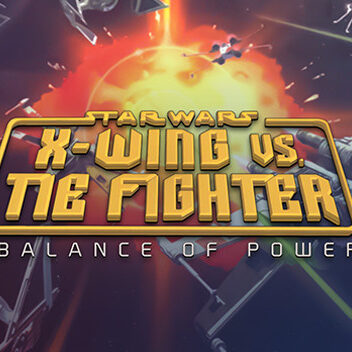
It was the birth of multiplayer gaming. It was a joyous time for fans of Star Wars looking to be the best in the galaxy far, far away.
In the mid-to-late 90’s, Star Wars had gone from being essentially a dormant property to an entertainment juggernaut again. In the space of 5 years, the property had gone from a successful novel series launch to dominating the space in a very short period of time.
1996 saw the release of a giant multi-media project: Shadows of the Empire.
This was to be the first novel release that took place during movie continuity – all other releases up to this point had taken place post-ROTJ. This project famously saw the release of “everything-but-a-movie”, including the novel itself, posters, action figures, statues, and a soundtrack. Crucially, Darth Vader himself would be a main character in the continuity, and the story promised to explain some unanswered questions that took place between The Empire Strikes Back and Return of the Jedi.
1997 was set to be an even bigger year – January 31st would see the release of the Star Wars: A New Hope – the Special Edition.
This was a first trial run for Lucasfilm using modern digital effects integrated into a 20 year old movie, and was intended to clean up effects work that had annoyed Lucas, as well as try to match up the quality between the original trilogy and the prequel trilogy movies that were in development.
But the more important date for me was April 27th – 1997. The release date of X-Wing vs. TIE Fighter.
The first two games in the series had been a single-player affair, but this game promised to allow you fly cooperatively or competitively against others, featuring all of the ships previously allowed in the series, plus a few new ones for good measure. Technically, the game made many improvements – including texture-mapping onto ship models, dynamic lighting, and introducing yet more flight mechanics that hadn’t existed in previous games. My favorite addition in this release was making your turn rate depend upon your throttle speed. Up utnil this point in the series, there was very little reason not to run at full throttle (unless of course you were flying an Imperial ship and needed to match speed behind a slower enemy.) The addition of turn-rate being dependent on your speed added a whole other level of strategy to the game, and immsersed the pilot even more. The difficulty level of the game had also been ramped up significantly, likely to deal with the fact that it was designed to be played with others… Which brings us to the elephant in the room.
This was the first X-Wing title to launch without a dedicated single-player campaign.
While the missions on offer could be played Solo, the trappings of the settting were mostly gone. Instead of a flight concourse with various different lobbies for Flight Training, Historical Missions, or Tours of Duty, the mission menu was accessed entirely through a datapad interface. From there, the player could choose sides and missions, and launch into the various missions. While still entertaining, the lack of these trappings led to the game feeling more like a “simulation” than an actual narrative – as though the entire experience was a series of Historical Missions, without weight.
On the other hand – I did play this game a lot at LAN parties in a gaming club I belonged to before the era of modern broadband. While playing the game solo was far less entertaining than previous entries in the series, nothing beat actually playing missions cooperatively with other players. Once a month, members of our club would all lug our setups to a giant auditorium – towers, peripherals, giant CRT’s and all…and plug into a LAN to frag each others hearts out for 24 hours. Once a year, a 3 day weekend “Meltdown” event would occur, when everyone would sleep over those 3 days to play Quake, Tribes, Team Fortress Classic, and dozens of others. X-Wing vs. TIE Fighter was in the rotation, and playing in that manner never ceased to give me a thrill as we shouted orders and call-outs across the room. Later dissections of the game by the developers noted that the net code for the project was particularly janky and difficult to develop, because of the sheer amount of data that had to be available to players and tracked QUICKLY for each client.
The knock against the lack of a dedicated single-player campaign was the only real serious complaint I remember from reviewers at the time. This criticism did eventually lead to the release of an Expansion Pack – Balance of Power. This campaign comprised 15 missions each for the Rebel and Imperial Sides, and offered the perspectives of the faction you chose around the same missions. The storyline took place post-ESB and involved the tracking and destruction of the Super Star Destroyer Vengeance (or it’s ultimate victory against the Rebels), and was the first time this ship-model had appeared in the series.
While the missions were entertaining and cut-scenes did provide a narrative, the late addition still marred the presentation, and marks it as a lesser offering, story-wise. Still – X-Wing vs. TIE Fighter likely offered the most satisfying advancement in flight mechanics throughout the series, and finally allowed friends (and frenemies) to determine who really WAS the hot hand in the stick in head-to-head competition – and who doesn’t like that?
Did you play this game back in ’97? Share your LAN Party stories down below!
As always, keep reading That Park Place for all the latest news and retrospectives for things we hold fun and dear.
