


This War of the Worlds Review contains Spoilers…
Some films honor the past. Others merely defile it. This War of The Worlds 2025 review is of the latter.
War of the Worlds (2025), the latest and perhaps most baffling adaptation of H.G. Wells’ enduring sci-fi novel, is neither a revival nor an evolution. It’s a clinical, creatively bankrupt exercise in screen-life storytelling that somehow manages to insult not just its source material, but the intelligence of its audience as well. To call it a “mockery” would imply the film has enough self-awareness to be in on the joke. It doesn’t.

A screenshot from the trailer to War of the Worlds – YouTube, War of The Worlds (2025)
This isn’t just a bad movie. It’s a cautionary tale for how corporate branding, conceptual laziness, and disregard for narrative can merge into something that can’t even be called cinema.
A War of the Worlds, Waged by Keyboard
Rather than grounding the story in spectacle, scale, or emotional investment, this movie is told entirely through a digital lens—literally.

A screenshot from the trailer to War of the Worlds – YouTube, War of The Worlds (2025)
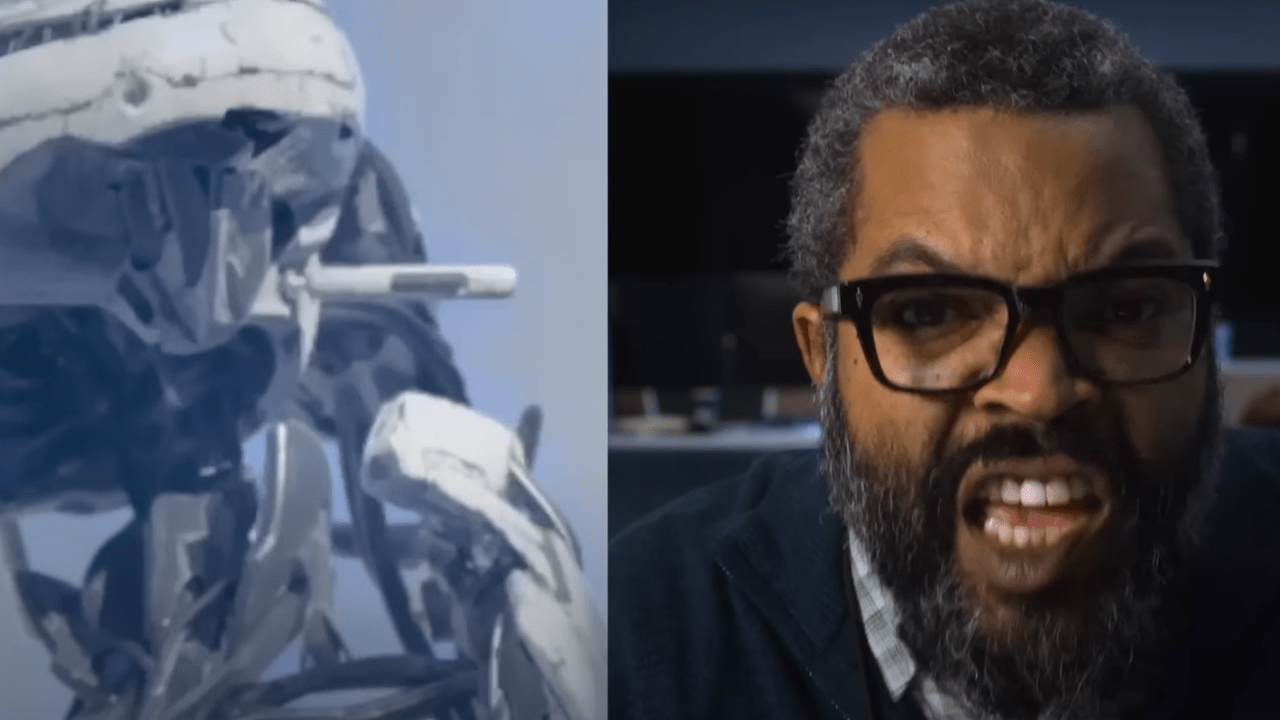
The entire run plays out via webcams, smartphone clips, security feeds, and screen recordings. This “screen-life” format, which has seen success in some horror and thriller films, is here reduced to a stale gimmick. The movie opens with Homeland Security analyst Will Radford (Ice Cube) sitting in front of a bank of monitors. Ninety minutes later, he’s still there.
That’s not an exaggeration.
Radford doesn’t engage in battle, attempt an escape, or participate in any dramatic arc. He observes. He comments. Occasionally he sighs.
The alien invasion arrives in the form of meteors followed by tripods, but we rarely see them. Instead, we hear about them through grainy surveillance footage, news overlays, and video calls. Even the few shots of destruction feel like placeholder assets in a bad video game.
It’s a storytelling format that, used well, can build tension. Here, it builds nothing but fatigue and boredom.
Wells Rolled Over in His Grave
When H.G. Wells published The War of the Worlds in 1898, it wasn’t just the first alien invasion novel. It was a brutal deconstruction of British imperialism, a reflection on humanity’s hubris, and a story that placed ordinary people under extraordinary, incomprehensible pressure. The terror wasn’t just in the Martians, but in realizing that we might not be the apex of creation.
This film ignores all of that. Instead, it retools the story into a sluggish commentary on surveillance culture and digital dependency. The aliens, now reimagined as data-harvesting parasites (like Technovore in the Iron-Man comics and media), unleash spider-like drones to infiltrate global data centers and drain the world’s digital infrastructure. The global collapse comes not through destruction, but via network outages.

A screenshot from the trailer to War of the Worlds – YouTube, War of The Worlds (2025)
READ: ESPN Officially Acquires NFL Network in Groundbreaking Deal with the NFL
The “climax” arrives when Radford’s daughter, working for a biotech startup, sends a cyber-vaccine encoded on a USB stick that’s delivered by an Amazon Prime Air drone (yes, that really happened) to Radford’s server farm. He plugs it in, the alien malware is defeated, and order is restored. One could charitably call it commentary on corporate infrastructure dependency. Or, less charitably, one could call it what it truly is: feature-length advertising.
A Protagonist Who Never Gets Up
It’s hard to believe this is the same Ice Cube who anchored Three Kings or Boyz n the Hood. Here, his considerable presence is reduced to static webcam footage and voiceovers. Radford never engages directly with the world-ending threat. He doesn’t change, grow, or suffer. He doesn’t even stand up.

A screenshot from the trailer to War of the Worlds – YouTube, War of The Worlds (2025)
This lack of movement—literal and figurative—is symbolic of the film as a whole. There’s no emotional core, no dynamic pacing, no character arc. Everyone exists as exposition dispensers, providing updates or vaguely ominous reflections about “how connected we all are” while the world burns off-screen.
An Abomination by Committee
The movie feels less like a passion project and more like the output of a marketing team that fed keywords into an AI script generator. “Cybersecurity,” “AI threat,” “screen-life format,” “drones,” “Amazon integration”—all checked off the list. What it doesn’t check? “Story,” “character,” “theme,” or “reason for existing.”

Jeff Bezos and wife Lauren Sanchez – YouTube, The Lazy Show
As MasteroftheTDS pointed out in his own review on Criticless: “This film is an abhorrent abomination against H.G. Wells. The fact that it even shares a name with him is a crime in itself… I genuinely cannot believe anyone greenlit this…. It should be expunged from the internet entirely, with prejudice and finality, to the point where no one can ever find it again.”
(Full disclosure: MasteroftheTDS is the husband of Raven Redgrave.)
It’s difficult to argue with that opinion. This film isn’t a creative failure. It’s a conceptual one. The problem isn’t that the movie did something different. It’s that it did nothing of substance at all.
Missed Opportunities and Misguided Choices
Let’s entertain, for a moment, the film’s ambition. A screen-life sci-fi thriller exploring how humanity might lose its grip on digital infrastructure in a first-contact scenario? That could have worked. A low-budget, human-scale drama about a man trapped behind a screen watching the world fall apart, wracked by guilt and helplessness? That could’ve had weight.

A screenshot from the trailer to War of the Worlds – YouTube, War of The Worlds (2025)
But this film doesn’t commit to any of it. It gestures toward ideas without ever digging into them. Its political commentary is surface-level, its science is pseudo, and its characters exist solely to relay information. Even the Martians—so vividly rendered in past adaptations—are reduced to background noise, barely glimpsed.
This isn’t a reinterpretation of Wells. It’s a simulation of relevance.
If the goal was to breathe new life into a classic tale, then this movie did the opposite and buried it under layers of digital detachment and branded mediocrity. It’s hard not to see this film as emblematic of a growing problem in modern sci-fi: the temptation to substitute style for substance, relevance for resonance, and algorithms for authorship. What Wells wrote was timeless. What this film delivers is forgettable.

A screenshot from the trailer to War of the Worlds – YouTube, War of The Worlds (2025)
War of the Worlds (2025) is not merely a bad film, but a fundamentally misguided one. By stripping away every ounce of humanity, tension, and narrative drive from a story about humanity confronting its own insignificance, it reduces a masterpiece to a marketing experiment.
In the end, it’s not just H.G. Wells who deserves better. We all do, for this film is an affront to all.
What’s your War of the Worlds review? Sound off in the comments and let us know!
