



A Walt Disney Imagineering filing has drawn attention to for a never-before seen projection surface patent. Patent application US 2026/0153748 A1 describes a projection-based system intended for themed entertainment environments where physical surfaces can change shape during a show and then retract when not in use.
The patent was filed December 3, 2024 and published June 4, 2026. It outlines a structure that uses flexible material supported by a mechanical framework. The framework can move the surface into different configurations during operation. It can also return the material to a stored position after a scene ends.
How the Projection System Is Designed to Work
Disney’s projection surface patent focuses on projection mapping applied to a surface that is not fixed in one form. Instead, the system allows the projection surface to be reshaped dynamically through mechanical movement. This approach is intended to align projected imagery with changing physical geometry.
Disney Patents a Projection Surface That Appears, Transforms, and Vanisheshttps://t.co/zIIPQgwPIQ
— WDW News Today (@WDWNT) June 4, 2026
READ: ‘The Mandalorian and Grogu’ Beaten by YouTube Series Fathom Event in Third Weekend Box Office
In practical terms, the design would allow visuals to adapt to a surface that is actively transforming during a performance. This could support environments where scenery appears to shift shape or structure without requiring permanent physical set changes.
The system can then disappear from guest view.
Potential Uses in Themed Entertainment Environments
Possible applications could include temporary scenic effects during attraction sequences. These effects may involve surfaces that rise, fold, or collapse as part of a programmed show moment. The projection surface would function as a temporary display layer that supports these changes.
The patent specifically names several possible applications. These include rising terrain, waterfalls, geysers, tornadoes, or a plant growing.
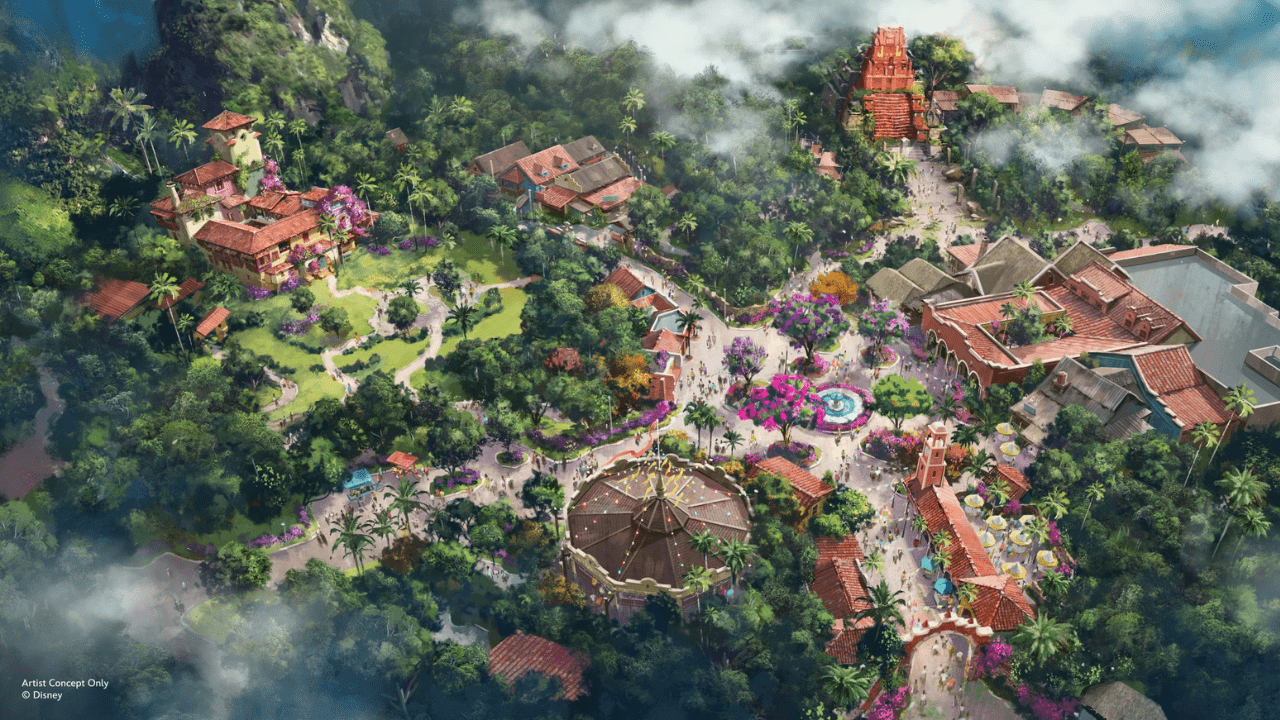
Tropical Americas at Disney’s Animal Kingdom Concept Art. Credit: Disney Parks Blog
READ: Andrew Stanton Admits Toy Story 5 is All About Jessie – Is This Another Disney Bait and Switch?
This approach could allow a single space to shift between multiple visual states over time. Instead of relying on fixed scenic builds, the system would enable a changing environment within the same physical footprint. However, these uses remain conceptual and are based on the patent description rather than confirmed installations.
With several new themed lands coming to the Disney parks, some fans and analysts have begun to theorize where Disney may utilize the new technology. Perhaps something for Indiana Jones in the Tropical Americas of Animal Kingdom? Perhaps Piston’s Peak or Monstropolis?
Interactive Potential With Guest Technology Like MagicBands
The Disney projection surface patent also leaves room for potential interaction with guest-facing technology, including systems similar to MagicBands. While the filing does not specifically reference any branded product, it describes environments where projection and physical motion could be coordinated with external inputs.
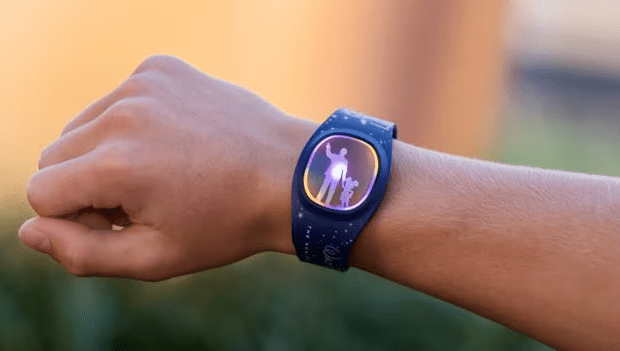
The special edition MagicBand+ for Walt Disney World’s 50th anniversary – Disney Parks Blog
In a practical theme park context, this type of system could theoretically respond to guest presence or timed triggers. Devices like MagicBands, which are already used within Walt Disney World for entry and purchase functions, could serve as one possible input source for synchronized show effects.
Part of a Broader Trend in Experience Design
The filing fits into a broader trend in themed entertainment engineering that focuses on adaptable and modular environments. Other patents in the industry have explored robotic scenery movement, reconfigurable set pieces, and integrated projection systems.
These approaches generally aim to increase flexibility in how themed spaces are used across different show moments. They also reduce reliance on permanent physical builds, allowing designers to alter environments dynamically within a single attraction footprint.
Current Status of the Patent
At this time, there is no official confirmation that the system will be used in any upcoming attraction. The patent should be viewed as a technical proposal that reflects possible directions in experience design rather than a verified construction plan.
As with many theme park patents, the concepts described may evolve, be combined with other systems, or remain unused. The filing provides insight into research directions but does not indicate production intent.
However, with several new themed-lands with attractions under construction, the technology may appear soon.
What do you think of the new patented technology? Let us know your thoughts in the comments below.
UP NEXT: Masters of The Universe Teela Actress Claims She Was Inspired by Rey from Star Wars
