


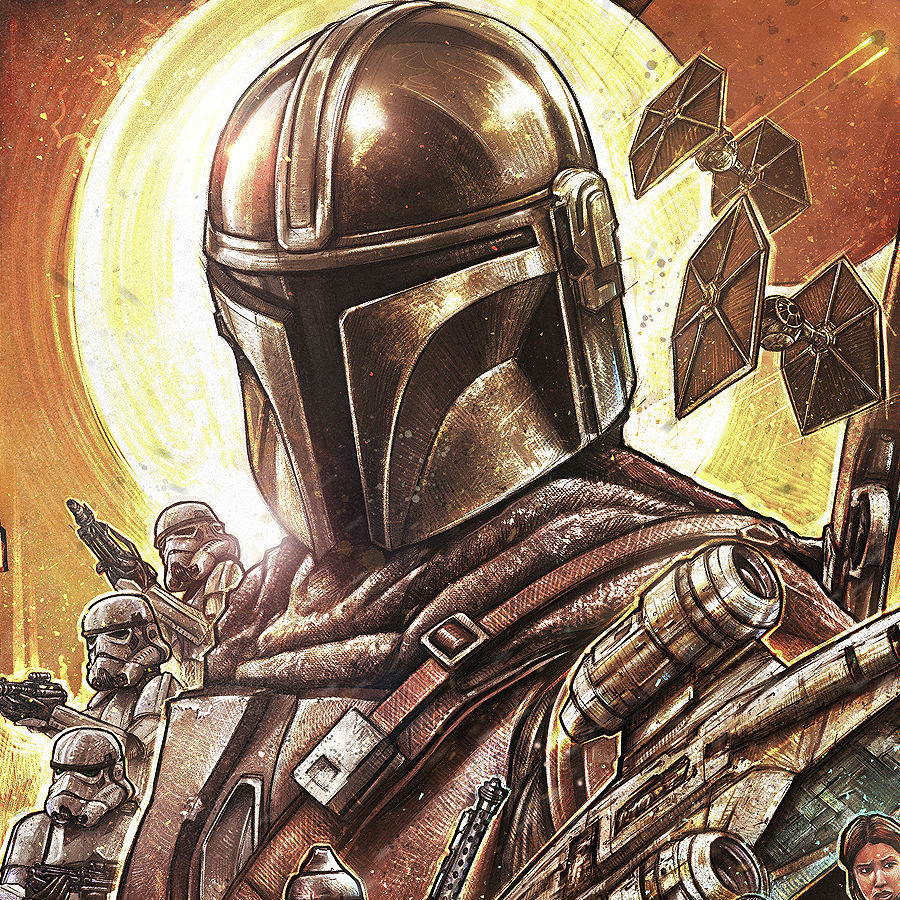
The second episode of the third season raises the bar in ways I didn’t expect. Come along with me while we delve into the mythic imagery being explored, and where I think this all could lead.
Star Wars has likely never been more damaged. It’s clear from reading several comments, whether here or elsewhere – that a portion of the fanbase is so angry and disgusted with what has become of the series that they will not view nor tolerate anything more that Disney produces.
When it comes to the sequel trilogy, I’m in agreement. They aren’t valid, and they betrayed the foundation of Star Wars as a whole. While I feel that they have badly bungled nearly everything they’ve attempted, for me there have been bright spots. Overall, I feel that Disney makes the Empire scarier/more competent (barring Obi-Wan Kenobi). I loved Rogue One, The Mandalorian, and Andor. Even though I recognize that Solo is not a good movie, I have a soft spot for it for my own reasons.
The Mandalorian has been the great hope for the future of Star Wars. The lament from the fanbase has been “It all leads to Jake Skywalker! Give up, they’re not going to retcon.” This is probably true.
What I have sought to do here is try to find a way to recognize what is good about Disney Star Wars, find ways to tie that to the old material and EU, and come to some common ground on some items. We don’t have to accept what is given to us – and our wallets (and lack of spending) speak loudly – especially now. My goal is to reward what is good, and to punish what is bad. You forfeit your vote if you stay away from the polls.
In time, leadership WILL change at Lucasfilm and Disney. Does that mean they will moderate? No, but hope springs eternal. This episode made hope spring much higher for me for some specific reasons that I want to dive into, and also address some of the criticisms that I’ve been hearing from other people.
The Mandalorian as RPG
One of the greatest criticisms that I’ve heard is that The Mandalorian feels too much like a CRPG. The format has been “adventure-of-the-week” style, with multiple questgivers, side quests, and upgrades to stats, armor, and equipment.
I think people forget sometimes that this story format didn’t originate with RPG’s – it originated with the stories that those RPG’s were based on.
King Arthur didn’t stride onto the scene with Excalibur in hand. His Father, Uther, used the magic of Merlin to lie with Igraine, the wife of the Duke of Cornwall. The Duke is killed in battle that night, and Uther and Igraine marry – but the cost for Uthers lust is the baby Arthur himself, who is spirited away by Merlin to be raised by Sir Ector, as brother to Sir Kay. Treated as an annoyance while growing up, labeled with the unkind name “Wart”, his destiny is only later thrust upon him when pulling the Sword from the Stone. His early experiences kept him grounded with the common men, and gave him the humility needed from a great leader.
Annointed King, he soon has to defend his territory, engaging in battles with rivals (and bringing some of these to his side.) He gains territory, followers, he creates the Round Table – founding an order of Knights at a table with no head to keep all humble. Pride and vanity being what it is, Lancelot du Lac betrays his greatest friend by laying with Guinevere, and the other knights quest for the Holy Grail to heal a broken land. (All this and the rivalries with Morgan Le Fay and Mordred besides.)
All of these tales feature questgivers, quests, legendary items and riddles, and a leveling up of the prestige of each of the players as their lives get better – and worse.
The same is true of Robin Hood – the legendary outlaw didn’t begin with his Merry Band, but through wit and weal gathered his followers, usually through trickery and charisma. Robin didn’t choose to be a hero – he was forced from his lands by a corrupt sheriff and a Princeling sitting on a stolen throne while his brother Richard fought the crusades. Robins gift was in winning over even those he robbed – by providing entertainment and feasts to his victims in the greenwood, so that while their purses were lighter upon leaving, their bellies were full and rather than feeling robbed, they felt they had paid for the privilege of a great story.
Epic Tales
Legendary tales – Epics – are a special kind of story. They are specifically made for children. This is another criticism that has been leveled at The Mandalorian, but I have trouble understanding this one. ALL of Star Wars has been aimed at children – they’re not especially complex. They deal in light and dark, right and wrong, and the themes of growing up trying to stay on a righteous path.
These stories are told to teach lessons – simple lessons, yes – but powerful ones.
When I was growing up, I used to love talking to my grandfather. He was a cowboy, who raised mules. He used to recite to me a fragment of a poem, that went like this:
“Elaine the fair, Elaine the loveable,
Elaine, the lily made of Astolat,
High in her chamber up a tower to the east
Guarded the sacred shield of Lancelot”
It was all that he could remember.
I didn’t know where it came from. I only knew that to me it was magical. He would make up stories of knights and dragons, and the adventures that they all would go on, and I loved that man with all my heart.
Only a few years ago, that fragment of verse came back to me and I got curious about where it had come from. I looked it up and found that it was from Idylls of the King, by Alfred Lord Tennyson. I found a copy and read the entire story – and loved it. My grandfather had been gone many years by then, but my grandmother is still alive. I called her up, wanting to tell her what I had found, and asked when Grandpa had read these stories.
She laughed.
“Oh, he had to memorize that in grade school! I don’t think he ever actually read the stories – he wasn’t a very good student.”
I had to laugh. Grandpa probably didn’t read the real stories – at least, no more than he needed to. But he knew what a young boy wanted to hear, and he was an amazing storyteller who could spin a yarn on the fly. He made me believe in knights and cowboys and honor, and I still love him with all my heart.
But what does this have to do with The Mandalorian?
It has to do with the complex nature of storytelling. In the times before the printing press, few people could read. Stories were preserved through oral traditions, with traveling bards and minstrels hearing tales, embellishing them, putting their own spin on them, and taking them to new places. They earned their lodging and food on the strength of their ability to entertain, so these legendary characters grew in stature the longer the tales were told.
Arthur himself, if he ever actually did exist, was likely a 5th or 6th century small time chief of early Britons, who may have won a battle or two. But his story carried on as the oral tradition persisted. His many stories and exploits have been embellished by Brits themselves, the French, The Irish, and even their poor cousins the Americans.
The same is true of Star Wars. George created the tale, but THOUSANDS have expanded it.
Boba Fett is the OG Mandalorian – and yet George claimed he wasn’t Mandalorian at all.
The Mandalorians have likely had the most complex and impossible to reconcile history in all of Star Wars!
The name “Mandalorian” wasn’t even uttered in the movies until the prequels – it came from a note in an Empire Strikes Back art book dubbing Boba Fetts armor to be representative of Mandalorian Supercommandos! (And boy did that get people talking!)
The Mandalorians in the old EU originated as the race of Taung native to the planet Coruscant, who thrived in battle against the human Battalians of Zhell – during one of these epic clashes, a volcano on the surface erupted, blocking out the sun. The Taung took to calling themselves “Warriors of the Shadow”, or “Dha Werda Verda.” The Taung were eventually driven from Coruscant, but continued their warrior traditions, migrating to the planet Roon. The first major Mandalorian Chief was known as Mandalore the First, who eventually claimed the planet of Mandalore. Gradually, the Taung began to die out. They recruited from other humanoid civilizations, usually from those that they conquered. The general rule was that those who defended their people in battle had honor, and thus were worthy of joining the Mandalorian clans.
As time passed, the warlike Mandalorians tested the Republic over and over – from Mandalore the Indomitable against Ulic Qel-Droma, to Mandalore the Ultimate at Malchor V against Darth Revan.
There were MANY Mand’alors.
And yet, somehow, at some point, the Mandalorians stopped being a major force in the galaxy. They became mercenaries and bounty hunters, and it was not known why.
Karen Traviss portrayed the Mandalorians as the paragon of the warrior culture, who sneered at the Jedi who relied on their powers like a crutch.
George Lucas himself COMPLETELY obliterated everything known about Mandalorians up to that point when he portrayed the planet of Mandalore itself much differently than it had previously been portrayed – with what were known as traditional Mandalorians becoming the Death Watch cult on the moon of Concordia. (Formerly Concord Dawn.)
The Mandalorian society itself had converted to pacifism, likely due to Georges discomfort with lionizing a warrior society. Jango and Boba Fett were downgraded to “less than Mandalorian”, despite Boba being the origin for the entire group.
Karen Traviss stopped writing Star Wars novels altogether because her vision couldn’t be reconciled with The Clone Wars.
The Restoration, and the Future
Through the efforts of Dave Filoni and Jon Favreau, an attempt has been made to retcon and unify all of these disparate story points. The incompatible viewpoints of all of these portrayals of Mandalorians became the actual fracturing of the Mandalorian society.
The Emperor became the Pharoah of Mandalore, with the Mandalorian tribes scattered and wandering the desert, unable to return home.
What was left of their people became mercenaries and bounty hunters by necessity. The distrust between the people prevents them from unifying, as what being a Mandalorian is, is different to each one of them.
There are a few things that unite all Mandalorians in their hearts though:
Their families and their Creed
Family has always been central to Mandalorian society. That has never changed in any iteration. They believe in honor and excellence through combat, yes – but they also take care of orphans, adopting them into their families and teaching them to take care of themselves. They share stories and songs and they live life lustily.
In this new canon – the Jedi and the Mandalorians share a tragic history in a way that they didn’t before. Each warrior society has something that the other needs. The Jedi need to accept empathy and attachment as vital to the human experience, while not letting their emotions rule them. The Mandalorians need to learn restraint and discipline. No longer is the tie between them just about warrior competition. Now, they share many commonalities, and a shared tragic fall.
The Epic tale, and why it moves us
Bo Katan had lost her faith. She treated the childrens stories of Mandalore the Great as just fairy tales, centered on magic that wasn’t real.
But the power of belief changes a person, and that demonstrated by Dins example has begun to change her. She has come eye-to-eye with a creature she likely believed never existed. She has seen that her planet supports life and might be saved – and she has seen that belief in that creed – honor and sacrifice – might restore a planet, and her people.
History, Changed
I said in my video review that with this episode, Mandalorian history had changed. I didn’t want to dive into it because I didn’t want to give too many spoilers. I wanted people to view and experience the episode for themselves.
In the episode, reference was made to the fact that every Mandalorian traces their history to Mandalore. This wasn’t always the case – at one time, the Mandalorians were portrayed as nomadic warriors, constantly warring on worlds at the edge of the Outer Rim – like horselord nomads, or the armies of Genghis Khan.
Mandalore the Great is a new invention, replacing Mandalore the First and the Taung.
But I believe the greatest change may be Bo Katans statement that they once worked with the Jedi. I don’t think she’s just talking about during The Clone Wars. I think something greater may be in the process of being reimagined.
How DID the Jedi become the Guardians of Peace and Justice in the Galaxy?
According to Obi-Wan, they’ve been serving in that role for over a thousand generations. But one of the great conflicts that exists in the new canon AND the old are the Mandalorian Wars.
In the old EU, these wars were caused by the Mandalorians raiding the borders of the Republic, testing defenses at the edge of the galaxy to draw the Jedi into a fight, secretly at the behest of a hidden Sith Empire. The conflict caused the Jedi Order to splinter – the Council not wanting to get involved, while the younger Jedi refused to let the galaxy burn without doing something.
This led to the ultimate rise of Darth Revan and Darth Malak.
But what if it weren’t so simple? What if at one point the Jedi were NOT the only guardians of peace and justice in the galaxy? What if that duty also fell to the Journeyman Protectors?
What if conflict between the Journeyman Protectors and the Jedi Knights somehow led to war, with the Mandalorians on the losing end? Left to lick their wounds, they fell back to their planets and defended their homeworlds, attempting to remain neutral in galactic affairs wherever possible – including during the Clone Wars.
Now, with the Jedi having been gone for at least a generation, the galaxy lacks a strong defense force. The Mandalorians can fill that gap, IF they can reclaim their homeworld and unite.
But first – that homeworld needs a lot of work.
The Impediments
If Mandalore is to be restored, it will need to be terraformed. Raw materials will need to be shipped in from every corner of the galaxy. And who will prey on those resources?
Pirates.
This will necessitate the reconstitution of the Journeyman Protectors, and later the Mandalorian Knights.
Don’t expect Moff Gideon to be idle, either. All signs point to Gideon possibly being of native Mandalorian birth himself. As he was captured in territory not under the jurisdiction of the New Republic, my guess is that the New Republic Tribunal has no power to hold him – he will be released for for his crimes. Dr. Pershing is still wandering out there as well.
No, Moff Gideon will be the Black Knight in this tale – and I expect we’ll be seeing him fully decked out in armor soon.
All of this sets the table for the Mandalorians taking up the position of galactic policeman in the era of the New Republic. In the absence of the Jedi as defenders of the Republic, the renewed Mandalore will fill the gap – and likely help the Jedi return, and grow, as well.
For all the latest news that should be fun, keep reading That Park Place. As always, drop a comment down below and let us know your thoughts!
