



Disney’s big-budget live-action remake of The Little Mermaid has now entered the record books for all the wrong reasons. According to a new report by Caroline Reid at Forbes, the production cost for The Little Mermaid ballooned to an eye-watering $379.8 million — far higher than previously believed and enough to make it one of the most expensive misfires in Hollywood history.
A Budget That Just Kept Growing
When Rob Marshall’s live-action Little Mermaid first released in May 2023, industry chatter suggested a production budget somewhere in the $250 million range. That was already excessive for a musical remake of an animated classic.
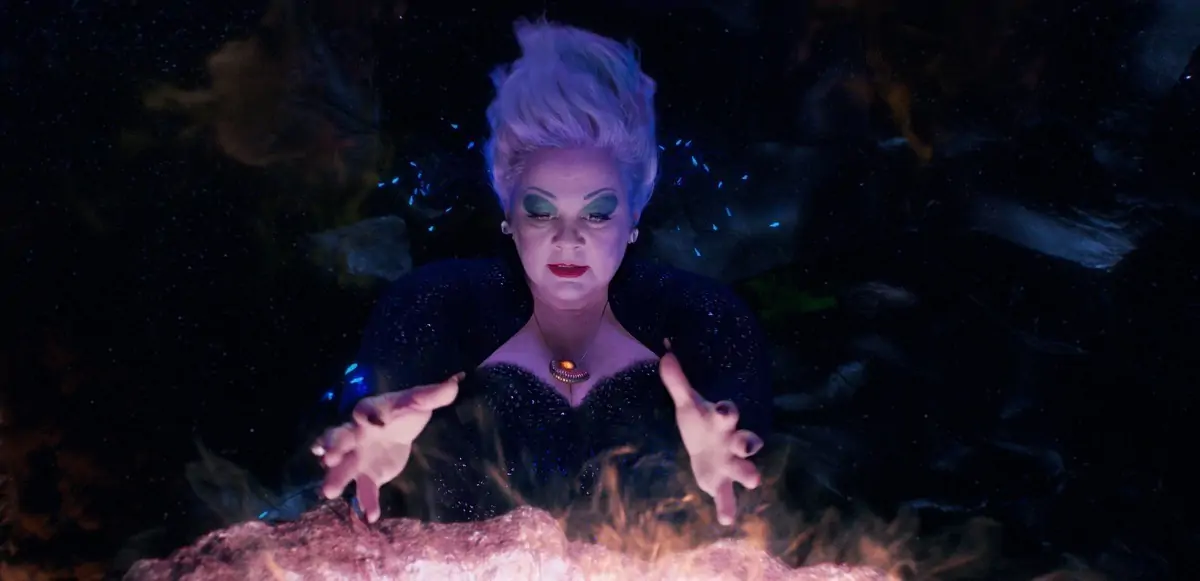
Melissa McCarthy as Ursula in Disney’s live-action THE LITTLE MERMAID. Photo courtesy of Disney. © 2023 Disney Enterprises, Inc. All Rights Reserved.
READ: Sophie Turner Cast as Lara Croft in Amazon’s Long-Delayed Phoebe Waller-Bridge Tomb Raider Series
But filings in the UK later revealed that Disney’s real spending was far higher. Forbes dug into those documents in 2023 and 2024, showing the number had climbed to $297 million and then later $355.1 million, even after Disney applied for tax rebates.
Now, the latest disclosures confirm that the final tally has grown yet again — topping $379.8 million. That figure doesn’t even include marketing, which insiders have estimated was another $140 million worldwide.
Box Office Returns Fell Short
On paper, The Little Mermaid didn’t flop outright. It grossed $569.6 million worldwide during its theatrical run. For most films, that number would be considered a hit. But when a studio spends close to $380 million before marketing, break-even moves far, far out of reach.
Disney typically keeps about half of box office revenue once theaters take their cut. That means the studio likely pocketed around $285 million from the global haul — less than the production spend alone, and nowhere near enough to cover promotional costs.
Put bluntly, even before factoring in Disney’s additional expenses, The Little Mermaid was underwater…financially.
The Real Losses
Taking everything into account, analysts estimate that Disney’s live-action remake ended up costing over $520 million when production and marketing are combined. With a net box office return of only about $285 million, the losses likely stretched into the hundreds of millions.
This places The Little Mermaid in the same league as other infamous Hollywood money-losers like John Carter and Tomorrowland — ironically, both Disney projects as well.
A Pattern of Expensive Failures
While The Little Mermaid may be the most striking example of runaway costs, it’s far from the only misfire in Disney’s recent catalog.

Mufasa (voiced by Braelyn Rankins) in Disney’s MUFASA: THE LION KING. Photo courtesy of Disney. © 2024 Disney Enterprises Inc. All Rights Reserved.
- Mufasa: The Lion King (2024) – Billed as a prequel to Jon Favreau’s 2019 remake, Mufasa struggled to justify its massive production budget. Early estimates pegged the film at over $250 million, and it failed to capture the same box office lightning as its predecessor. While not an outright flop, it was certainly a commercial disappointment.
- Haunted Mansion (2023) – Released just weeks after The Little Mermaid, this family-friendly remake cost around $150 million to make, not including marketing. It barely scraped past $115 million worldwide, making it one of Disney’s most glaring flops of the decade.
- Strange World (2022) – Disney’s original animated adventure reportedly cost $180 million to produce. It flopped with only $73 million worldwide, resulting in estimated losses of around $200 million.
- Indiana Jones and the Dial of Destiny (2023) – While not strictly a Disney-created IP, the Lucasfilm sequel carried a production cost north of $300 million and limped to $384 million worldwide. It has since become shorthand for blockbuster overspending.
- Snow White (2025) – The long-delayed live-action remake starring Rachel Zegler has become another high-profile headache for Disney. With a budget reportedly over $200-$300 million due to expensive reshoots, the film faced public backlash before release thanks to Zegler’s controversial comments and the studio’s awkward marketing. The film made $207.8 million worldwide, with only $87.2 million coming from the domestic box office. That places Snow White firmly among the ranks of Disney’s costly misfires.

Rachel Zegler as Snow White in Snow White (2025), Walt Disney Studios
READ: Disney to Pay $10 Million for Allegedly Mishandling Children’s Data on YouTube
When viewed together, these failures paint a troubling picture: Disney has repeatedly gambled on sky-high budgets that simply cannot be recouped in today’s theatrical marketplace.
Controversy Over Ariel’s Casting
Another factor that weighed heavily on The Little Mermaid’s reception was the decision to reimagine Ariel as a different race from her animated counterpart. Disney cast Halle Bailey in the lead role, a choice that sparked widespread debate long before the film hit theaters.
Supporters praised the casting as a modern update, while critics accused Disney of forcing identity politics into a beloved classic. The backlash grew across social media, with hashtags, petitions, and even international pushback — particularly in regions where audiences felt less connected to the reimagined character.

Halle Bailey as Ariel in Disney’s live-action THE LITTLE MERMAID. Photo by Giles Keyte. © 2023 Disney Enterprises, Inc. All Rights Reserved.
READ: Hollywood Press Tells Colbert and Kimmel to Double Down on Politics as Late Night Ratings Collapse
While some in the press dismissed concerns as mere “review bombing,” the numbers tell a more complicated story. The Little Mermaid significantly underperformed in overseas markets, where cultural attachment to the original design of Ariel was stronger. In places like China and South Korea, the film was met with indifference or outright rejection, contributing to its inability to come anywhere remotely close to the $1 billion mark that Disney had hoped for.
In short, what Disney may have intended as a progressive update ended up fueling division and alienating portions of the global audience. Combined with runaway production costs, the controversy surrounding Ariel’s redesign almost certainly played a role in The Little Mermaid’s lackluster box office run.
Why The Little Mermaid Production Cost Matters
The revelation about The Little Mermaid and its ballooning cost couldn’t come at a worse time for Disney. The studio has already been battered by underperforming Marvel entries, costly streaming miscalculations, and theme park competition from Universal’s Epic Universe.
The remake was supposed to be a “can’t miss” cultural event — a modern reimagining of one of Disney’s most beloved animated films. Instead, it spiraled into a mega-budget cautionary tale, showcasing how unsustainable Disney’s production model has become.

Concept art for The Little Mermaid – A Musical Adventure
If a classic like The Little Mermaid can’t turn a profit even with brand recognition, international marketing, and merchandising tie-ins, what hope is there for riskier projects?
As of today, The Little Mermaid is officially one of the most expensive flops in company history — and a symbol of the wider problems plaguing Disney’s creative strategy. Unless the company reins in costs, this won’t be the last time a “can’t fail” project sinks under its own ambition.
Are you surprised by the true cost of The Little Mermaid live-action remake? Sound off in the comments and let us know!
UP NEXT: Superman Sequel ‘Man of Tomorrow’ Officially Announced by James Gunn With 2027 Release Date
