


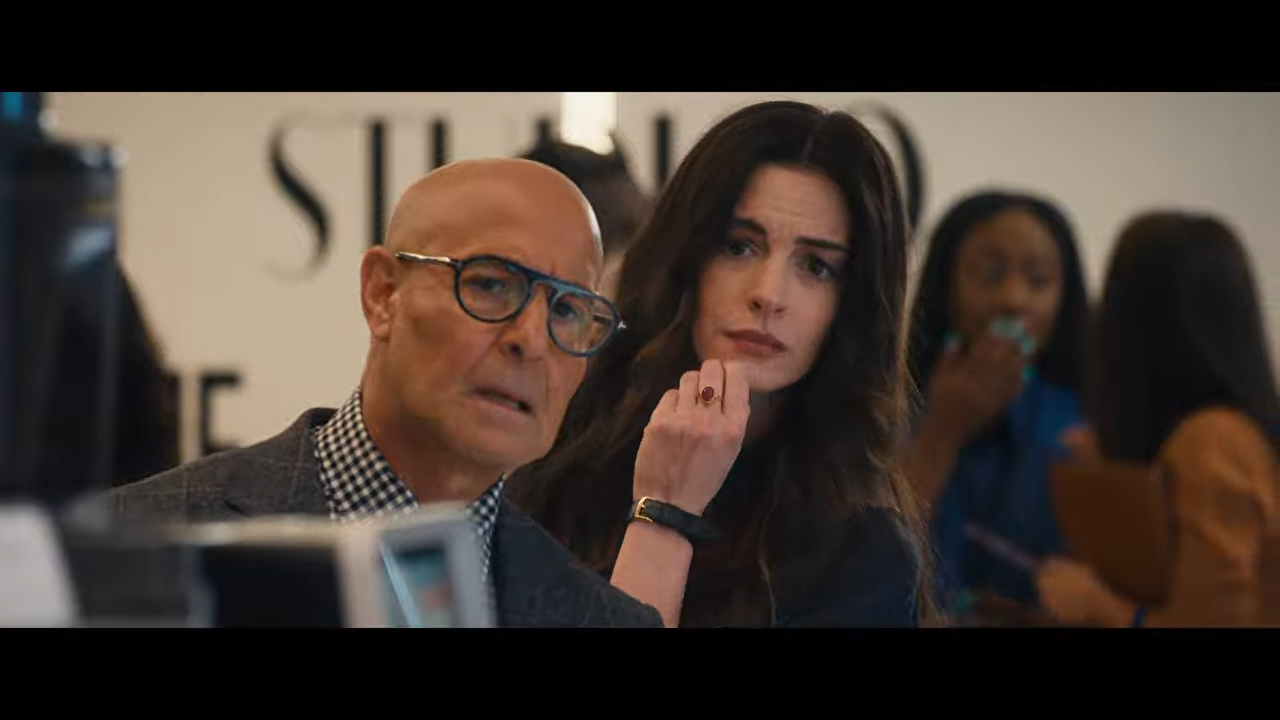
When I was handed the assignment to watch The Devil Wears Prada 2, my first response wasn’t excitement, it was hesitation. Not because I thought the movie would be bad, but because I had never seen The Devil Wears Prada in the first place. At the time it originally came out, it looked like something that had nothing to do with me. It felt like a fashion-driven story aimed at a completely different audience, and I passed on it without much thought. I picked something else, an anime movie with lots of fighting, screaming, and some plot about saving the galaxy.
That decision made sense for me back then. I lived in jeans, a black t-shirt, and crocs in a life that didn’t require presentation, presence, or polish. There was no need to think about how I showed up in a room because I wasn’t stepping into rooms where it mattered.
That changes, though. As soon as you start working with people, leading conversations, attending events, or representing something bigger than yourself, you learn quickly that presentation is not vanity but a form of communication and authority establishing. The pairs of heels I own now outnumber my hiking boots and flannel is not allowed in my closet (but I miss it so).
Watching both films back-to-back years later reframed everything. What I originally dismissed as a “chick power fantasy” revealed itself to be something far more grounded. These films are not about fashion. They’re about power, influence, and the systems people move through to get what they want.
Framing: The Unspoken Engine of the First Film
Before even touching the sequel, it is worth understanding why the first film works as well as it does. The Devil Wears Prada is built on a concept most people experience but rarely name: framing.
Framing is the ability to control a situation so completely that others unconsciously adapt to you. It’s not loud, aggressive, or precise. The person who holds the frame defines the rules of engagement, and everyone else operates within those boundaries whether they realize it or not.
Miranda Priestly is one of the clearest examples of this put on screen. She doesn’t demand attention, she assumes it. She doesn’t explain expectations, she enforces them through presence alone. A delayed response, a glance, a single word—these are tools, and she uses them with surgical precision.
There’s a moment in the film where she arrives before everyone else expects her, and without saying anything, she shifts the energy of the entire room. That’s her framing to force other to react. She controls not just what happens, but how it feels while it is happening. People rush, adjust, and correct themselves in real time because her presence dictates that they should. In doing so, they have made themselves lesser than her as they’re catering to her.
Even Christian Thompson plays with this concept in a different way. His approach is built on assumed agreement. He moves forward as if the answer is already yes, and in doing so, he removes hesitation from the interaction. It is a quieter form of control, but it is just as effective.
Although my favorite example of framing is the social framing we see with James Holt. On his first introduction, he’s calm, controlled, and in his element. Even the camera is slightly tilted up to him to make him look bigger for us as he speaks with total confidence to Andy. In the next scene, I almost didn’t recognize him as his manner had changed from someone in control to someone striving to please another. He was slightly hunched over, speaking faster, and always looking to Miranda for her reaction and approval — and didn’t earn it.
What makes the first film sharp is that it understands this dynamic and never spells it out. You feel it through the interactions, see it in how people respond, and it becomes the invisible engine driving the story forward.
The Devil Wears Prada 2 and the Shift to Networking
Where the first film is about controlling the room, The Devil Wears Prada 2 is about navigating the room.
The sequel pivots away from framing as the dominant force and instead leans into networking as its core principle. This is immediately visible in how Andy Sachs approaches problems. She’s no longer trying to establish dominance in a space—she’s trying to move through it. Calls are made, favors are requested, and relationships are activated.
There’s something real about this portrayal. Networking is often misunderstood as transactional, but at its best, it is cumulative and also very time consuming. Every interaction builds toward a moment where fostered trust can be called upon. As someone who does a great deal of networking, I know how much effort can go into this.
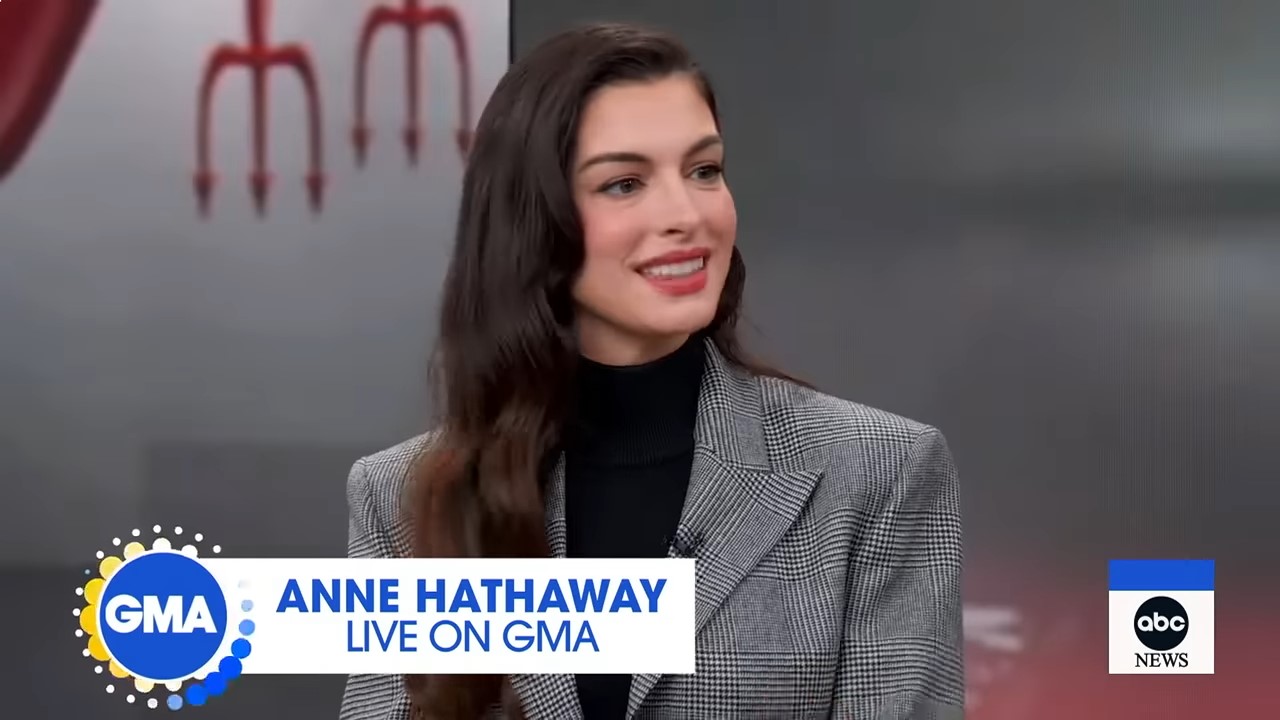
Anne Hathaway promoting The Devil Wears Prada 2 – Good Morning America, YouTube
Several years ago, the Rippaverse had a problem: our site went down and we could not get it back up while we were in the middle of one of our biggest releases. Tickets were flooding the inbox, online comments were tagging us non-stop to let us know the website didn’t work (we noticed, thank you). In the middle of it all, Eric D. July walked into the room and said “I don’t care how you do it, but fix it.”
I was up and on my phone, pacing around the warehouse like I had to get my 10,000 steps a day in an hour (similar to how Andy was) calling all my friends I knew in IT, web development, and anything that involved a keyboard asking for help. After an hour, I got a lead, a name to call, and sent that over. In a few more hours, we had a specialist looking at the website and by the next day things were up and running again.
The film captures that kind of payoff well. When Andy needs something that should be impossible, it is not her authority that makes it happen. It’s the people she knows, who they know, and talking to them in a way they were willing to listen to.
Andy’s role reinforces this idea in a way that feels uncomfortably accurate. Her opportunity doesn’t come from grinding her way up from nothing in isolation. It comes from someone with credibility putting her name in the right room. That endorsement acts as a shortcut, not in effort, but in access. She is seen because someone chose to make her visible.
That’s the part people don’t always want to say out loud. Talent matters, but access determines whether talent is even noticed. Andy represents that reality. She’s not less capable, but she’s positioned differently, and that positioning changes everything.
Social Capital vs. Positional Power
Looking at both films together, a clearer structure starts to emerge. They’re exploring two different forms of power: positional power and social capital.
In the first film, Miranda operates almost entirely through positional power. Her authority is institutional. It’s tied to her role, her reputation, and the system she controls. People respond to her because of what she represents. She doesn’t need to negotiate influence because she already holds it.
In the sequel, that foundation begins to erode. The systems shift, and suddenly positional power is not as stable as it once was. Miranda is forced into situations where her title doesn’t carry the same weight. Watching her hang her own coat or sit through consultants explaining how to dismantle her life’s work is jarring because it strips away the illusion of permanence.
Andy, on the other hand, operates through social capital. Her influence comes from relationships. It’s not tied to a title, which makes it more flexible but also more demanding. Social capital has to be maintained. It has to be nurtured. It exists within people, not institutions.
The contrast between these two forms of power is where the sequel finds its footing. It’s not trying to replicate the dominance of the first film. It’s showing what happens when dominance is no longer enough.
Attention Economics: The Fight to Be Seen
Layered on top of all of this is a more modern reality: attention is currency.
In The Devil Wears Prada, attention is centralized. Miranda doesn’t chase it, she controls it. Her presence determines what matters, and everything else falls in line. There’s a hierarchy of attention, and she sits at the top. By the time we reach The Devil Wears Prada 2, that hierarchy has collapsed. Attention is fragmented. It’s pulled in a thousand different directions at once, and no single person fully controls it anymore.
Andy’s behavior reflects this shift. She’s constantly moving, constantly reaching out, constantly trying to hold onto threads of attention long enough to make something happen. This isn’t inefficiency, but adaptation. The system has changed, and she’s operating within that change and making the most of it where Miranda flounders.

Meryl Streep in The Devil Wears Prada 2 – 20th Century Studios, YouTube
There’s a line that stands out in the film: write something people read. It sounds simple, but it carries weight in a world where attention is constantly being competed for. On one hand, you can say that Andy was doing that, but not in a way that could be measured by the company. These days, it’s no longer enough to produce content. It has to matter enough for someone to stop, engage, and respond.
I think any journalist feels this struggle as most writers strive to do their best to create something worthwhile. But we are not just writing for your eyes, but also for artificial ones who will take our precious prose and convert them into three bullet point summaries—brutal.
But the film touches on this through the discussion of evolution with the conversation between Miranda and Benji Barnes where we got to see Benji shift from goofy and loving boyfriend to a cutthroat business person.
Very well done by Justin Theroux.
Status Signaling: How Power is Communicated
Status in the first film is clear. It’s communicated through environment, behavior, and presentation. Miranda’s office, her wardrobe, the reactions of those around her—all of it reinforces her position. You know who holds power without anyone needing to explain it.
In the sequel, that clarity fades. Status becomes more fluid and has to be reinforced constantly because the signals that once defined it are no longer enough on their own. Miranda’s struggle highlights this shift. Her past authority doesn’t automatically translate into present control because the environment around her has changed. She’s forced to adapt in a way that challenges the very identity she built.

Anne Hathaway in The Devil Wears Prada 2 – 20th Century Studios, YouTube
Andy’s situation plays into this as well. Her status isn’t self-contained—it’s borrowed. It exists because someone with influence has chosen to extend it to her. That doesn’t make it less real, but it does make it dependent.
This is where status signaling becomes less about permanence and more about momentum. It’s not just what you’ve built. It’s how consistently you can reinforce it in a changing environment.
Andy’s Arc and the Question of Growth
One of the more frustrating elements of the sequel is Andy’s character progression. After everything she experienced in the first film, there’s an expectation that she would return with a stronger sense of control. Instead, she feels closer to her earlier self. More reactive, uncertain, and aligned with the “relatable” version of her character.
There’s an argument to be made that this is realistic. People revert, they fall back into patterns that feel safe. Growth isn’t always linear. At the same time, it creates a disconnect. Is Andy not a journalist who has spent 20 years writing and interviewing others? Should she not have developed her own way to take back control in a social situation? The experiences she’s had should’ve equipped her with a different kind of presence and not left her as the same character we met in the first movie.
As a personal note, whoever did the romance beats for Andy’s romance subplot needs to be ashamed of themselves. Both felt shallow for the sake of giving the film filler content. In the first film, it would’ve been better to focus on how Andy’s job took her away from her friends and family and let the romance subplots be absent (with the exception of the encounter with Christian Thompson who was adding to the environment and scene of the overall story).
Romance subplots are often abused for the sake of trying to add depth when they are really a mild distraction from the plot. I may have had a different feeling on this if Nate was still around in the second film.
A Softer Ending and What It Loses
The ending of The Devil Wears Prada 2 wraps things up cleanly. Conflicts resolve, relationships stabilize, and the story closes in a way that feels complete. The problem is that completeness is not always what makes a story stick.
The first film ended with a decision that carried weight. Andy walking away from Miranda wasn’t framed as a victory. It was a sacrifice that acknowledged success comes with a cost, and that cost isn’t always worth paying. The sequel leans away from that complexity. It chooses resolution over tension in a way that makes the film feel good and safe. Nothing was really lost or sacrificed with even the friendship between Emily and Andy resolved at the end to no real cost.
That makes it satisfying in the moment, but it doesn’t linger in the same way.
In short, the ending of the second film lacked the same teeth the first had.
Final Thoughts: An Okay Film Following a Great Film
The Devil Wears Prada 2 is a solid film. It has strong ideas, relevant themes, and moments that genuinely land. Its exploration of networking, social capital, and the shifting nature of influence gives it a foundation that feels grounded in reality.
At the same time, it’s following a film that executed its core idea with precision. The Devil Wears Prada knew exactly what it was about and delivered on it without compromise.
The sequel expands the conversation but loses some of that sharpness in the process. It trades control for connection, dominance for adaptability, and tension for resolution.
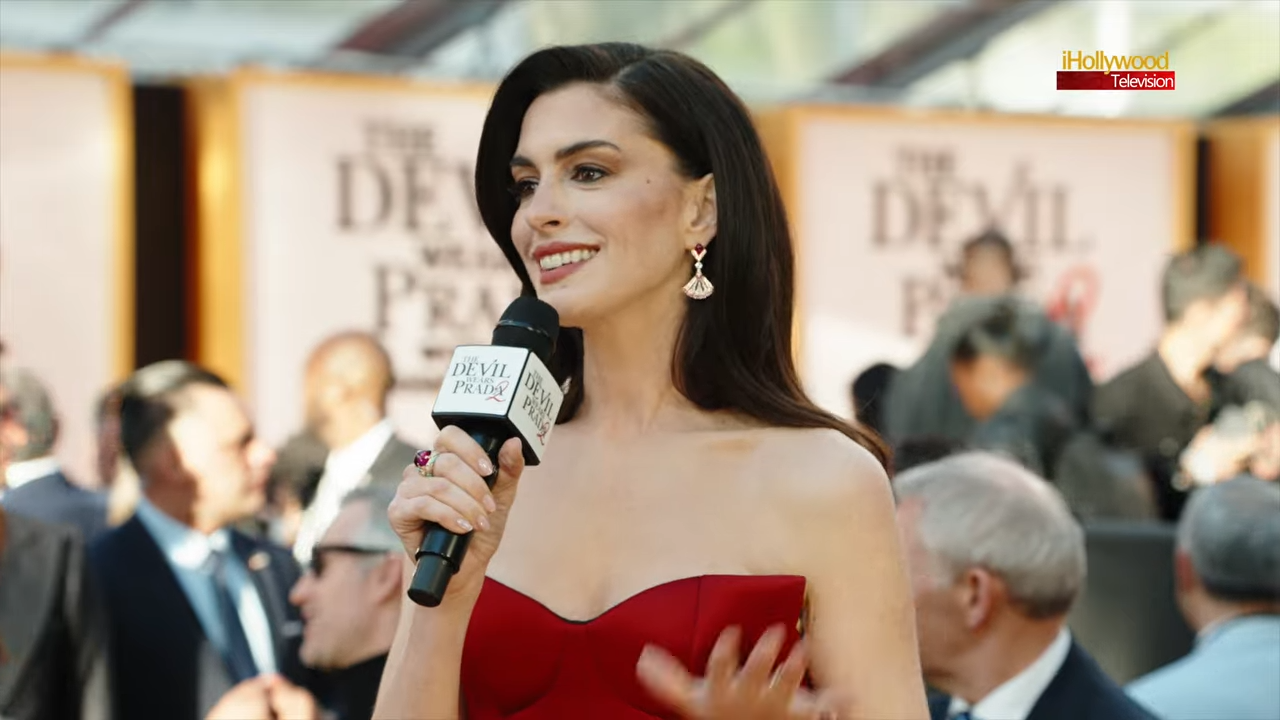
Anne Hathaway at the Devil Wears Prada 2 world premier – iHollywoodTV, YouTube
That trade is not inherently bad, but it does change the experience.
In the end, it feels like a film that understands the world it’s portraying but doesn’t quite challenge it in the same way its predecessor did. It adds value, but it doesn’t redefine the space.
I saw that the films were based off a book and I’m curious enough to read those and see what liberties were taken. Maybe the literature will ease my disgruntlement with shallow romance plots. We will find out!
Final score: 7 out of 10.
UP NEXT: The Rock Claims the “Most Masculine Men” Wear Skirts While Wearing a Skirt
