



Disney has worn its share of very expensive bruises at the box office. Prior to the post-pandemic trend of losing money on major blockbusters, Disney would often react strongly to a public failure. John Carter and The Lone Ranger are the two canonical examples that triggered boardroom autopsies and strategy pivots.
However… on the numbers, velocity of collapse, and return-on-spend, Tron: Ares is an even bigger failure than either of those two mega-flops ever dreamed to be. In fact, Tron: Ares might even make Rachel Zegler’s Snow White look like a cinematic money-making queenpin.

Rachel Zegler singing in the Snow White Trailer – YouTube, Disney
READ: Gloria Estefan Says Rachel Zegler Will Play Her….in a Movie That Doesn’t Exist
Two weekends in, Ares sits at roughly $103 million worldwide (about $54.6M domestic and $48.4M international) after a steep 66% second-weekend drop to $11.1M in North America. That’s against a net production budget around $180 million—before a nine-figure global marketing push that tentpoles typically require. By the industry’s own rule-of-thumb, films generally need ~2–2.5× production budget in global box office to break even; Ares isn’t in the same zip code.
Contrast that with Disney’s prior fiascos. John Carter ultimately reached $284.1M worldwide and still forced Disney to book an historic $200M loss and endure a public and internal reckoning. The Lone Ranger finished at $260.5M worldwide and caused a $190M studio write-down. In other words, both infamous bombs grossed more than double what Tron: Ares has mustered so far, and they still triggered write-downs and leadership fallout. If Carter and Ranger were unacceptable at $284M and $260M, Ares at ~$103M, on a comparable modern tentpole cost, has already underperformed them on raw revenue, not just profitability.
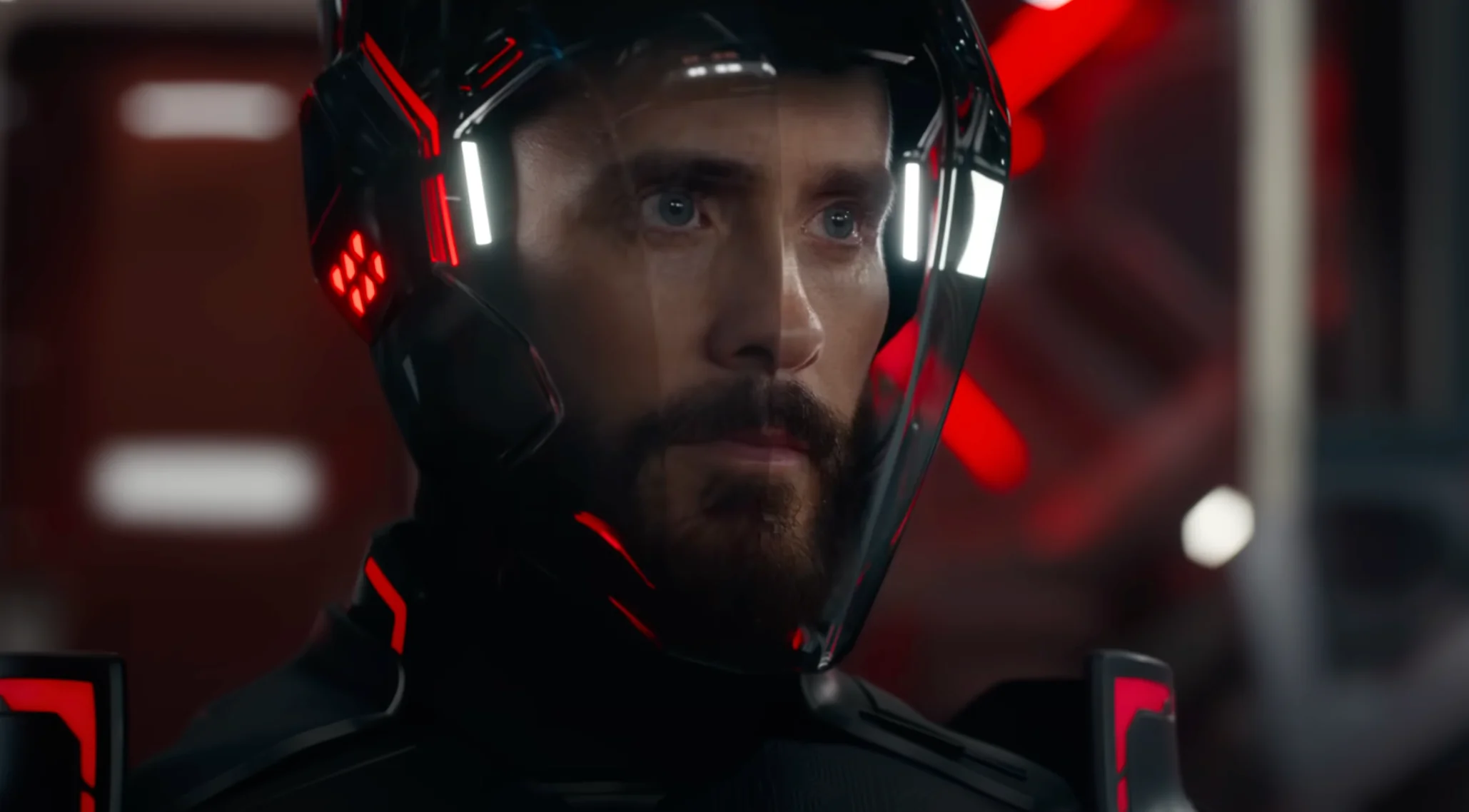
Jared Leto in a Helmet in Tron Ares – YouTube, Disney
And let me just say this for those who might not be paying attention. We’re not adjusting for inflation here. If we did so, John Carter and The Lone Ranger might be above the $400M mark!
The opening-to-legs profile makes the picture worse. Ares launched with $33.5M domestic (below Tron: Legacy’s $44M bow in 2010) and immediately cratered in weekend two. That deceleration places it among the year’s softer tentpoles and suggests poor word-of-mouth plus minimal international ballast—especially glaring given that Legacy managed $400M worldwide on a $170M budget fifteen years ago. Even Rotten Tomatoes’ weekend wrap notes that with only about $48M overseas, even $200M global may be out of reach. This is not just “underperforming”; it’s a flame-out in a franchise that previously proved it could at least reach mid-tier global numbers.

A screenshot from the trailer for Tron Ares – YouTube, Disney
READ: Marvel’s X-Men Reboot Finally Gets a Release Date — Kevin Feige Promises a “Reset,” Not a Reboot
Why this is more company-shaping than Carter/Ranger: First, Ares’ revenue-to-cost ratio is demonstrably worse. Using the conservative 2–2.5× break-even multiple for tentpoles (and adding an estimated $150M for marketing), Ares would need roughly $550–$600M worldwide just to wash its negative cost, before interest and overhead.
With the film hovering near $103M and already collapsing domestically, Disney faces a likely loss trajectory that, proportionally, eclipses those earlier debacles.
Second, prior bombs happened in an era when Disney’s slate had stronger offsets (animated hits, Marvel in hyper-growth). In 2025’s thinner hit environment, a nine-figure miss dents film P&L and undermines synergy plans (consumer products and parks cross-promotion) that depend on cultural momentum. Historically, John Carter’s failure precipitated high-level fallout and strategy questions; Ares is poised to force similarly uncomfortable postmortems—only with less box-office cushion than those earlier “change-the-company” moments.
Let’s get real here… Tron: Ares is performing so badly that it may be the end of Tron as a franchise for good.
The Disney logo with a Tron Ares Overlay – YouTube, Disney
Finally, the optics are brutal: Disney’s expensive sci-fi sequel getting routed in weekend two while a $30M horror film claims No. 1 with a $26.5M domestic debut and $42M global weekend underscores how unforgiving the market is for over-budget IP without must-see urgency. That split-screen weekend narrative, horror thriving while Ares plunges, crystallizes the risk/return imbalance Disney’s been wrestling with.
If The Lone Ranger and John Carter were cautionary tales that shifted Disney’s course, Tron: Ares is a louder siren: fewer $150M–$200M+ gambles without airtight four-quadrant appeal, or face losses larger (in efficiency terms) than the flops that once re-wired the company.
Were you surprised Tron: Ares was a major flop for Disney? Sound off in the comments and let us know!
UP NEXT: ‘KPop Demon Hunters’ Tops 2025 Halloween Costume Charts Amid Continued Streaming Success
